
“Aggressive technocapitalism wins, safety dies” is a long name for a movie and a short logline for a film, yet the phrase might accurately be used for both when it comes to Artificial.
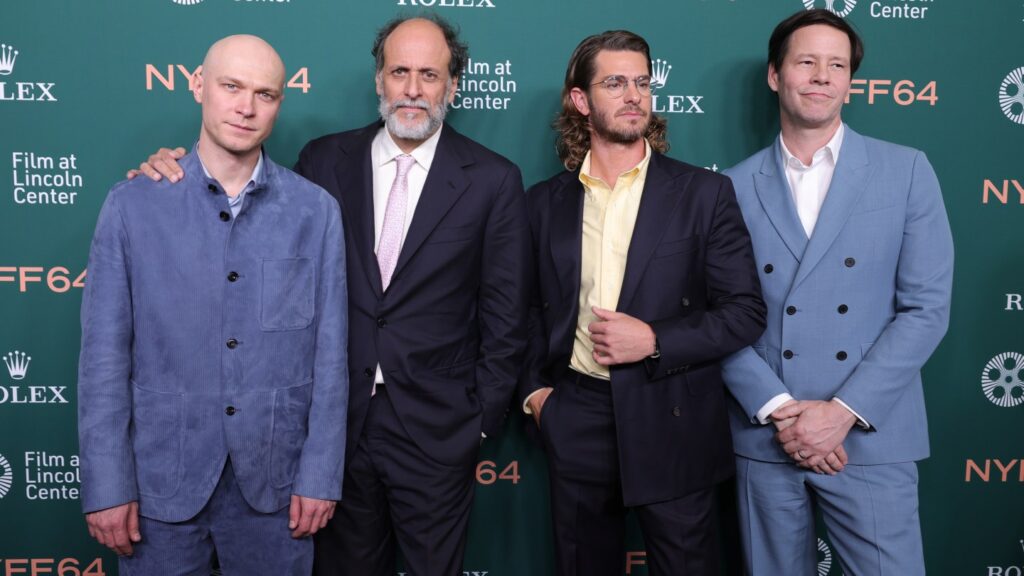
Luca Guadagnino brought his latest and by far most-topical movie to a world-premiere at the 64th New York Film Festival Monday evening, the first stop of what has already seemed like an unusually long journey. Ditched by Amazon MGM Studios after its parent company’s $50 billion investment in OpenAI, the film, as it turns out, would be non-grata at a large tech firm even if it never signed on for that 5 percent equity stake in Sam Altman‘s company. Persistently bleak under the rays of the California sun, Artificial (now under the aegis of Anora studio Neon) is the movie of the moment — the origin story of our current AI quagmire at the literal, psychological and pretty much every other level.
Or as NYFF programming chief Dennis Lim said before the screening:
“We are already in a threshold period. We need to understand how we got here, and the film you’re about to see shows us that way.”
The movie is notably faithful, at times dutifully chronological and nearly always horror-movie bracing on the subject of the rise of capitalist AI, as Ilya Sutskever, an idealistic and socially unpolished Russian immigrant, shows up at the office door of Geoffrey Hinton, a godfather of AI, at the University of Toronto in 2003. There he will learn under the well-intentioned eventual Nobel Prize winner, soon following him to Google and its Bay Area halo. As observers of the space well know, Sutskever ends up meeting Sam Altman at a 2014 conference, where the Y Combinator financier, already well established in Silicon Valley at barely 30, chases down the prodigy to convince him to work at a nascent OpenAI as chief science officer and supercharge its LLM ambitions. Or, more accurately, make them possible in the first place — Sutskever is Wozniak to Altman’s Jobs, but more so.
Soon a (last) supper follows with Altman, Elon Musk, Greg Brockman and others — the prelude to a slow realization by Sutskever, and us, that the science Sutskever wants to develop to save the world is the capital Altman wants to use to build a warchest. We know the rest — OpenAI rushes out ChatGPT in November 2022, shocking the industry and even many of its own employees; Altman displays a growing accelerationism with the abetment of lead investor Microsoft (mixed with blog-y pronouncements of transforming and saving the world, and a weird word-cloud fondness for the word compute); and OpenAI transitions from a nonprofit to its opposite. The whole story culminates in Sutskever’s notorious November Coup of 2023 in which Microsoft CEO Satya Nadella and assorted OpenAI loyalists back Altman, engineering his return so that he’s stronger than ever — a day clear then and doubly indicative now of capitalism’s ultimate triumph and on which, Yom Kippur-style, our AI fate was inscribed and sealed.
Which brings us to late 2026 — right up to it, as the film collides with the last month of AI safety warnings, which also make the screen with a postscript (one of about five) about AI researcher and whistleblower Jacob Coxon warning of a pox on all their houses (or, at least on his former employers Anthropic and OpenAI) for a reckless speedplow over any semblance of safety. On cue, Coxon was taping Jon Stewart a half mile downtown at the exact time the movie was playing, in what one commenter very reasonably called a “most serious and chilling episode” of The Daily Show.
A slow-burn account that will not surprise those who have covered the meteoric ascent and Teflon resilience of Altman, Artificial still offers a rich and often entertaining primer on the becoming of OpenAI, integrity and caution time and again sacrificed on the holy altar of finance. (You can read The Hollywood Reporter’s review of the film here.) Not to mention a parable of modern Silicon Valley, the place where advanced science and obscene wealth converge in a way that has never happened in the history of humanity and can only, if every novel on either subject can be believed, will end splendiferously well.
Guadagnino took an interest in the subject because “as much as AI belongs to a world of mathematics and computers, it is still generated by peoplle and exists in space of their interaction,” as he noted from the NYFF stage. Screenwriter Simon Rich took an interest in the subject after being told by a childhood friend decades ago about what was possible with AI. That friend ended up going on to work in the industry, prompting Rich, a former Saturday Night Live and Pixar writer as well as a novelist and essayist, to pen this script. “I’m not particularly charismatic or good looking but as a last-ditch effort to warn mankind I wrote this movie. I hope to God a couple people pay attention,” he said.
Amazon initially backed the movie before, well, “the concept of a conflict of interest is a very important, let’s say, elephant in the room here,” as Guadagnino told THR’s David Canfield. In retrospect it’s almost shocking the company would have even contemplated signing on to a movie so innately critical of a Valley vision in which noble use cases form but a thin camouflaging membrane over the bloody black heart of a human-trampling moneygrab — so much so that the question becomes not why Amazon abandoned the film but which Hollywood agent is responsible for the Houdinian feat of convincing them they should hop aboard in the first place, and why aren’t they the ones ruling the world?
To give you a sense of just how scabrous this film is, and just generally to level you up on how some of Silicon Valley’s most powerful people are getting shown in what will surely be an Oscar mainstay and cultural lodestone this Hollywood season, here’s a quick rundown:
Greg Brockman — In real life he’s an AGI evangelist and Altman lock-stepper who’s a jock-like presence that donates millions to a pro-AI Super PAC. In the movie he’s all of those things but nerdier and more simpering. Cooper Hoffman, who plays him, said at NYFF he didn’t read any books about Brockman, but let himself think about a phrase Garfield told him: that the man would leave his wife for Sam Altman.
Mira Murati — Long the most enigmatic of OpenAI figures — she tries to stop Altman but also sticks with him; she is at once Cassandra and complicit — the Albanian ex-Tesla engineer gets her due from Monica Barbaro who gives the character just enough warmth to seem like a hero, until undertaking actions that make her seem like the opposite.
Sam Altman — Hinton in the film describes Altman as someone so toxically charismatic he would land on an island of cannibals and shortly after become their king. Andrew Garfield portrays him as a completely dishonest personality who will always tell everybody how much he likes them to their face while screwing them behind their back. A flamboyant cipher to a sometimes-cartoonish degree (you can read his articulate descriptions of how he crafted the character here) Garfield’s Altman is going for a different kind of spiritual truth. “Of course it will feel confronting [to Altman],” Garfield said at the screening, “[but I wanted] to a deep interrogation of who are giving our power, our autonomy, our data too.”
The best gift Garfield could give Altman is going so hard on the caricature-y touches, allowing Altman to discredit the whole thing. He’s already tried to do that, without having seen the movie. “I don’t think they’re going for accuracy,” Altman just said to Vanity Fair, admittedly basing his assessment on the trailer. He and Garfield cannot even agree on whether they waved to each other when the film was shooting near the mogul’s house. Altman says they did; Garfield said at the premiere that “if that happened I must have blacked out because I don’t remember it at all.”
Yann LeCun — The other godfather of AI gets a cameo in which he shows up Sutskever by mockingly asking him from the audience if he’s ever seen 2001. I don’t know that this ever happened, but as an object lesson in Sutskever not being taken seriously by the AI establishment it serves its purpose. It feels like shade that LeCun never appears in the film again, though given the treatment some of the other tech personalities receive, he might want to send Luca a bouquet.
Guy on Bench — Jason Schwarzman plays an anonymous prophet of doom (and ex-techie) who shows up at an San Francisco park to describe to Sutskever all the ways the AI boom can go wrong, providing the movie with its from-the-headlines leitmotif and cinema more broadly its wildest hair since Forrest Gump.
Elon Musk — Ike Barinholtz has Musk wandering in from another movie, or dimension, a ramble-y, arrogant but ultimately comically non-threatening figure. This will be noticeable and even triggering to anyone who sees Alex Gibney’s Musk or just followed the man’s DOGE-based eviscerations of important aspects of the federal government. “When you play someone as beloved, as universally admired…” Barinholtz began his intro at the festival, before saying he tried to capture Elon how he was viewed then, long before “the RNC with a chainsaw.” Barenholtz’s portrayal raises what’s actually a key question in fact-based art: are we required to inject a modern understanding we couldn’t know at the time?
Tasha McAuley — Entrepreneur, Joseph Gordon-Levitt’s wife and coup-joiner on the OpenAI board, she is played briefly by Zosia Mamet (though not identified by name).
Geoffrey Hinton — If there’s one good thing about AI going so pop-cultural, it’s that we get a full-blooded character representing one of the great scientific minds of our time, here depicted (accurately) as the conscience of an industry. If there’s a second good thing, it’s that we get Mark Rylance portraying such a conscience.
Dario Amodei — He is now known as the man who founded the breakaway Anthropic and, a showdown or two with the Pentagon aside, is running a company that could destroy the job market and the world as we know it (hey, his words). But back during his OpenAI era, he’s part of Altman’s gallery, if a very nerdy and definitely more idealistic member of same. Honestly on the scale of image-rehab to complete evisceration, Amodei is one of the few AI entrepreneurs to end up closer to the former in this film. A far cry, to say the least, from his recent depiction on SNL or portrayal in Stewart’s coverage.
Ilya Sutskever — The story’s unabashed hero, aided in real life by him all but disappearing after the failed coup (though he did raise $1 billion for an AI safety company). Garfield’s is the showier performance but Yura Borisov‘s depiction as a man slowly realizing how he’s been had is Richard-Gere-at-the-end-of-Primal-Fear-level stuff. “I was just trying to put this [lost innocence] in the film so you can feel what I hope you feel,” he said at the screening. The Jacob Coxons and other figures who continue Sutskever’s legacy, not to mention the concerns that only become more urgent, make him feel less like a figure from ye old AI days of 2023 but one speaking to us over our shoulder as we scroll the headlines at the breakfast table today.
The only downside to such a fiercely of-the-moment take is that said moment can change in the nearly three months until the film’s Christmas release. Maybe by then Neon will need to include 20 postscripts, and submit to the Oscars’ documentary category.