
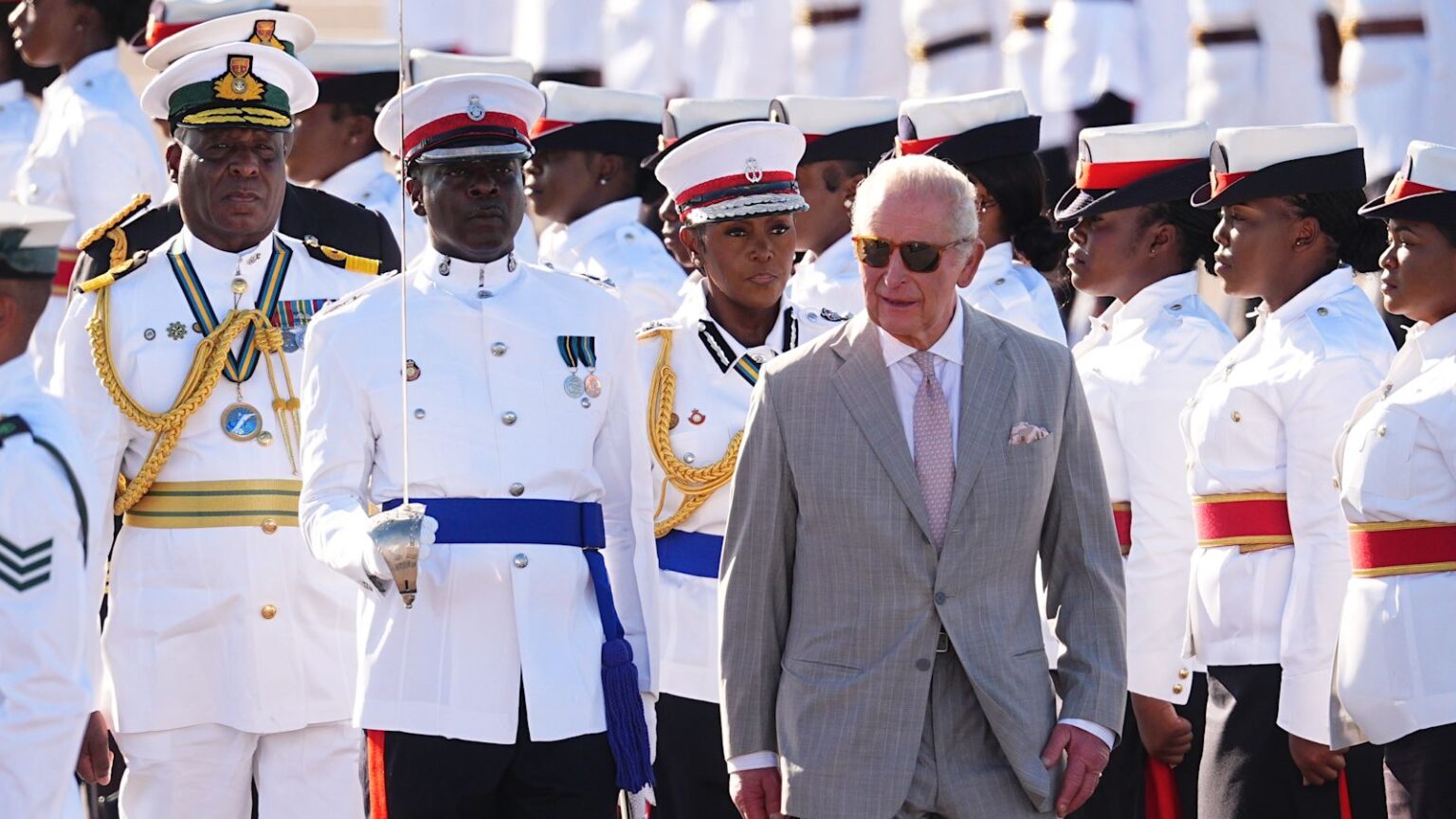
King Charles has landed in The Bahamas on the first stop of what could be the most difficult royal tour of his reign – but he will immediately reference the “darkness” and “great suffering of the past”.
The King is due to make his first speech of the trip on Tuesday evening, in which he will address the issue so many people in the Caribbean region want him to address: Britain’s involvement in the transatlantic slave trade.
Palace sources said the King understands the strength of feeling in many countries and that he is “not blind to the fact” there are painful legacy and colonial issues in all three of the nations he is visiting.
But senior aides to the King have ruled out the chances of him making an apology for the past.
Protests are being organised to coincide with the royal visit.
Within hours of landing in The Bahamas, the King is expected to tell a youth rally in the capital Nassau, that he recognises the dark times their ancestors experienced.
Charles is expected to say: “Some of what is best in Bahamian culture today, the most joyful, the most hopeful, the most bright, was born out of darkness.
Charles arrived at Lynden Pindling International Airport, in Nassau, on Tuesday Credit: PA
“It is only right that we should acknowledge the great suffering of the past in these islands and beyond, even as we rejoice in the successes of the present and build new opportunities for the future.”
He will also make clear that the governments of the Commonwealth will discuss the difficult issue when they meet in Antigua and Barbuda next week.
The heads of government of the 56 Commonwealth countries meet once every two years.
King Charles will say more about the slave trade when he speaks during the opening ceremony of the summit.
The King is facing calls from many campaign groups to issue an apology on behalf of the British state for its role in the enforced transportation of African people to work as slaves in the British colonies of that era.
But Royal tours such as this one are carried out on behalf of the British government, and the King is not permitted to deviate from his government’s own longstanding policy on this issue.
Ahead of the trip, a senior Foreign Office official reiterated Britain’s position that it cannot apologise for something that was not illegal at the time it took place.
Consequently, the UK does not say sorry for its actions during this period, nor does the government consider itself liable for compensation in the form of reparations.
Subscribe free to our weekly newsletter for exclusive and original coverage from ITV News. Direct to your inbox every Friday morning.
Campaign groups in the Caribbean reject this narrow legal definition and claim that the enslavement of Africans was a crime against humanity and a violation of international law at the time.
Buckingham Palace says all three countries on the tour, The Bahamas, Guyana and Antigua and Barbuda, have requested that the programme of events also looks to the present and future, as well as the past.
So during the speech at the youth rally, the King will tell the crowd: “Tonight it gives me enormous hope to see the way generations of Bahamians have carried the history, the legacy and the promise requested to you by your ancestors with pride in your heart and purpose in your steps.”
Senior palace staff say all three countries are low-lying islands which are at, or just shortly above, sea level so they are vulnerable to the effects of climate change. On that issue, the King will tell them that “our world cries out for healing”.
He will urge Bahamians to “take up the sacred task to play your part” to protect Planet Earth, which he says is “the source of our life, our prosperity and our security.”
After a two-day visit to The Bahamas, the royal tour rolls on to Guyana – the only former British colony on the South American mainland.
And the legacy of that period will once again come to the front of many people’s minds.
King Charles will meet with the President of Guyana later this week and attend a State Banquet in his honour in the capital, Georgetown.
But before the King set off for the trip, President Mohammed Ifraan Ali spoke to ITV News and repeated his demand for an apology from the King on behalf of the British state and his ancestors.
He told our correspondent Robert Moore that King Charles must go further than his previous public statements when he called slavery the “darkest days” of human history and a “stain” on Britain’s past.
The president said: “Now, moving to the apology is the next step. You [Great Britain] exploited the region. You destroyed lives; you created under-development, so imagine what the region faces, the damage that slavery would have created for generations.”
The former prime minister of St Vincent and The Grenadines is another Caribbean politician who wants to hear the King say the word “sorry”.
Ralph Gonzales told ITV News that Britain benefitted from “250 years of free labour” during the period of slavery.
He says it is the reason why the UK must now contribute financially to countries where slavery set in motion a downward spiral of poverty and underdevelopment which has lasted for generations.
The Commonwealth summit in Antigua will be Charles’ second as Head of the Commonwealth, after succeeding his mother, Queen Elizabeth, in the role.
It could be the most difficult royal tour of the King’s reign Credit: PA
Antigua, like The Bahamas, is a Commonwealth Realm, where the British Monarch remains the head of state. There are movements in some of those Realm countries that want to follow Barbados.
It is the most recent country to replace the monarch with a president and transition to a republic, although it stayed as a member of the Commonwealth.
But these are tensions the King has experienced before as they surface when he goes to any of his 14 Realms.
It was part of the debate when he visited Canada and Australia in recent years, and they will again surface on this trip to The Bahamas and Antigua.
The last time senior members of the Royal Family toured the Caribbean, the tensions over Britain’s colonial past made for a diplomatically challenging trip.
The Prince and Princess of Wales, when they were the Duke and Duchess of Cambridge, were criticised for being tone-deaf to the mood in the region when they visited three Realms, Belize, Jamaica and The Bahamas on behalf of the late Queen in 2022.
Their trip was condemned for failing to properly address the slavery issue and for agreeing to take part in outdated ceremonies, like the military parade they inspected whilst standing in the back of a Land Rover.
The King’s closest advisers are aware they can’t afford to make a similar mistake on this tour and are determined to address Britain’s past head-on without ignoring issues like the climate crisis and youth opportunities.
Charles won’t “shy away” from the legacy and colonial chapters of Britain’s past, they said.
This is the Talking Royals – our weekly podcast about the royal family, with ITV News Royal Editor Chris Ship and Producer Lizzie Robinson