
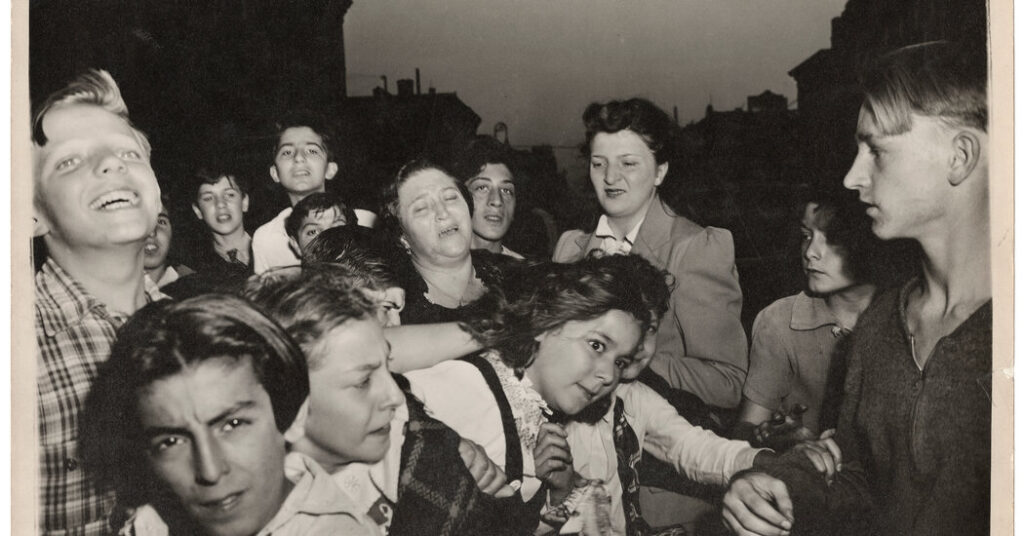
How did the photographer Arthur Fellig, better known as Weegee, go from hard-boiled shots of New York murder victims, criminal arrests and tenement fires during the 1930s and ’40s — classic images that have never been equaled — to the cheesy distorted portraits of Hollywood celebrities that engaged him for the last 20 years of his life?
That question is posed, if not persuasively answered, by “Weegee: Society of the Spectacle,” a career-spanning retrospective that runs through May 5 at the International Center of Photography, which owns Weegee’s archive. Like your family’s ugly knickknacks that are sequestered in the attic, the lesser-known photographs of Weegee, from the late 1940s until his death in 1968, have been mostly ignored by critics as an embarrassment. This is a rare chance to view the work and make a judgment.
Arguing a revisionist case for the disparaged late output of a major artist is a popular endeavor. While the effort has partially succeeded for Pablo Picasso, the verdicts on the decline of Francis Picabia, Robert Frank, Giorgio de Chirico and Willem de Kooning have not, at least to my mind, been reversed. Nor will this show change most opinions about Weegee.
It is the contention of the curator, Clément Chéroux, director of the Fondation Henri Cartier-Bresson, which organized the exhibition with the ICP, that Weegee — both during his glory years in New York and then, in a completely different body of work that began in Hollywood in 1947, and continued after his return to New York in 1952 — consistently portrayed the urban spectacle. To support that theory, Chéroux enlists the French critic Guy Debord, whose book, “The Society of the Spectacle,” published in 1967, argued that in the advanced stages of capitalism, a world dominated by consumer commodities is perceived as images representing those commodities — or, in a word, as spectacle.
Many of Weegee’s most powerful pictures focus on spectators. Although famously quick to arrive at the scene of the disaster (a police radio tipped him off with the preternatural accuracy of an Ouija board, probably the source of his nickname), he inevitably got there after the homicide had occurred or the car had crashed. What was happening in the decisive moment was the reaction. By turning his camera on the spectators, not the victim, he captured something vital, not dead.