
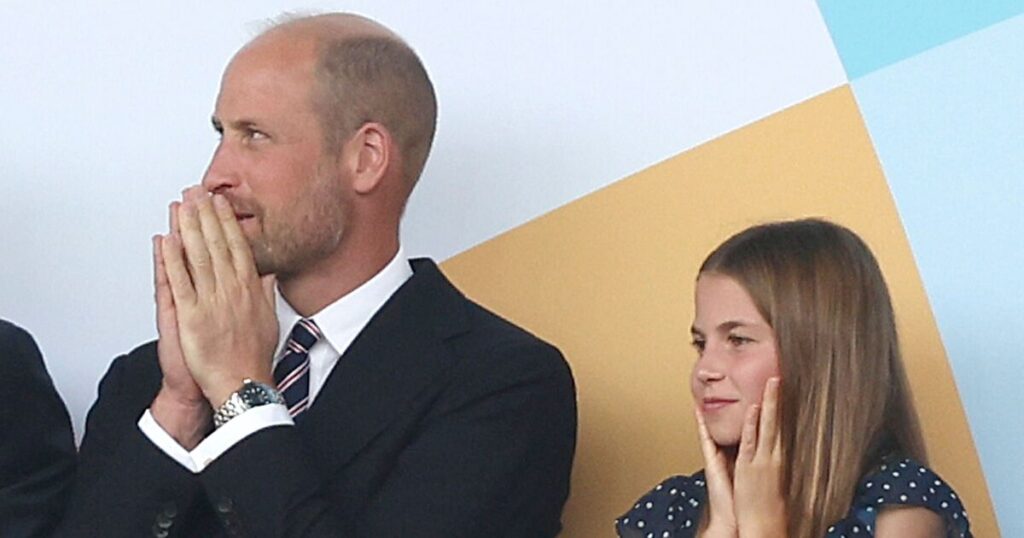
Princess Charlotte’s attendance at the Women’s Euro 2025 final sends a “clear” message that “women’s football is for girls”, a commentator has claimed. In a comment piece coming in the wake of the Lionesses’ victory, writer Emily Watkins weighed in on what she described as the “distinctly male preserve” of football and how it remains “undeniably masculine”.
She claimed that women’s football is an example of how female pursuits are ultimately gendered and pointed to Prince William and Princess Kate’s daughter Princess Charlotte’s attendance at the Euros final. Emily argued that the decision to take Charlotte was likely “carefully considered”, as the Royal Family’s “every move is choreographed”, but, according to her, the “message was clear”.
She wrote: “And while I understand that a young girl might find female athletes more interesting to watch than men, surely it would send a stronger message to see her brothers there with her – and to see Charlotte at men’s matches too?”
Writing in the i Paper, she added: “To me – and presumably to children across the land – the message was clear, even if inadvertent: women’s football is for girls.”
On Sunday (July 27), the Prince of Wales and Charlotte were seen celebrating as they watched the Lionesses achieve consecutive European Championship titles at St Jakob‑Park in Basel, Switzerland.
During the tense match, England’s national women’s football team clawed back a win from Spain after conceding a goal in the first half, with Alessia Russo equalising and the match resulting in a penalty shootout.
However, the Lionesses would ultimately prove victorious, with substitute Chloe Kelly scoring the winning penalty for England and making the final score a decisive 3-1.
It follows reports that the women’s game has experienced a spike in interest ever since the team’s Euro 2022 win. Indeed, the team’s ‘Everyone watches the Lionesses’ t-shirts have even become part of Nike’s official merchandise.
Commenting on their success, captain Leah Williamson told a press conference that the landscape “keeps changing” and they’re “trying to change with it”, admitting that they don’t want to be a “flash in the pan”.
She said: “We don’t want to be a flash in the pan or a memory. We’re still trying to play our role by being on this stage, we know how powerful that is. We’re trying to elevate the respect for the women’s game and the respect for women generally.”
The Lionesses have also been a positive influence on the grassroots level. Last year, the FA announced that the number of women and girls playing football had climbed by 56 per cent over four years.
In the announcement on the FA website, Baroness Sue Campbell, the FA’s director of women’s football, said: “It is remarkable what has been achieved in just four years across all levels, with more women and girls stepping forward to play, coach, officiate and participate as fans. But there is still more work to be done for the sport to reach the heights we know it can grow to.”
Kensington Palace has been contacted for comment.