
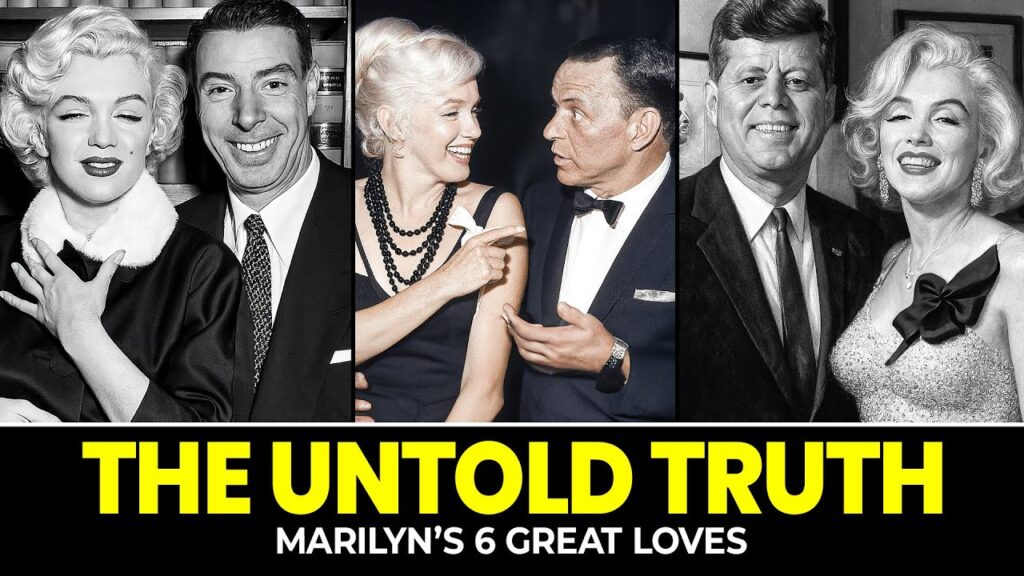
The 6 Men Marilyn Monroe Loved Most — Ranked From LEAST Loved To MOST Loved
The six men Marilyn Monroe loved most. Ranked from least to most. She was the most desired woman in the world. A blonde bombshell whose image defined an era and whose smile launched a thousand fantasies. Yet behind Marilyn Monroe’s dazzling public persona was a deeply vulnerable woman desperately searching for something that eluded her until her tragic end. Genuine love. Though millions of men would have given anything for just a moment of her attention, only a handful ever truly knew the real Normmaene. Today, we’re ranking the six men who meant the most to Marilyn Monroe. From fleeting connections to the profound loves that shaped her tumultuous life, this isn’t just about her famous romances, but about the complex emotional landscape of a woman who once confessed, “I’ve never been in love with anyone but myself.” Was that really true? Or did the world’s most famous sex symbol actually find the authentic love she so desperately craved? The answer might surprise you, especially when we reveal the one man who truly captured Marilyn’s heart in a way no one else ever could. Marilyn’s search for love was far more complex than the tabloids of her era could possibly capture. Her childhood spent bouncing between foster homes and orphanages, left deep emotional scars that followed her into adulthood, creating a woman who simultaneously craved affection, yet distrusted it when it arrived. Each relationship we’ll examine today represents a different kind of connection for Marilyn. from marriages of convenience to passionate affairs with some of the most powerful men in America. By understanding these relationships, we’ll see beyond the glamorous facade to the vulnerable woman underneath, whose desperate search for genuine emotional connection ultimately ended in tragedy. What’s particularly fascinating isn’t just who she loved, but how each relationship revealed a different facet of Marilyn’s complex personality and how only one man seemed to truly accept her completely, flaws and all. Marilyn Monroe’s relationships weren’t just celebrity gossip fodder. They were chapters in the tragic story of a woman who never experienced the stable family life she craved as a child. Born Norma Gene Mortonson in 1926, she spent much of her childhood in foster homes and orphanages, creating a lifelong pattern of seeking security and validation through relationships with men. This desperate search for belonging shaped every romantic connection she formed. While the public saw a confident sex symbol who could have any man she wanted, the reality was a deeply insecure woman who often felt unworthy of genuine love. “I’m selfish, impatient, and a little insecure.” She once confessed. “I make mistakes. I am out of control, and at times hard to handle. But if you can’t handle me at my worst, then you sure as hell don’t deserve me at my best.” The question was, which of these men, if any, could handle both sides of Marilyn? Let’s count down the six most significant relationships in her life. Ranked from least to most meaningful connection. We did a lot of things together. Possibly people uh looking at her as the sex symbol of the world wouldn’t believe that she could uh catch fish, skin a rabbit. Six. James Dogardy. The teenage survival marriage. At the very bottom of our list is James Doerty, Maryland’s first husband, a man she married not for love but for survival. In 1942, 16-year-old Norma Jean faced a devastating choice. Return to the orphanage or get married. Her foster family was moving to West Virginia and couldn’t take her along, making marriage to 21-year-old factory worker James Dogerty her only escape from returning to institutional life. “I never knew Marilyn Monroe and I don’t claim to have any insights to her to this day.” Doerty later admitted, “I knew and loved Norma Gene. For the teenage girl who would become Marilyn, this wasn’t a love match, but a practical arrangement, a way out of the foster care system that had defined her childhood. The marriage lasted just four years. When Doerty joined the merchant marines during World War II, Normmaagene began working in a factory where she was discovered by a photographer. As modeling opportunities emerged, so did her ambition. By 1946, she had secured a contract with 20th Century Fox, divorced Dogerty, and transformed herself into Marilyn Monroe. What makes this relationship rank at the bottom isn’t just its brevity, but Marilyn’s own assessment. “My marriage brought me neither happiness nor pain,” she later said, revealing the emotional detachment that characterized this union. It wasn’t that she disliked Doerty, she simply never formed a deep emotional connection with it. Doherty himself seemed to understand this, later remarking, “I was just a stop on her way to stardom.” Their marriage was a stepping stone for a young woman desperate to escape her circumstances, not a love story. When opportunity knocked, she didn’t hesitate to leave the relationship behind, suggesting this was perhaps the least emotionally significant romantic connection of her adult life. Not hearing of runaway productions and costs and the star system and how we need government subsidies. Five, Frank Sinatra, the supportive friend with benefits. Rising one spot above Doherty in our ranking is Frank Sinatra, a complex figure in Marilyn’s life who straddled the line between romantic partner and protective friend. Their relationship blossomed in 1961 following her divorce from Arthur Miller when Marilyn was emotionally vulnerable and increasingly isolated. Sinatra, unlike many men in Marilyn’s life, didn’t seem to want anything from her beyond companionship. He didn’t need her fame to boost his own career. He wasn’t trying to control her public image, and he had no political agenda. Instead, he offered something rare in Marilyn’s world. Genuine friendship wrapped in casual romance. Frank was real. He didn’t put on heirs. One of Marilyn’s close friends later revealed she could relax around him in a way she couldn’t with most men. This relaxed dynamic created a safe space for Marilyn during one of the most difficult periods of her life after her third failed marriage and as her mental health was deteriorating. Some Hollywood historians claimed the relationship was more serious than either party publicly acknowledged with rumors of a potential engagement circulating in early 1962. However, Marilyn’s emotional investment appeared limited. She enjoyed Sinatra’s company and appreciated his support, but there’s little evidence she saw him as a long-term partner. What makes this relationship rank fifth on our list is precisely this comfortable but ultimately casual connection. Sinatra provided Marilyn with stability and affection during a turbulent time. But their relationship lacked the intense emotional investment that characterized her more significant romances. It was perhaps one of her healthiest connections, but not one that captured her heart completely. Sinatra, for his part, seemed to understand Marilyn in ways few others did. After her death, he was reportedly devastated, telling friends, “If I’d known how bad things were, I would have been there.” This protective instinct defined their relationship, making it significant, but ultimately not the great love affair of Marilyn’s tumultuous life. Mr. President four, John F. Kennedy, the destructive obsession, rising to fourth place in our ranking, is perhaps Maryland’s most famous alleged relationship. Her rumored affair with President John F. Kennedy. While never officially confirmed during their lifetimes, this connection has become part of both Kennedy and Monroe mythology, symbolized by her breathless Happy Birthday, Mr. President performance at Madison Square Garden in May 1962. What makes this relationship particularly complex is the stark contrast between Marilyn’s emotional investment and Kennedy’s apparent detachment. According to multiple biographers and confidants, Marilyn became deeply infatuated with Kennedy, allegedly believing he might leave his wife for her. It’s the president of the United States. She reportedly told her housekeeper, “He’s in love with me and is going to divorce his wife.” Kennedy, by contrast, reportedly viewed their encounters as casual diances, nothing more than fleeting entertainment. I could take care of the president’s sexual needs, Marilyn allegedly confided to a friend. But that doesn’t make a relationship. This fundamental misalignment of expectations created a deeply unbalanced dynamic. What places this relationship at number four on our list is not its intensity, which was certainly significant from Marilyn’s perspective, but its ultimately destructive nature. The affair, if it occurred, as reported, represented one of Marilyn’s most painful patterns, investing emotionally in men who viewed her as little more than a beautiful diversion. Some historians and biographers suggest that Marilyn’s involvement with Kennedy contributed to her fragile mental state in her final months. The realization that she had been used rather than loved by a man whose power and status she deeply admired reportedly devastated her. It was like she finally understood she’d been a play thing, one friend later recalled. And it broke something in her that was already cracking. This relationship ranks above her marriages to Doerty and her connection with Sinatra because of its emotional intensity and significant impact on her life, but below her more authentic connections with men who, for better or worse, engaged with Marilyn as a complete person rather than just a fantasy contribution. I don’t think that uh that we’re really going to have any place to come home to if we do get a job. Three, Marlon Brando. The genuine connection. Rising to third place in our ranking is Marilyn’s relationship with Marlon Brando. A connection less publicized than her marriages or alleged political affairs, but potentially more authentic than either. Their relationship, which reportedly began in the early 1950s and continued intermittently for years, represented something rare in Marilyn’s life. A connection with a man who saw her as an intellectual and artistic eek. Marilyn was incredibly smart. Brando later wrote in his autobiography, “She was far brighter than people gave her credit for being.” This recognition of her intelligence, something many men overlooked in favor of her physical appearance, created a foundation of respect that distinguished this relationship from many others in her life. Unlike the power dynamics that characterized her relationships with studio executives, directors, and even President Kennedy, Marilyn and Brando connected as fellow artists navigating the complicated terrain of Hollywood stardom. both understood the disconnect between public persona and private self, creating a shared understanding that fostered genuine intimacy. “When I was with Marlin, I didn’t have to be Marilyn Monroe,” she reportedly confided to a friend. “I could just be me.” This ability to shed her carefully constructed public image was precious to a woman who often felt trapped by the character she had created. Their relationship wasn’t a grand public romance or a marriage of convenience, but something perhaps more valuable, a genuine friendship that occasionally blossomed into romance. They shared not just physical attraction, but intellectual curiosity, with Brando later recalling conversations about literature, politics, and the craft of acting. What places this relationship third on our list is its apparent authenticity and mutual respect. While it may not have been Marilyn’s most passionate romance or longest relationship, it was perhaps her most balanced, a connection between equals rather than the uneven power dynamics that characterized many of her other romantic entanglements. The relationship didn’t last with both stars eventually moving on to other partners. But the impact of their connection remained significant. In Brando, Marilyn found something tragically rare in her life. someone who saw beyond the blonde bombshell to the complex, intelligent woman beneath the carefully constructed facade. Often times smash up around here. And I asked the press uh to uh assemble all at once today so that uh the pictures could be taken that are wanted uh in the hope that that could be avoided every day in the week. Uh I’m not going to say where we will be married for just that reason because uh I think it’s time enough for everybody to know when it two Arthur Miller the intellectual aspiration rising to second place in our ranking is Arthur Miller Marilyn’s third husband and perhaps her most complex relationship. Their union, which lasted from 1956 to 1961, represented Maryland’s desperate desire to be taken seriously as an intellectual an artist rather than just a sex symbol. When they met, Miller was America’s most celebrated playwright, having won the Pulitzer Prize for death of a salesman. For Marilyn, marrying him represented validation of her intellect and artistic aspirations. “This is the first time I’ve been really in love,” she told the press after their wedding. What she didn’t say publicly was how much she believed this relationship would transform her image. From blonde bombshell to serious actress worthy of respect. The early days of their marriage seemed to fulfill this dream. Miller wrote the screenplay for The Misfits, specifically for Marilyn, creating a character that would showcase her dramatic talents rather than just her physical appearance. For a time, it seemed she had finally found someone who saw her complete self. Both the glamorous star and the insecure, intelligent woman behind the image. But the reality proved more complicated. As their marriage progressed, Miller’s attitude toward Marilyn reportedly shifted from admiration to frustration and eventually contempt. The turning point came when Marilyn discovered Miller’s notebook, in which he had written that he was sometimes embarrassed by her in front of his intellectual friends and questioned whether marrying her had been a mistake. It was as if my whole world collapsed, she later told a friend. Arr was my hero, my intellectual idol. Finding out he was ashamed of me destroyed something inside me. This betrayal cut deeper than perhaps any other in Marilyn’s life, precisely because she had invested so much of her self-worth in Miller’s approval. The marriage limped along for several more years before ending in 1961 during the troubled production of The Misfits. What places this relationship second on our list is its profound emotional impact on Maryland. both the initial joy of feeling truly understood and the devastating pain of discovering that understanding was at least partially an illusion. Miller would later write about their relationship in his play after the fall, creating a character widely recognized as a thinly veiled and unflattering portrayal of Marilyn. This final betrayal using their intimate relationship as literary material cemented the profound emotional significance of this connection in Marilyn’s life, even if it ultimately brought more pain than happiness. We married in San Francisco and um his background um you know his family they were immigrants. One Joe Deaggio the enduring love. At the top of our ranking stands Joe Deaggio, Marilyn’s second husband and arguably the most significant relationship of her life despite their marriage lasting only 9 months. What earns Deaggio this position isn’t the length of their official union, but the depth and longevity of his devotion to Marilyn, which extended far beyond their divorce and even beyond her death. When they married in January 1954, it seemed an unlikely pairing. The retired baseball legend and America’s most famous sex symbol. The early passion of their relationship quickly gave way to conflict with Deaggio’s traditional Italian-American values clashing with Marilyn’s career. The famous scene from The Seven-Year Itch, where her dress blows up over a subway great, reportedly triggered a violent argument that contributed to their divorce later that year. But what makes this relationship truly exceptional is what happened after their marriage ended. Unlike her other ex-husbands, Deaggio remained a constant presence in Marilyn’s life. Sometimes as a friend, sometimes as more, but always as someone she could depend on when crisis struck. Joe was the one person who never wanted anything from me except me. Marilyn reportedly told a friend in her final years. This simple but profound statement reveals why their connection stands above all others in her life. Deaggio loved Marilyn for herself, not for what she represented or what she could do for his career or status. As Marilyn’s mental health deteriorated in the early 1960s, it was Deaggio who repeatedly tried to help her. When she was institutionalized at the Payne Whitney Psychiatric Clinic in 1961, she called Deagio, who immediately came to get her released, threatening to tear the place down brick by brick if necessary. This fierce protectiveness stood in stark contrast to how many others in her life treated her vulnerability. Most tellingly, when Marilyn and Deaggio reconnected in 1961 after her divorce from Miller, there were reports they were considering remarage. “I know now what’s important in life,” she reportedly told him. I thought I knew, but I didn’t. Joe, I always loved you. The ultimate testament to Deaggio’s devotion came after Marilyn’s death in August 1962. For 20 years, he arranged for fresh roses to be delivered to her crypt three times a week, never missing a delivery, never seeking publicity for this silent tribute. When asked why he maintained this ritual for two decades, he simply said, “I promised her I’d always take care of her.” Deaggio never remarried, never wrote a memoir exploiting their relationship, and rarely spoke publicly about Marilyn. His final words, according to some accounts, were, “I’ll finally get to see Marilyn again.” This lifelong devotion, extending far beyond their brief marriage into decades of quiet, unwavering love, places Joe Deaggio firmly at the top of our ranking. These six relationships reveal the complex emotional landscape of a woman whose public image as a confident sex symbol masked profound insecurity and loneliness. From her marriage of convenience to James Dogerty to her intellectual aspiration with Arthur Miller, from her destructive obsession with Kennedy to her genuine connection with Brando, each relationship represented Marilyn’s desperate search for something that eluded her throughout her life. Unconditional acceptance. What emerges most clearly from examining these relationships is the tragic pattern that defined Marilyn’s romantic life. Time and again, she invested emotionally in men who viewed her primarily as an object of desire or a trophy. Men who claimed to love her but couldn’t or wouldn’t accept the complicated, fragile woman behind the glamorous facade. The exception to this pattern, Joe Deaggio came to fully appreciate her authentic self only after their marriage had ended, creating perhaps the most poignant what-ifbing is how these relationships often reinforced Marilyn’s deepest insecurities. Miller’s private writing suggesting embarrassment about her intellectual capabilities cut to the core of her self-doubt. Kennedy’s casual dismissal after passionate encounters confirmed her fears of being valued only for her body. Each disappointment seemed to confirm what her difficult childhood had taught her, that she was ultimately unworthy of genuine lasting love. The legacy of Marilyn’s relationships extends far beyond celebrity gossip or Hollywood history. They reveal a woman caught between contradictory desires, craving the security of traditional relationships while fiercely protecting her independence and career, seeking intellectual respect while feeling trapped by her sex symbol image, desperately wanting to be loved for herself while never quite believing she was worthy of that love. Perhaps the most revealing aspect of these relationships is how they reflect changing perspectives on Marilyn herself. In the decades since her death, cultural understanding of her has evolved from simplistic sex symbol to complex intelligent woman struggling with mental health challenges. In an era before such issues were widely understood or compassionately treated, the men who loved Marilyn or claimed to each saw different facets of her complex personality. Doy knew the innocent young Norma Gene before fame transformed her. Miller was drawn to her intellectual curiosity and artistic ambition. Kennedy reportedly saw little beyond the fantasy that millions of men projected onto her. Only Deaggio, it seems, eventually came to see and accept her complete self. Though tragically, this understanding came too late for Marilyn to fully benefit from. What these relationships ultimately reveal is not just who Marilyn loved, but how desperately she wanted to be loved in return. not as Marilyn Monroe, the blonde bombshell who belonged to the world, but as Normma Jean, the vulnerable, intelligent woman behind the carefully constructed image. That she found this acceptance only partially and temporarily, is perhaps the greatest tragedy in a life defined by both extraordinary success and profound personal pain. And there you have it. The six men who meant the most to Marilyn Monroe, ranked from her teenage marriage of convenience to James Dugerty to the enduring devotion of Joe Deaggio. What makes these relationships so fascinating isn’t just the celebrity connections or Hollywood glamour, but how they reveal the vulnerable woman behind one of the 20th century’s most iconic images. Marilyn once said, “I’m selfish, impatient, and a little insecure. I make mistakes. I am out of control, and at times hard to handle.” Through these relationships, we see a woman desperately searching for someone who could love all those aspects of herself. Not just the glamorous movie star, but the complicated, flawed human being beneath. Which of these relationships surprised you the most? Had you heard about Marilyn’s connection with Brando, or did you assume Kennedy would rank higher on the list? Let us know in the comments below. We’d love to hear your thoughts on Marilyn’s complex romantic history. If you enjoyed this deeper look at the private life behind the public image, don’t forget to hit that like button and subscribe for more videos exploring the complicated truth behind Hollywood’s most enduring legends. Thanks for watching and we’ll see you in our next
The 6 Men Marilyn Monroe Loved Most — Ranked From LEAST Loved To MOST Loved
Marilyn Monroe’s love life was as fascinating as her films—and filled with more drama, passion, and heartbreak than the tabloids ever revealed. In this video, we rank the six men she loved most, from the least to the greatest love of her life.
From high-profile Hollywood marriages to secret affairs that changed her forever, Marilyn’s romantic history is a window into the private struggles behind her public glamour. We’ll explore what drew her to each man, why some relationships burned out quickly, and which one stood above all the rest in her heart. This countdown is based on historical accounts, close friends’ testimonies, and Marilyn’s own words. By the end, you’ll see her love life in a way you’ve never seen before.
► If you enjoy this video, please like it and share it to support our channel!
► Don’t forget to subscribe to this channel for more updates!
Copyright Notice: All content on this YouTube channel, including but not limited to videos, graphics, and text, is protected by copyright law. Any unauthorized reproduction, distribution, or modification of our content is strictly prohibited and may result in legal action. All rights reserved by Legacy News.
Related Keywords:
Marilyn Monroe, Marilyn Monroe love life, Marilyn Monroe relationships, Marilyn Monroe husbands,
Marilyn Monroe boyfriends, Marilyn Monroe dating history, Marilyn Monroe romance, old Hollywood love stories,
classic Hollywood marriages, Marilyn Monroe Joe DiMaggio, Marilyn Monroe Arthur Miller, Marilyn Monroe affairs,
Hollywood legends, Marilyn Monroe secrets, celebrity relationship history, old Hollywood romance, Marilyn Monroe emotional life, famous love stories,
NOTE
This video contains affiliate links. If you make a purchase through these links, I will earn a commission at no extra cost to you.
4 Comments
Joe & Marilyn Together Forever. ❤
I have had the pleasure of Joe DiMaggio’s company on several occasions. He was a friend of my father and his confidant. I never asked him about Marilyn or asked my Father. Even if my Father knew more than most he had too much respect and discretion. My seeming indifference to Joe was really just a bit of shyness and nervousness in his larger than life presence. It made him very endearing and inquisitive of my life and dreams as a young man. He was a great and classy gentleman. And it was one of the great pleasures of my life to have dined with him.
I think a lot of men of her time period dodged a bullet by not ever having the opportunity of knowing her.
Love Is something that either you give or you get, but not something you desrve because you feel it's a right! Love is unselfish……