
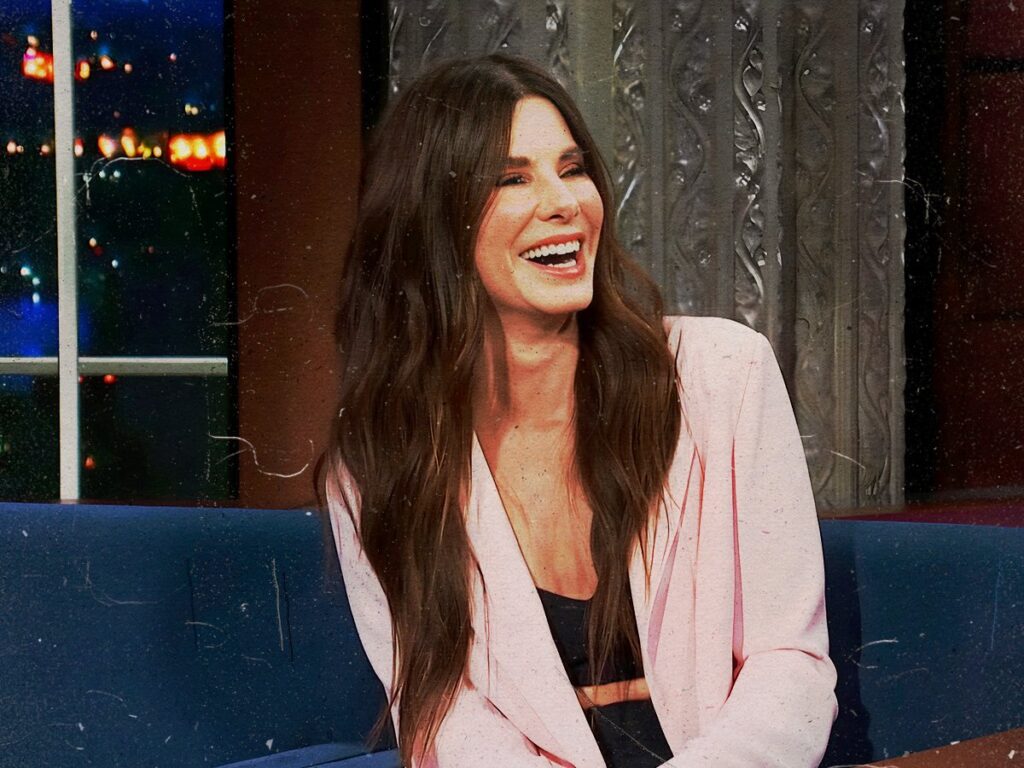
(Credits: Far Out / YouTube Still)
Mon 11 August 2025 20:15, UK
Being a Hollywood star certainly isn’t for the weak. The pressure of performing well, both with critics and the box-office, can certainly get too much at times.
Sandra Bullock has been open about the fact that she has sometimes found herself struggling throughout her career – feeling the pressure to take on certain roles because she thought she should, not necessarily because she wanted to.
In an industry as cutthroat as Hollywood – one defined by stereotypes where actors are often boxed into certain kinds of roles – you can’t always afford to be super picky. Bullock rose to prominence in the ‘90s with roles in the likes of Demolition Man alongside Sylvester Stallone before breaking through more widely with Speed the following year, which cemented her as one of cinema’s biggest new stars.
Yet, success isn’t always guaranteed, and despite the acclaim she’d begun to receive, Bullock then took on several movies that failed to achieve critical or commercial recognition, making her realise that she was not satisfying her own desires as an actor. She wasn’t listening to the voice in her head that knew the movies she was starting to pick weren’t what she actually wanted to do, but it can be hard to know which side of your brain to listen to sometimes. Should she try to appease others or stick to her guns?
“I was making decisions based on fear, based on other people telling me what I should be doing. I was trying to please everybody. I was trying to be all those perky adjectives that people had been attaching to me. I was not trusting my own instincts,” the actor told Texas Monthly.
This isn’t a sustainable way to navigate your career, though, and Bullock soon felt the effects of doing projects that didn’t fulfil her. She might’ve found success with While You Were Sleeping, but her next attempts at romance movies didn’t exactly go down the same way. Two If by Sea and In Love and War both came out in 1996, failing with critics and flopping at the box office.
The latter was even directed by award-winning filmmaker Richard Attenborough, but it seemed like 1996 was just not Bullock’s year for romance movies. Her other project that year was the legal drama A Time to Kill, which proved much more successful for the actor.
“I needed to get away. I needed to find a place where I could go to the convenience store and get a Slurpee whenever I wanted and not have to talk about the film business,” Bullock continued.
However, a project was soon sent her way that would bring her optimism back. Hope Floats – in which Bullock played the mother of a young daughter, portrayed by Mae Whitman, who returns home to her own parents following her separation from her husband – felt like the perfect script to redeem her career.
“Talk about life imitating art,” she said. “Everything that was happening to this character paralleled what was happening to me. Here was a woman who left one life behind and came to a small town to find out again who she was.”
The movie was directed by Forest Whitaker, but it failed to receive an ounce of acclaim. Bullock even received a nomination from The Stinkers Bad Movie Awards, signalling another low moment for the star. Yet, she failed to let this disappointment destroy her; after all, she had chosen the part because she felt much more authentically drawn to it than her other recent roles. Over the coming years, her career luckily picked back up with leading parts in everything from Practical Magic to Miss Congeniality.
Related Topics