
King and Conqueror (BBC)
Feuding royal rivals Wills and Harry are at daggers drawn again, and this time the stakes are higher than a broken necklace or a cracked dog’s bowl.
James Norton plays Harold II and Nikolaj Coster-Waldau his old friend turned bitterest enemy, William Duke of Normandy, in King And Conqueror.
History dictates that it’s William who defeats Harry. But look at it another way, and the duke comes out triumphant over the newly crowned monarch. So if you’re looking for portents, read that any way you like.
This sweeping saga on events leading up to the Battle of Hastings in 1066, with all eight parts available on BBC iPlayer, is steeped in blood.
Traitors are gutted and tortured, bandits are bludgeoned, virgins are raped and axes are hurled, in such a blur of violent action that it’s sometimes difficult to work out who is disembowelling whom.
When William first meets Harold, on their way to London for the coronation of Edward the Confessor, the Englishman helps him to fight off a gang of highway robbers.
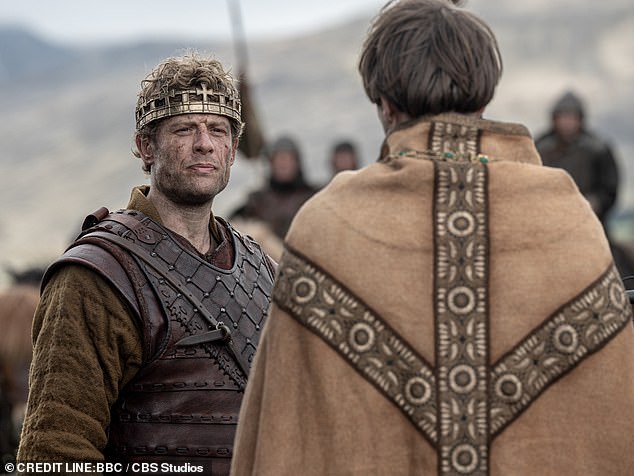
Feuding royal rivals Wills and Harry are at daggers drawn again, and this time the stakes are higher than a broken necklace or a cracked dog’s bowl (pictured: James Norton, left, as Harold II in BBC’s King & Conqueror)
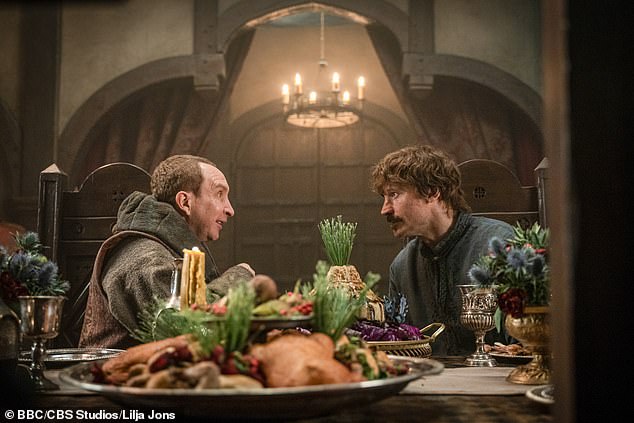
History dictates that it’s William who defeats Harry. But look at it another way, and the duke comes out triumphant over the newly crowned monarch (pictured: Eddie Marsan as King Edward and Nikolaj Coster-Waldau as William the Conqueror)
One villain gets his head bashed in with a shield. Another has his nose bitten off before being stabbed through the neck.
Back in Normandy, William’s wife Matilda (Clemence Poesy) is encouraging a captured prisoner to talk.
She has his arms clamped to a table and then, with a cruel smile, gives the signal to a henchman to chop off the man’s hand.
‘William was famous for that,’ English Heritage historian Dr Michael Carter tells me. ‘It was a fairly common kind of retribution in the 11th century.
‘This was a very violent age, and William had a reputation for violence — not a character you’d want to meet under any circumstances.’
Though director Baltasar Kormakur revels in the bloodshed, other scenes feel oddly mannered.
One featuring Henry I of France (Jean-Marc Barr), teaching his young son Philip the science of archery, would not have looked out of place in a 1950s Hollywood studio epic: sturdy men-at-arms stand motionless while the king listens grim-faced to a messenger who brings bad news.
‘Rectify this!’ Henry commands, his goatee bristling. ‘Find Guy of Bouillon!’ It’s a line that would sound better coming from the dastardly Sheriff of Nottingham in an Errol Flynn version of Robin Hood.
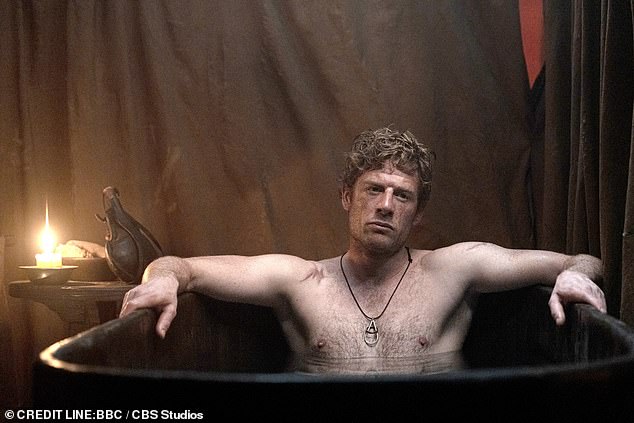
This sweeping saga on events leading up to the Battle of Hastings in 1066, with all eight parts available on BBC iPlayer, is steeped in blood
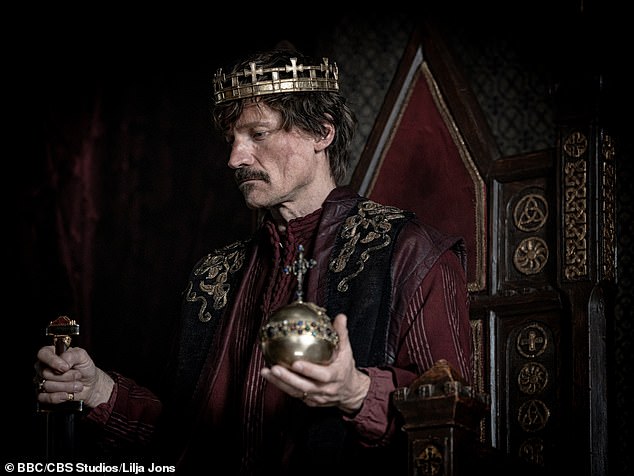
‘This was a very violent age, and William had a reputation for violence — not a character you’d want to meet under any circumstances,’ English Heritage historian Dr Michael Carter tells Christopher Stevens
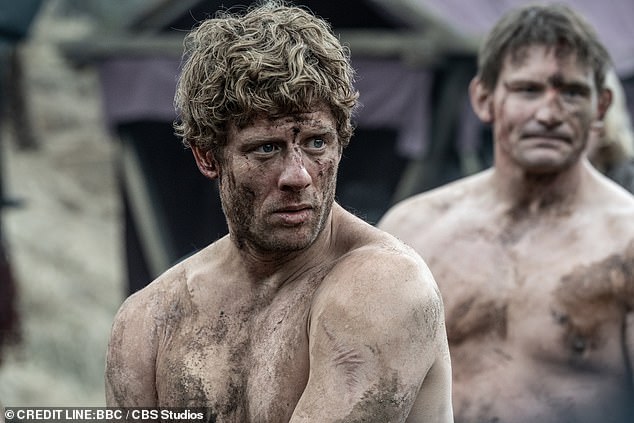
Though director Baltasar Kormakur revels in the bloodshed, other scenes feel oddly mannered
For all the blood-and-thunder melodrama, the high points of the first hour are dominated by Eddie Marsan as Edward the Confessor and Juliet Stevenson as his scheming mother, Lady Emma.
She’s the widow of two English kings, and now her son is about to ascend to the throne.
This has not come about by accident, and Lady Emma is not in the mood to let anyone spoil Edward’s big day. Unluckily for her, he keeps gazing heavenwards to heed the disembodied voice of St Swithin… a voice no one else can hear.
Edward keeps one of Swithin’s fingers in a locket round his neck. Just a finger? By 11th-century standards, that’s a mere trinket.
Share or comment on this article:
Feuding royal rivals William and Harry go to war. Sound familiar? CHRISTOPHER STEVENS reviews BBC’s King & Conqueror