
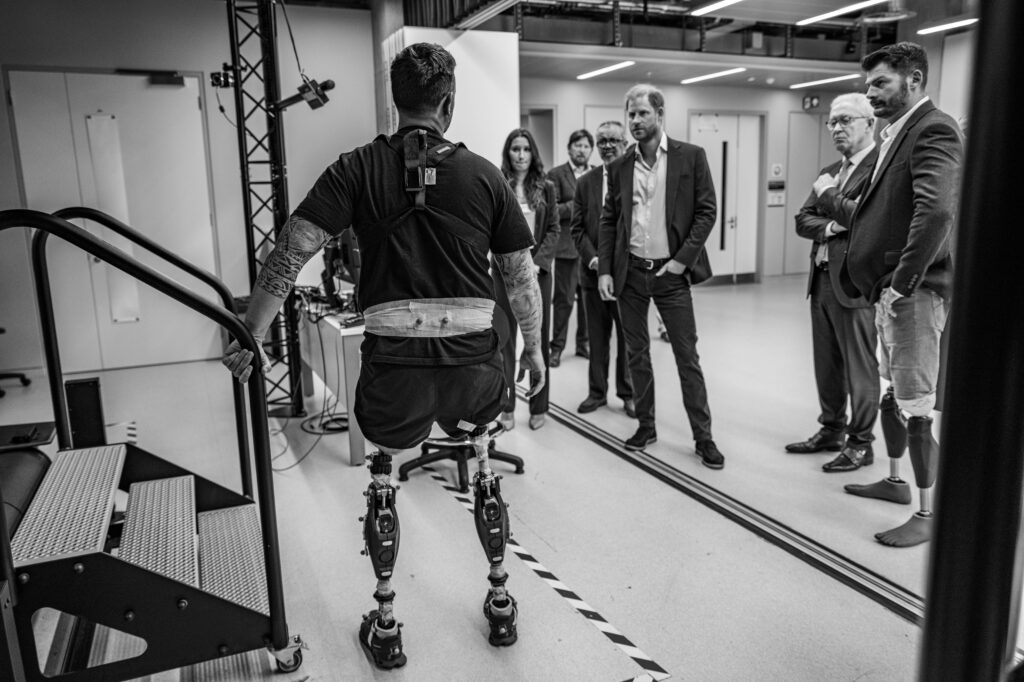
The Duke of Sussex returned to Imperial College London for his third engagement with the Centre for Blast Injury Studies, to learn more about their pioneering focus on pediatric blast and crush injuries.
The visit began with a laboratory tour inside the Sir Michael Uren Hub, where the Duke was met by Imperial College President Professor Hugh Brady, representatives from Save the Children, and Dr. Tedros Adhanom Ghebreyesus, Director-General of the World Health Organization (WHO).
Researchers demonstrated the latest innovations in point-of-wounding care, prosthetics for child amputees, and rehabilitation technologies. From early-stage research into the mechanics of blast injuries, to the use of robotics and gait analysis to improve recovery, the Duke saw firsthand how science and medicine are being applied to maximize learning for conflict and disaster zones.
Spotlight on Children in Conflict
The Centre’s focus on children is rooted in the Paediatric Blast Injury Partnership (PBIP), established in 2017 by Imperial College and Save the Children. What began as a pioneering workshop has since grown into a global collaboration delivering practical resources, including the Paediatric Blast Injury Field Manual, now used by frontline responders in conflict zones.
In 2023, this work expanded further with the launch of the Centre for Paediatric Blast Injury Studies, bringing together medics, engineers, humanitarians and policymakers to address the unique challenges children face when injured by explosive weapons.
Roundtable on Gaza and Global Action
Following the lab tour, the Duke joined a roundtable discussion alongside representatives from Imperial, Save the Children, and WHO. The session explored the urgent realities facing children in Gaza and beyond, with a particular focus on medical evacuation, mental health, and long-term rehabilitation.
Participants included Dr. Tedros, who has been a leading advocate for increasing child medical evacuations from Gaza, and Save the Children staff who shared frontline experiences. Becky Platt, a pediatric nurse who recently worked in Gaza, spoke movingly about the children she treated, and the ongoing need for mental health support alongside physical care.
Other contributions highlighted new data from the Blast Injuries Report, and the ways in which Save the Children and WHO are advocating globally for children’s rights to treatment and recovery.
Continuing the Commitment
In his closing remarks, the Duke praised the collaboration between Imperial, Save the Children and WHO, and the progress made since he first opened the Centre in 2013: “Every time I return here, I’m struck by the commitment, innovation, and compassion that drives your work. From the labs I opened over a decade ago, to today’s focus on prosthetics for children, the progress and dedication are extraordinary. The voices we heard today remind us that behind every dataset is a child — a child in pain, in need of care, and deserving of a future.”
The Duke’s long-standing engagement with the Centre for Blast Injury Studies reflects his commitment to those affected by conflict and to ensuring that children receive the care, dignity, and support they need to rebuild their lives. Today the Duke, together with the Duchess and the Archewell Foundation, announced three grants in support of this ongoing important work.
One grant for the Imperial College London Centre for Blast Injury Studies will go toward developing prostheses for children, particularly those in Gaza and Ukraine.
Another grant to the World Health Organization to kickstart their upcoming fundraising campaign and will be used to support medical evacuations from Gaza to Jordan.
A third for Save the Children to provide ongoing humanitarian support in Gaza.
“No single organization can solve this alone,” the Duke stated. “Gaza now has the highest density of child amputees in the world and in modern history. It takes partnerships across government, science, medicine, humanitarian response and advocacy to ensure children survive and can recover after blast injuries.”