
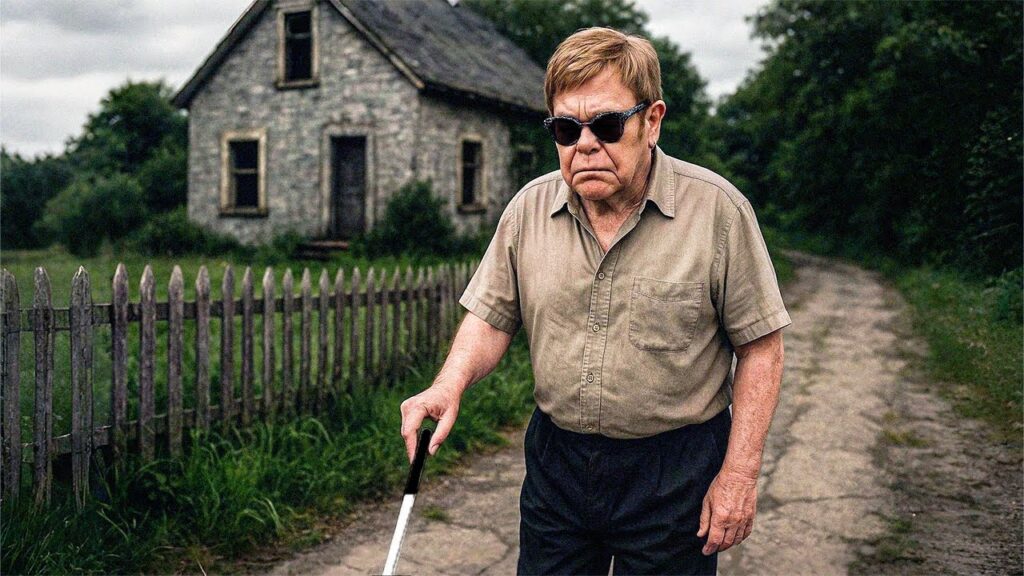
Elton John Is Now 78, But How He Lives Is Incredibly Sad!
She went and did the Oprah show and kind of badmouththed me and said I was a spoiled child and in fact I wanted to put the record straight on what really happened. I can’t see anything. I can’t read anything. I can’t watch anything. It’s horrible. I unfortunately lost my eyesight in my right eye in July because I had an infection in the south of France and it’s been 4 months now since I haven’t been able to see. At 78, fans expected Elton John to be enjoying a peaceful, fulfilled retirement, but whispers from insiders paint a much darker picture. I hope there’s an afterlife, but I’m I’m a bit cynical about it. Some claim his health struggles are worse than he lets on. Others insist his personal life isn’t the fairy tale he shows to the public. And the most shocking part, this is the latter time of my life. I don’t know how much time I have left. Those closest to him are staying unusually quiet. Has Elton John been hiding the truth about how he really lives today? Or is this the sad downfall of one of music’s greatest icons? Let’s find out. The roar of an audience is like a tidal wave. It surges. It crashes. It drowns out everything else. For decades, Elton John lived inside that roar. The sequin suits, the oversized glasses, the pianos that seemed to explode with fire. All of it convinced the world they were witnessing a celebration of life. But behind the curtain, when the music stopped and the spotlight dimmed, what remained was far darker. a man who even at 78 carries scars no applause could ever heal. And I was a little angry at the time. And I also learned a lot that you can’t shove things in people’s faces and expect them to understand things for straight away. It’s tempting to look at Elton John’s career and imagine a fairy tale. A boy from Pinner Middles’s X who transformed himself from Reginald Kenneth Dwight into one of the most flamboyant, successful, and adored performers in history. Over 300 million records sold, countless soldout arenas, a nighthood, Oscars, Grammys, Golden Globes. The list of triumphs stretches longer than any set list he ever played. Yet, every triumph concealed a tragedy. Every award was a plaster over wounds that never closed. Because the truth is, Elton John is now 78. But how he lives is incredibly sad. The tragedy of his life is not marked by a single dramatic fall, but by the quiet accumulation of pain. The broken bonds of a cold childhood, the ruthless demands of fame, the destructive escapes of addiction, and the haunting awareness that even when the world loves you, loneliness can still linger in the silence. How rotten can you get? You just have such a baby face. Come on. I know. I’m a real tantrum galore. It’s John Macar has nothing towards me, but when I have a tantrum, they everybody just runs away. And after 10 minutes, I think, where are they all? Today, when he steps onto a stage supported by doctors, assistants, and sheer willpower, the audience sees a legend. They see glitter and glory. What they don’t see are the surgeries that nearly ended his voice. The chronic pain that gnaws at him daily. The nights he admits he nearly gave up. They don’t see the tears hidden behind tinted glasses or the scars that no fame, no family, no philanthropy can truly erase. Elton John built his legend on spectacle. But at 78, the story behind the sparkle is one of survival and a reminder that sometimes even the brightest stars burn saddest when the crowd goes home. Seen binges, aolfueled blackouts, nights swallowed by rage and despair. These weren’t just phases in Elton John’s life. They were battles that carved permanent cracks into his body and soul. The hip surgeries, the infections, the sudden collapses on stage. Each is a brutal reminder that the bill for decades of excess has finally come due. This is the latter time of my life. I don’t know how much time I have left. And you think about that more when you get to my age. And yet the world still demands more. More tours, more shows, more magic. And Elton, ever the consumate showman, delivers. But deep down, he knows that each performance could be his last. Because at 78, the tragedy isn’t that Elton John has lost his gift. It’s that he’s given so much of himself to the world that there’s almost nothing left for himself. Always have our health, our blood tests every six months in Los Angeles. Our health has never been better and it’s never fortunate for anything like this to happen. And I can’t see anything. I can’t read anything. I can’t watch anything. Here lies the cruel irony. Elton spent years clawing for acceptance from his parents who never showed him love. From an industry that doubted him from a society that once criminalized who he was. He won that acceptance. He earned it with blood, sweat, sequins, and songs. But it never filled the void. Fame amplified his loneliness. Success magnified his insecurities. And now Elton John is 78, but how he lives is incredibly sad. When the lights go down and the applause fades, Elton faces the same haunting question that tormented him as a boy in Pinner. If the music stopped, would anyone still love me? Millions rever him. Millions owe their life soundtracks to his songs. But love from a distance is not the same as love that stays when the stage is dark. John is set to play at Dodger Stadium. No solo artist has ever put on a live stadium show. Behind the tinted glasses, beyond the feathers and glitter, what remains is Regginald Kenneth Dwight, the quiet, chubby boy who once sat at a piano, not to entertain, but to escape. His father’s cold discipline, his mother’s volatile rage. A childhood starved of warmth. Those scars never healed. And today, beneath the legend, they still ache. That is the real tragedy of Elton John at 78. The world sees a legend. But he still feels like a boy who never stopped hurting. Stanley Dwight wanted Reginald to follow a respectable path. Banking perhaps or something equally steady. Show business was in his eyes a joke. A distraction unworthy of serious ambition. And so the sensitive child who spent hours at the piano received no encouragement from his father, only indifference. His mother Sheila was more present, but no safer. Volatile and sharp tonged, her support came in bursts, followed by dismissive cruelty. Even decades later, Elton admitted their relationship was fraught until the very end of her life. Love in that house was conditional, fleeting, and always out of reach. A great relationship with my my mother and my stepfather. Um yeah, and it’s been nice to be able to reward them with some things like the nighthood and the fact that, you know, we have this great relationship now and we talk to each other. For young Reginald, the piano was more than an instrument. It was survival. Each melody drowned out the shouting, the silence, the rejection. By three, he could pick out tunes by ear. By 11, he had a scholarship to the Royal Academy of Music. To outsiders, it was a triumph. To Reginald, it was another stage where he felt unseen. Surrounded by prodigies and praised for his talent, he still carried the voice of his father in his head, reminding him he would never be enough. That wound never healed. And perhaps it was this very wound that later gave birth to Elton John, the larger than-l life persona, the feathers, the rhinestones, the flamboyant disguises that screamed for the world’s attention. Because as a child, he had been invisible. At family gatherings, his father dismissed his playing as a hobby. When he tried to express feelings, his mother snapped that he was too sensitive. Behind the sequence that would one day dazzle millions was always the same little boy at the piano, desperate for a smile that never came. Well, you know, happens and you have to deal with it and and but you dealt with that. This is where the tragedy of Elton John begins. Not with fame, not with addiction, but with a child who learned that love must be earned and even then it might never arrive. That hunger shaped him. It drove his compulsions later in life. Shopping, eating, working, performing. Each excess another attempt to fill the void carved by rejection. In the gray suburbs of postwar England, music was the only escape hatch. Rock and roll records became his lifeline. Elvis Presley, Jerry Lee Lewis. They were confident, adored, unafraid. They embodied everything Reginald believed he was not. He dreamed of becoming like them, though deep down he doubted anyone would ever look at him the same way. His first taste of transformation came in the early 1960s with a band called Blueology. Awkward, overweight, and painfully shy, he looked out of place until he touched the piano keys. In pubs clouded with smoke and filled with indifferent crowds, he glimpsed something radical, a way to become someone new. But the cruel irony is that even now at 78, after decades of reinvention, superstardom, and survival, Elton John still carries that invisible child inside him. And that’s why despite all the glory, how he lives today is incredibly sad. So then the question is, where is it coming from? Yeah. Well, I I I think he says it’s this childhood trauma. Still, his insecurities never let him go. Even as his talent grew sharper, Elton worried constantly about how he looked, about whether he was good enough, about whether anyone truly cared. The more his music blossomed, the more his self-worth withered. It was a fragile foundation, one that would later collapse under the crushing weight of fame, sending him spiraling into addiction and despair. But in those early years, the tragedy was quieter. It showed in the way he practiced endlessly, not from joy, but from fear. It showed in the way he changed his clothes, his style, even his very name, as if each reinvention might finally win him the unconditional love his parents had denied. Elton John wasn’t born flamboyant. He built that armor piece by piece, note by note, sequin by sequin, until Regginald Dwight disappeared. From the ashes rose Elton John, a persona beaming with confidence and flare. Yet beneath the rhinestones, the lonely boy at the piano still lived and still longed to be loved. Norman, that’s perfect way to deal with me. Oh, in this business, you go crazy sometimes. And that’s the tragedy that clings to him even now at 78. The world remembers the superstar. Elton remembers the child who played for silence. His career, his fame, his very genius grew out of that hunger. The melodies that made him immortal were, in truth, just letters to a world that never hugged him back. By the late 1960s, the British music scene was exploding with rebellion and raw energy. Elton was no longer Reginald. He was reborn, ready to carve out a destiny of his own. His partnership with lyricist Bernie Topen became the spark that lit the fire. They were opposites by design. Bernie couldn’t carry a tune. Elton couldn’t write words. But together, they created something alchemical. Topin’s poetry gave Elton a language for feelings he had never been able to express. And Elton’s melodies gave those words wings. From their earliest collaborations, your song, border song, tiny dancer, it was obvious that something extraordinary had been unleashed. A superstar had been born. But the shadow of Regginald Dwight, the boy who was never enough, never went away. They didn’t just hear those songs, they felt them. The yearning, the vulnerability, the desperate need for connection rolled out of the speakers and into concert halls. What the audience didn’t know was that those songs were confessions. Every lyric Bernie Topen handed him became a mirror. Every melody Elton wrote was a plea. I’ve been incredibly lucky to have people to help me through the bad times. By the early 1970s, Elton was everywhere. Goodbye, Yellow Brick Road, Honky Chateau, albums that turned him into a global phenomenon. He sold out Madison Square Garden, toured relentlessly, and broke records that once seemed impossible for the insecure boy from Pinner. On stage, he grew louder, costumes bigger, glasses larger, shows more extravagant. He became a carnival of sequins and feathers, a walking spectacle whose excess became his trademark. But that spectacle was also a mask. Elton admitted the more outrageous his wardrobe got, the more insecure he felt. Behind the rhinestones was still Reginald, the child his father dismissed, the son his mother belittled. Fame amplified those old wounds instead of erasing them. Every standing ovation made the silence afterward feel heavier. Every soldout arena sharpened the loneliness backstage. The early years of stardom also unleashed temptations he was illquipped to handle. AOL flowed freely arrived as a supposed remedy for stage fright, for anxiety, for the whisper that said he wasn’t good enough. At first, they numbed. Soon they chained. See me became constant. Vodka replaced water. Binge eating and purging shadowed the highs. The public saw brilliance. Elton saw a man coming apart. Worse, he had to live a double life. In the 1970s, being openly gay in the mainstream music world was dangerous. Love had to be secret, desires locked away. The flamboyant performer in Feathers was in private terrified of rejection. He described that era as a non-stop performance. Not just on stage, but in every waking moment. The tragedy wasn’t only addiction or secrecy. It was isolation. Surrounded by managers, groupies, and flashing cameras, he had few true friends. Bernie Topin remained a rare constant. But even that bond frayed under the pressure of excess. Bernie wrote honesty. Elton gave it music. And then when the lights went out, he battled demons alone. I have great respect for me, but they don’t hold back. They’re very honest people, you know. They tell you when they think something’s wrong with you. They tell you they don’t like something. And I’m being an absolute roter, which I can be all all of the time. Hit after hit poured from him. He seemed unstoppable. He became not just a musician, but an icon. People copied his glasses, his flamboyance, his refusal to be ordinary. He gave the world permission to be bold. Privately though, every morning after a binge arrived with shame. Every new headline about his genius reminded him of the hollowess inside. By the mid 1970s, at the peak of his powers, he was also spiraling. Overdoses, collapses, rages, nights when he contemplated ending it all. The irony was brutal. The man who wrote anthems of hope was drowning in despair. The applause only grew louder. But the tragedy of Elton John’s rise was that it was both a triumph and a trap. Fame gave him the freedom he had always longed for. Yet, it also built an invisible prison. Every tour had to be bigger. Every album had to outshine the last. Every performance had to be more outrageous. The Boy Who Only Wanted Love now carried the crushing weight of millions of expectations. And no amount of applause could quiet the emptiness inside. Elton admits this was both the best and worst era of his life. He was conquering the world but losing himself. The cheers were thunderous, but the silence afterward was unbearable. His rise should have liberated him, but instead it deepened his chains. This was when Elton John became immortal. Yet Reginald Dwight nearly disappeared, buried beneath sequence, sea, nay, and a loneliness no stadium could fill. The glitter dazzled the mass convinced. But behind it, the tragedy was already in motion. I’ve made a lot of mistakes and been a real pig to people and been horrible and had points in my life where I wasn’t very happy. But no, I don’t think I’d change anything because I think you can learn from those sort of things. By the late 1970s, Elton had sold out arenas, top charts, and etched his name alongside legends. But inside, his empire was collapsing. The man who once found salvation in melodies was now drowning in the noise of excess. His life became less a tragedy and more a near-death opera played behind closed doors. See me was no longer a luxury. It was survival. He later described his routine with chilling honesty. three days awake, joints and a bottle of Johnny Walker, then binging until he was sick, purging and starting over. It wasn’t pleasure, it was punishment. The 1980s should have been his decade of triumph. Instead, they became a battlefield of self-destruction. Yes, albums came out, but the magic didn’t. Too high, too numb, too broken. He often couldn’t care. The costumes grew stranger, the shows wilder, but they only disguised the collapse. Elton was now a prisoner of his own creation, dazzling the world while destroying himself in private. In your life, your biggest regret? My biggest regret is taking relationships fared no better. He craved love yet couldn’t accept it, pushing people away only to beg them back. His sity still hidden under layers of fear and shame fueled the turmoil. In 1984, in what seemed like a desperate reach for stability, or maybe just a way to silence the whispers, he married German sound engineer Renate Blowell. For four years, they lived in a marriage Elton later admitted was doomed from the beginning. He loved her, but not in the way a husband should. When it ended, Renat was devastated, and Elton was left with even deeper guilt. And so, the spiral worsened. Sein had become his only lover. By the end of it, I had a shoe box full of joints behind someone on the on the on the road with me rolling joints, especially English joints are different to American joints. American joints are very thin and weedy and English ones have a they’re called spliffs and they have um cardboard like a filter in them. Alol became his comfort excess his daily ritual. Friends tried to intervene. Some walked away unable to watch him drown while others enabled the chaos. Elton later admitted that in those years he didn’t care if he lived or died. Fame had given him everything he thought he wanted yet robbed him of the one thing he needed most peace. toward the middle 70s uh 767 my abuse was from like there till the late 1990s and still the music never stopped he kept recording kept touring kept appearing in headlines but listen closely to the songs of the 1980s and the cracks are impossible to ignore ballads carried a heaviness they hadn’t before. Even the upbeat tracks were shadowed with sorrow. It was as if Elton’s soul was bleeding onto vinyl while his public face hid behind sequins and shades. The most chilling truth. Elton knew he was dying. He confessed years later that he would look in the mirror and see death staring back. His body was breaking down. His voice cracked. His hands trembled. Yet, he kept returning to the stage because the stage was the only place he could still pretend to be alive. For an hour or two, the applause numbed him. But once the lights dimmed, the silence hit harder than ever. In those darkest years, Elton’s despair nearly consumed him. He recalled nights of waking up surrounded by strangers with no memory of what he’d done. Moments when the thought of ending it all pressed in. And yet something inside him, perhaps the same resilience that once kept a lonely boy at his piano, pushed him forward barely. By the end of the 1980s, Elton stood at a crossroads. His health was shattered, his relationships in ruins, his reputation scarred. Loved by millions, he despised himself. It wasn’t until the early 1990s, after burying friends, after too many funerals, after grief finally broke through denial, that Elton confronted his demons. All the pain and all the and all the self-hatred I went through to get to where I got now. I got sober and I learned to live my life. But survival left scars. Even at 78, Elton admits those years haunt him still. In dreams, he sees his former self, the ghost of a man who nearly didn’t make it, lurking in the shadows, waiting to drag him back. The tragedy of Elton John’s spiral is that it nearly cost the world one of its greatest artists. It nearly erased a legacy that should have been untouchable. Yes, he survived, but the cost was staggering. Lost years, broken bonds, and a body that would never fully recover. Every limp, every scar, every doctor’s warning reminds him of how close he came to the edge. The world may still cheer for the rocket man, but Elton knows the rocket nearly crashed. He knows he came within inches of becoming another cautionary tale. Another genius destroyed by the very excesses that fame demands. The darkness of those years will never vanish. It can only be endured. And Elton endures. But the crulest irony is this. The boy who once played piano to escape his pain had grown into a man who almost played himself into the grave. The glitter still sparkled. The applause still roared. But behind the music, Elton John was fighting for his life. And that fight, brutal, endless, remains a wound that never fully healed. By the early 1990s, Elton John stood at a turning point. The decade did not open with another dazzling tour or glittering costume. It opened with funerals. The AIDS epidemic swept mercilessly through his world, stealing friends, colleagues, lovers, an entire generation of voices silenced. Elton attended service after service, staring into caskets, watching grief carve permanent lines into faces around him. It was there at the gravesides that something inside him shifted. He could not keep living as he had, not if he wanted to live at all. Rehab offered no sequins, no applause, no dazzling escape. It offered only silence. It stripped Elton Bear. Broken, angry, humiliated. He faced what he had spent decades running from. The wounds of childhood, the hunger for love, the addiction that had nearly consumed him. Beneath the feathers and flamboyance was still Regginald Dwight, the lonely boy from Pinner, desperate to be healed. Do you regret changing your name? Do you ever think I wish I had? I know. God, I love changing my name. I hated being Reg Dwight. I loved it. Uh, I was euphoric when I was became Elton John. Recovery was punishing. His body ravaged by years of abuse, screamed in protest. The cravings tore at him. The self-loathing was louder than any crowd he’d ever faced. But slowly, through sheer stubbornness, through the help of those who refused to give up on him, he began to crawl back. Each sober day was a victory, each confession, a release. For the first time in decades, Elton saw the possibility of a life not ruled by excess, but by survival. And it was during this fragile rebirth that he chose honesty over fear. In 1992, Elton John publicly came out as gay. For years, he had hidden behind ambiguity and shame. Now, he stood unapologetically in his truth. It was a declaration not only to the world but to himself. Some fans turned away. Critics sharpened their knives but for once applause meant less than authenticity. In 1976 you made an admission of of peace. What has been the response particularly in the United States? This is supposed to be the great liberal country in the whole world but unfortunately it isn’t. I don’t regret saying it. Then in 1997 came the tragedy that bound his story to something greater than himself. Princess Diana’s death shocked the world and Elton was asked to sing at her funeral when he performed Candle in the Wind rewritten in her honor. The moment transcended music. His voice raw with grief carried through Westminster Abbey and across the globe. The single went on to become one of the bestselling songs of all time. But more than that, it was proof that Elton John, scarred, reborn, unapologetic, could still channel his pain into something eternal. But those closest to him knew the truth behind the performance. Diana had been one of the rare few who saw Elton not as the superstar, not as the mask, but as the man. Losing her was like losing a mirror that reflected his humanity. As he sang for the world, he was mourning her and all the countless losses that had already scarred his life. And yet, out of that grief came redemption. The 1990s marked a turning point. Elton channeled his pain into purpose, founding the Elton John AIDS Foundation, which would grow into one of the leading organizations in the fight against HIV AIDS. Through concerts, fundraising, and unrelenting advocacy, he wielded his fame not as a shield, not as a stage, but as a weapon against injustice. And until people more people get tested um and more people come out and say I’m HIV positive, um then we’re facing an uphill battle. It’s um it’s a very much a treatable disease. Still, even redemption had its shadows. Sobriety did not erase the scars. Elton admitted often that recovery was fragile. That temptation never disappeared. Even in his triumphs, Grammys, Broadway successes, induction into the rock and roll hall of fame. He felt the weight of what he had lost. Sobriety gave him life, but it forced him to live face to face with the wreckage of his past. Then came love. In the mid 1990s, Elton met Canadian filmmaker David Furnish, the man who would become his partner, then his husband. For someone who had spent decades chasing affection and fleeing rejection, their relationship was transformative. With David, Elton found what he had always longed for, stability. It wasn’t easy. His temper, moods, and insecurities tested their bond, but David stayed. And from that commitment, Elton built something he had only dreamed of as a boy, a family. I have two young boys that need me. I have David as my husband that needs me. I love spending time with my boys and I love being here at this house. And I understand why people find it hard to stop, but I didn’t find it hard at all. Through surrogacy, the couple welcomed two sons. Fatherhood changed him more than fame ever had. The man who once lived for applause now lived for bedtime stories, school runs, and the quiet joy of being called dad. Yet even this joy was shadowed by doubt. Elton confessed he feared his past. The addictions, the chaos, the fame might someday darken his children’s lives. The tragedy, even in love, was that he could never silence the fear of failing them. By the 2000s, Elton John seemed to have triumphed. Sober, married, a father, a philanthropist. His concerts still filled arenas. His legacy secure, but beneath it all, fragility remained. Health problems mounted, hip replacements, throat surgery, infections that nearly killed him. Each recovery was hailed as a comeback. The headlines called him indestructible. Elton knew better. Each return to the stage took more out of him. Each brush with death left him weaker. The tragedy of Elton John is not that he failed to find redemption. It’s that redemption itself has been bittersweet, fragile, forever shadowed by the ghosts of his past. The boy who only wanted love finally found it, but never stopped fearing its loss. The addict who clawed his way to sobriety still hears the cravings whisper. And the legend who conquered the world still lies awake some nights, wondering if without the piano, without the applause, he might vanish into silence once again. Is there any piece of you that misses Tori? Not any. The glitter still dazzles. The music still endures, but behind the immortality of Elton John lies the most human of truths. Survival is its own kind of tragedy. Elton John’s fight for redemption gave the world hope, but for Elton himself, it has always remained a battle without end. And as age strips away his strength, one question lingers. Can he ever truly rest or will he remain even in his final days, the lonely boy still playing for love? In 2018, he announced his farewell yellow brick road tour. The world gasped, not because he was leaving, but because it seemed impossible that he ever could. For decades, Elton had been a constant, a soundtrack to millions of lives. Yet at 71, he declared it was time to step away, to spend his remaining years not as a superstar, but as a father. The announcement was bittersweet. Fans cheered his honesty, but mourned the inevitable silence. The tour itself was monumental, spanning years, continents, and hundreds of performances. Audiences filled arenas, desperate to witness history, to be part of the last notes of a legend. The shows dazzled with grandeur. But behind the fireworks and bravado was a man whose body was failing. Every performance was a battle. Hips aching, knees weak, infections looming. Some nights he collapsed backstage, barely able to walk. Yet, he returned to the piano, unwilling to let the audience see him fall. In 2019, Elton revealed he had undergone surgery for prostate cancer. Though the cancer was removed, complications nearly him. A postsurgery infection left him hospitalized for weeks, fighting for his life. He admitted later that he feared he would never see his children again. That brush with death changed him. Every show that followed felt borrowed, fragile, precious. It’s a justosition of the first LA Dodgers concert in 1975 and the last one and what I was like then and what I’m like now. Then came pandemic. For most, lockdowns were a pause for Elton. They were an existential reckoning. The silence he had always feared returned not from collab, but from the stillness of a world in shutdown. Trapped at home, he leaned on his family. But he also confronted a painful truth. For the first time in decades, he had to face who he was without the stage. When the world reopened, Elton returned, of course, he always does. But the delays and cancellations revealed the truth. His body was nearing its limit. He performed in a wheelchair at times, propped up by sheer willpower. He confessed the pain was constant, every step agony, but he could not stop. Not yet. His fans deserve their goodbye. Elton’s tragedy is written not only in his music, but in his flesh. Every scar tells a story of survival. Every strained note carries the weight of years lost to addiction. Every step onto the stage is an act of defiance against age and illness. Yet beneath the defiance lies fear. Fear of mortality. Fear of silence. Fear that once the final curtain falls, he will no longer know who he is. They love my music and they love what I do. But they’re not that intertwined. His children give him purpose, yet they also remind him of time lost. Decades wasted in haze and self-destruction. He is grateful to be alive for them, but he admits that each birthday feels less like a celebration and more like a countdown. The glittering costumes remain. The oversized glasses still gleam. But they are no longer symbols of invincibility. They are relic, a shield for a man holding on to identity as time strips him bare. The world sees resilience. Elton John knows the truth. Resilience is just survival dressed in sequins. The world calls Elton John a survivor. But Elton himself admits that survival has left him weary. He has described his life as one lived at the extremes. Ecstasy and despair, fame and isolation, triumph and collapse. Now, in the quiet spaces between applause, he confronts the cost of those extremes. His hearing is weaker, his voice is older, his body fragile, and though he still flashes smiles for cameras, in private, he has confessed that the hardest battle is accepting he is no longer the man he once was. The tragedy is not simply aging. It is the awareness that after giving everything, his music, his soul, even his health, he is still chased by the same emptiness that haunted him as a boy, he has love, family, and redemption. Yet, one question lingers. When the music stops, will that be enough? The final curtain is inevitable? He has said his farewell yellow brick road tour will be his last. But can a man who has lived more on stage than off truly step into silence? Or will that silence consume him? At 78, every performance feels like a goodbye. Fans cheer louder, sensing the fragility, the fleetingness of the moment. They cheer not only for the songs, but for the survival, for the fact that Elton John still stands before them, defying odds. Yet Elton knows the truth. Each show could be his last. Each bow could be final. The tragedy of Elton John’s final act is that it is both victory and surrender. He conquered addiction, built a family, and created a legacy that will outlive generations. But he cannot conquer time. He cannot outrun mortality. And when the piano keys ring out one last time, Elton must face the reality that the boy from Pinner, the global superstar, the man of glitter and pain, will eventually fade into silence. The curtain has not yet fallen, but it hangs heavy. And when it does, the tragedy will not be that Elton John died. It will be that he gave everything to music only to discover that even music cannot shield us from the darkness of age and the inevitability of goodbye. Elton John at 78 is a portrait of contradictions. He is celebrated as one of the greatest songwriters and performers in modern history with over 300 million records sold and generations shaped by his sound. Yet behind the celebration linger shadows, questions of love, acceptance, and identity that fame never erased. His legacy is immense. His songs are stitched into the fabric of human experience. Your song remains a declaration of raw, vulnerable love. Rocket Man captures the loneliness of isolation hidden beneath spectacle. Candle in the Wind became a hymn of mourning not once but twice, bridging decades with its grief. Elton John’s story is not just about music. It is about what happens when the music ends. That’s it for today. See you in the next video. Until then, goodbye.
Elton John Is Now 78, But How He Lives Is Incredibly Sad!
At 78, fans expected Elton John to be enjoying a peaceful, fulfilled retirement, but whispers from insiders paint a much darker picture.
Some claim his health struggles are worse than he lets on, others insist his personal life isn’t the fairytale he shows to the public—and the most shocking part?
Those closest to him are staying unusually quiet. Has Elton John been hiding the truth about how he really lives today? Or is this the sad downfall of one of music’s greatest icons?
Here on Hollywood Whisperer we are all about the latest spill in Hollywood! You can rest assured that we will bring you all the latest celebrity drama and gossip especially concerning your favorite actors! We´ll also make sure to keep you updated on the newest movie updates and releases – so if you are interested in anything that happens in Hollywood, you should make sure to stay tuned!
And there you have it guys! We hope you enjoyed the video! If you did please consider leaving a like and telling us what you thought in the comments!
Here are some links to some of our other videos that you might find interesting as well:
“FORGIVE ME” Justin Bieber Apologies to Hailey Bieber (IG LIVE VIDEO): https://www.youtube.com/watch?v=u-m_Q7FS91I
Emilia Clarke REACTION Before Replacing Amber Heard in Aquaman 2! https://www.youtube.com/watch?v=PYXp9wXHUWw
Johnny Depp OFFICIALLY REHIRED | Back In a New Pirates of the Caribbean 6 Movie? https://www.youtube.com/watch?v=utozMdfngVk
Elon Musk Speaks Against Amber Heard & Defends Johnny Depp!
https://www.youtube.com/watch?v=wOo2BFTRrL4
So, if you are interested in anything related to Hollywood, make sure to smash that subscribe button to see more of our content in the future! 🎬 https://bit.ly/3kzplQd
Disclaimer: Content might be gossip, rumors, exaggerated or indirectly besides the truth. Viewer advised to do own research before forming their opinion. Content might be opinionated.
#HollywoodWhisperer #Celebrity #eltonjohn #discovery
1 Comment
Elton John will always be my best entertainer and his personal life is between him and his maker. 💋🙏