
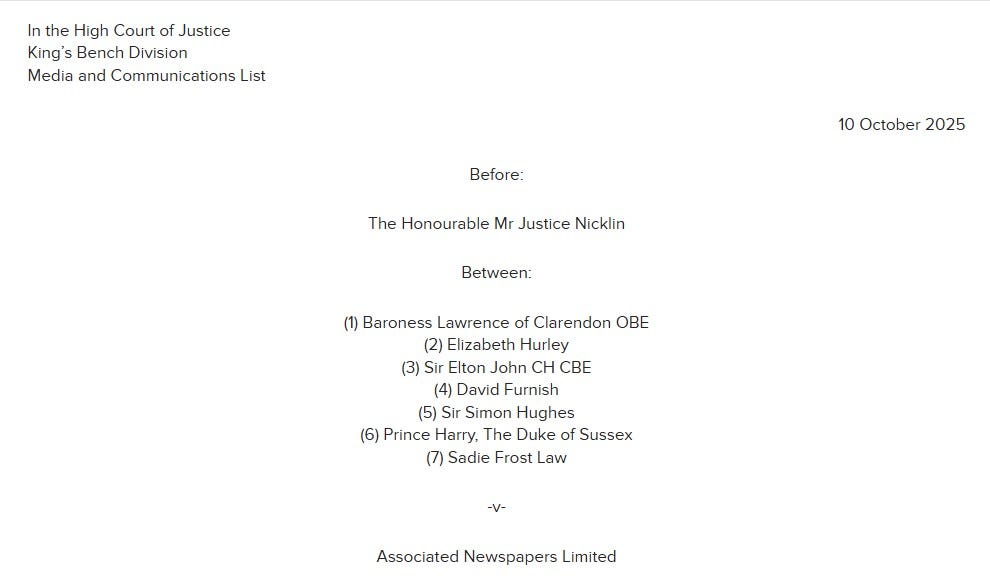

This year has been a legal roller coaster for Prince Harry. He’s settled one case, lost another, and is now in the midst of pre-trial motions, arguments, and decisions in his last case. In it, he and six others allege that Associated Newspapers, the publisher of the Daily Mail, engaged in unlawful information gathering (UIG), commonly known as phone hacking (though UIG doesn’t always involve phones).
That civil case is now back in the news because of a judicial decision by Justice Nicklin that could best be described as testy, maybe even a tad exasperated at Harry’s legal team. So I thought now would be a good time to catch up on what has been happening with Prince Harry’s cases in the courts this year.
(On Friday, the Times revealed that Prince Harry had revived his security issue, though not through the courts. “Prince Harry makes new bid for taxpayer-funded security,” was the headline, which included information from sources that he’d written to the British home secretary asking for a new risk assessment to be done. Some papers had reported that a stalker had gotten close to Harry when he was in Britain in September. )
At the beginning of 2025, I spent a week creating a legal timeline of Prince Harry’s cases, orders, and judgments. It was partly to inform readers and partly as an aide-mémoire; the saga is complicated, in part because some of the cases interacted with each other as information buried in the filings of one case could reveal new contexts in another.
At the time, Prince Harry had three live cases — against Rupert Murdoch’s News Group Newspapers for unlawful information gathering (UIG) aka phone hacking, against the government over his security, and against Associated Newspapers, which publishes the Daily Mail, for UIG.
My timeline was out of date the day after it was published as Prince Harry settled his case with Rupert Murdoch’s News Group Newspapers just as the trial was to begin, obtaining a public apology and substantial damages (My piece is here).
Yet that settlement wasn’t the “slaying dragons” victory he’d obtained in December 2023 for his successful legal action against the Mirror Group and what he had long talked of achieving through his myriad legal actions.
As I wrote about the January 22, 2025 settlement:
Over the years, Harry had indicated he wanted the accountability that comes with a public trial. At the NYT DealBook summit held the month before the trial was set to begin, he sounded determined to hold fast after so many had been paid compensation to end their claims. They’ve settled because they had to settle,” the prince said. “So therefore, one of the main reasons for seeing this through is accountability, because I am the last person that can actually achieve that.”
…The Duke of Sussex’s settlement also likely ends any chance of having the roles of Murdoch’s executives and reporters examined in detail in civil court (some have faced criminal prosecutions).
Rather than eight weeks of daily headlines exposing all Prince Harry believed is wrong with the British press, he got one day’s worth of stories about his settlement. Then the world moved on.
Two days later, another of Prince Harry’s cases was generating headlines. On January 24, 2025, Justice Nicklin issued a decision in the vexing issue of “costs management” in the UIG case that Harry and six others are pursuing against Associated Newspapers. After each side told the court that they will spend around 18-19 million pounds (around CAD$$35 million each), the judge and Senior Master Cook issued a decision. Stating that the claims in this case are “really rather simple,” Cook wrote: “We therefore approve total budgeted costs of £4,084,000 for the Claimants and £4,445,000 for the Defendant.” That’s roughly CAD$7 million each.
That decision poses a seven or eight-digit dilemma to each side’s expensive lawyers and their clients, I wrote in January:
Harry and his fellow claimants are free to spend what they want, but the judge will use his budget estimate of CAD$7 million to determine any legal cost payments, not what they actually spent on the case.
HYPOTHETICAL: Harry and the others spend CAD$35 million and win on all counts. The losing side has to pay their legal costs. Based on this ruling, the judge caps that amount at CAD$7 million, meaning Harry and the other claimants would be responsible for the remaining $28 million of their own legal fees.
Even if Harry wins, he could lose millions.
Two months later on May 2, Harry lost his security appeal. He did not take the decision well.
As I wrote that day:
The panel of three judges upheld the original ruling that the way current “bespoke” security system was put in place in 2020 may not be exactly the process that Prince Harry believes is necessary, but it is legal and was no way decided in a manner that was unfair or irrational. As it stands, he gets protection as needed when he visits the United Kingdom, but the level and type of protection is decided on a case-by-case basis.
Harry lashed out in what can only be described as a bitter, angry diatribe in an interview with a BBC journalist in California, calling the ruling by three judges on the Court of Appeals “a good old-fashioned establishment stitch-up.”
After that, Prince Harry had only one civil legal case on his plate. He and six other plaintiffs, including Elizabeth Hurley, and Elton John, are suing Associated Newspapers Limited, publisher of the Daily Mail, Mail on Sunday, and MailOnline. The case was launched in October 2022. (Harry’s individual case number is KB-2022-003357.)
Recently, there have been signs that the judge is none too happy with the lawyers on Harry’s side as he pushes both parties of the civil case to be ready for a court case that should begin on January 14, 2026.
On July 11, Justice Nicklin issued a judgment “arising from the second substantial case management hearing” involving issues arising from discovery (handing over documents to the other side of the case) and other legal matters.
In particular, he asked the claimants to undertake a more thorough search for information regarding what is called the “watershed moment” — the point at which each claimant “realized that s/he had a claim worth pursuing against Associated in respect of the claim now pursued.” The date of that “watershed moment” starts a litigation clock ticking; it has to have occurred for each of the plaintiffs within six years of starting their legal action in 2022 (so no earlier than October 6, 2016).