
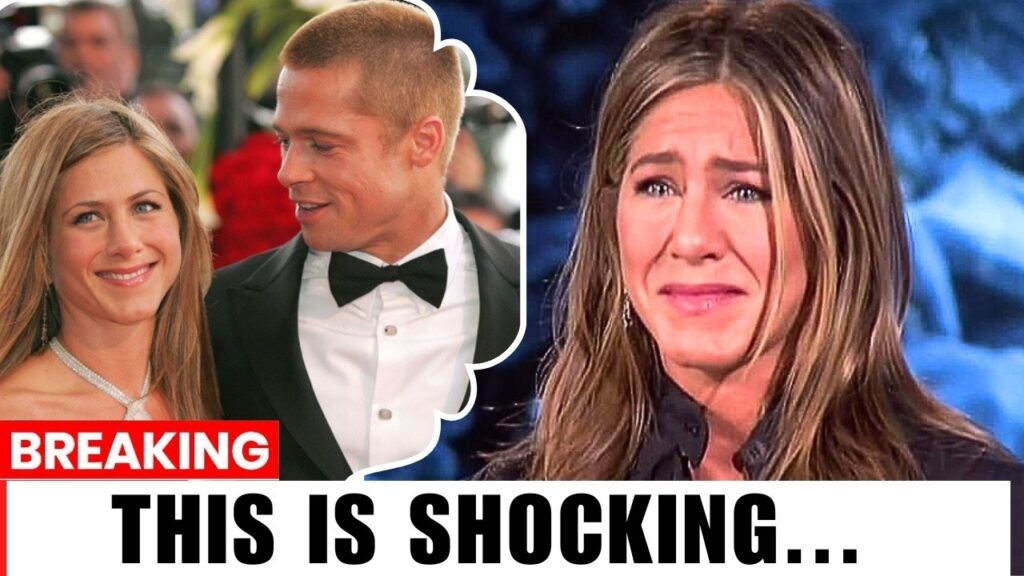
At 56, Jennifer Aniston Finally Admits the Truth About His Marriage to Brad Pitt
[Music] Jennifer Aniston, the girl born beneath the radiant skies of Los Angeles, learned far too early that love can disappear without warning. A living symbol of beauty, grace, and resilience, she has been etched into the collective memory of popular culture through her iconic role as Rachel Green in Friends. She is not merely America’s sweetheart, but the heartbeat of an entire generation, where every radiant smile concealed a crack, and every graceful step was taken upon the shattered glass of private pain. Every laugh she gave was an act of defiance against despair. every hidden tier a hymn of survival until fame itself bowed before her quiet endurance. A woman the nation has long praised as an angel. Brad Pitt, the boy from Missouri’s quiet fields and the soft echo of church bells, carried silence like a shadow that never left his side. Both a symbol of glory and a monument of tragedy, he has been Hollywood’s golden boy for decades. The man every woman desired, the actor every director dreamed of. The face adored by thousands of magazines. With a single appearance, he could steal a room. A man who seemed to have everything. Beauty, wealth, fame, and love affairs that mesmerized the world. Yet behind the applause echoed a truth he could never escape. The love of others could not heal a heart that had never truly known rest. When Jennifer and Brad met, it was not mere attraction. It was an alchemy of destiny. The golden girl of America who had spent her life searching for safety met the golden boy of Hollywood who had spent his life running from peace. They were like two mirrors reflecting the same fracture. so beautiful that the world believed love could conquer anything. Their wedding in Malibu was not a ceremony, but a coronation where fire met water, laughter met longing, and two wounded souls dared to believe that the world could never bring them down. For years, they stood like twin constellations, shining so brightly that even the most doubtful hearts began to believe that forever was real. But how long does forever last? The world was stunned as their marriage collapsed and heartbreak closed in. Now at 56 and 61, they walk separate roads. She the emblem of gentle strength. He the monument of remorse. And somewhere in the hush between applause and memory, Jennifer Aniston has finally spoken a quiet truth about their marriage. Before we begin, if their journey has ever touched your heart, leave a like. As a tribute to two souls who have weathered storms few could ever endure. Before the laughter that made the world fall in love. Before the marriage that once crowned her Hollywood’s golden girl. Before the fame that glittered brighter than her pain. There was only a little girl barefoot in spirit holding her breath. Learning too soon that even love could vanish without warning. Behind every golden name lies a truth far less radiant. And for Jennifer Joanna Aniston, born on February 11th, 1969 in Sherman Oaks, Los Angeles, the shimmer of her Hollywood lineage could never hide the fractures beneath. Long before the world adored her as Rachel Green and Friends, she was simply a quiet child, standing between the light of cameras and the shadows at home. Her father, John Aniston, a Greek-born actor with a commanding presence, and her mother, Nancy Dao, a striking beauty of Italian, English, and Irish descent, gave her heritage, but not harmony. Her godfather, the legendary Telly Savilus, added another stroke of glamour, but fame, she would later say, was something that surrounded me, not something that filled me. When she was just a toddler, her father’s career pulled the family to New York. The skyscrapers dazzled her, yet the light could not reach the chill that settled in their apartment walls. By 9, the cracks in her parents’ marriage had widened into a chasm. One evening, her father left, not for work, but from her daily life altogether. “It wasn’t the leaving,” she whispered years later. It was the silence afterward that was the hardest. In that silence, she learned the first cruel rule of her life. Love can disappear without a sound, and the world keeps turning as if nothing broke. At home, her mother’s pursuit of perfection became a second storm. comments about her weight, her posture, her hair, meant perhaps as guidance felt like tiny blades to a girl starving for tenderness. So she learned another lesson. If she could make them laugh, maybe they wouldn’t see her ache. Humor became her armor, performance, her shelter. Life was not golden. It was a string of quiet humiliations and small survivals. Money was scarce, tempers shorter. And when success finally knocked, the past returned with its crulest echo. In 1996, her mother stepped onto national television, revealing private wounds that were never hers to tell. Two years later came the book, From Mother and Daughter to Friends, a memoir that turned trust into spectacle. To Jennifer, it wasn’t merely betrayal. It was exposure under the harshest lights. For 15 long years, mother and daughter would barely speak. Some things, she admitted later, take a long time to heal, if they ever do. Those early storms, a father’s quiet departure, a mother’s piercing expectations, a public heartbreak disguised as family, forged Jennifer into something the world rarely sees. A woman who transformed her pain into grace. Beneath the laughter that defined a generation still lives that little girl, the one who learned to smile so no one would notice she was breaking. The world saw beauty, poise, the radiant ease of America’s sweetheart. What it never saw was the invisible war behind her eyes. The child who longed to be held and the woman who learned to hold herself. From that battlefield, she built a fortress, not of stone, but of light. And within it, she became one of Hollywood’s most admired and enduring souls. And maybe that is her quiet triumph. That from the silence which once crushed her, she built a voice strong enough to make the whole world listen. If Jennifer’s childhood was marked by love that vanished without warning, Brads began in silence. The kind that teaches a boy to smile while he’s breaking and to mistake stillness for strength. Every tragedy has roots and Brad Pitts were planted deep in the still wind stirred streets of Springfield, Missouri. Born on December 18th, 1963 in Shaune, Oklahoma, and raised as the eldest child of a devout Baptist family, he grew up in a home that worshiped order more than expression. His father, William, ran a trucking business with an unbending sense of duty. His mother, Jane, was kind and faithful. But even her warmth lived within lines drawn too tight. To the outside world, their life was wholesome. Inside, for a boy as tender as Brad, it was heless. By six, he already knew how to measure each word. By 10, he had perfected the mask. the charming, athletic kid who lit up a room while his own heart learned to hide in the corners. He would later admit almost in a whisper, “I grew up hiding behind a smile.” That confession carried the weight of a thousand uncried tears. The loneliness of a child praised for his manners yet unseen in his quiet ache. Growing up in a house where faith was sacred, but feelings were forbidden. In church pews, he sat so that even breathing felt like rebellion. At school, he ran faster, laughed louder, desperate to prove that belonging was possible. And at night, when the house fell still, he would lie awake, tracing the cracks on the ceiling like unanswered prayers, wondering if anyone truly saw him. The world saw brightness, a golden boy with an easy laugh. But inside him lived the restlessness of someone already aching for gentleness that never came. That contradiction, radiant from afar, uncertain up close, became the quiet curse of his life. Loved by millions, yet still searching for the simple safety of being understood. At 13, when other boys were testing limits, Brad was already guarding himself from them. He later called those years a map with no room for detours, as if his very soul had been drawn inside lines too narrow to breathe. Yet from that confinement, hunger was born. The desperate need to break free, to feel without fear, to live beyond the script others wrote for him. That hunger carried him beyond Missouri’s borders into acting. The fragile magic where pretending became the only safe way to tell the truth. Decades later, standing in a room filled with applause, he would sometimes feel the same Missouri silence pressing against his ribs. Proof that even glory can echo like loneliness. Perhaps that’s why he spent a lifetime chasing love gentle enough to quiet that silence and fierce enough to stay. It was there in that small Midwestern home that the blueprint of Brad Pitt’s life was drawn. A boy taught to dazzle in public and ache in private, to wear charm as armor and still long for tenderness. And when the cameras flashed, when the world called his name, he sometimes caught his reflection and saw that boy again. The one who smiled too hard, prayed too quietly, and never stopped waiting for someone to tell him it was finally safe to just breathe. And while Brad learned to hide his pain in silence, Jennifer learned to turn hers into sound. the fragile beginning of a voice the world would one day recognize. In the quiet corners of her childhood, long before the world knew her name, Jennifer found her first refuge, a tattered notebook, a handful of dreams, and the fragile belief that stories could save her. While other children filled playgrounds with laughter, she hid within daydreams, scribbling little worlds where love stayed and no one left without goodbye. By six, imagination had become her only safe place, a secret stage where she could become anyone, anywhere, free from the fractures at home. Her parents enrolled her at the Waldorf School, a small sanctuary that taught creativity not as rebellion but as survival. There she discovered something sacred. That storytelling could turn pain into purpose. That performance could be more than escape. It could be healing. At 14, she stepped into the world that would define her. LaGuardia High School of Performing Arts. Under the watchful eyes of acting coach Anthony Abison, Jennifer learned the lesson that would shape her craft forever. Real acting isn’t pretending. It’s standing unguarded and letting the world see your soul. In dim rehearsal rooms, smelling faintly of dust and paint, she fought both fear and belonging. I just wanted to belong somewhere, she would later say, her voice softened by the ache of memory. But after graduating in 1987, the dream gave way to struggle. There were no red carpets, only telemarketing scripts, diner aprons, and long bicycle rides through Manhattan’s hard rain. Each odd job bought her a single audition. Each rejection another night questioning if the little girl who once escaped into stories had believed too much in magic. From Mac and me to half-lit commercials and forgotten pilots, she gathered crumbs of hope from a city that barely looked up. Maybe this isn’t for me, she once whispered. But even in that doubt, she kept showing up. And then fate arrived disguised as ordinary. One afternoon at a Los Angeles gas station, she met Warren Littlefield, the NBC executive who would unknowingly change her life. His words were simple. Don’t quit. You have something. For Jennifer, they were sunlight after years of cloud. That something became friends. When she walked into the NBC audition room in 1994, she had no idea she was stepping into immortality. She read for Monica, but destiny, or perhaps mercy, chose differently. Rachel Green became hers. As if the role had been waiting for her since childhood. Her wit, warmth, and unguarded humor melted through the screen. Audiences didn’t just watch her, they felt her. For 10 years, friends didn’t just dominate television. It defined an era. The Ross and Rachel love story became myth. And Jennifer, America’s sweetheart. Yet behind the laughter and the milliondoll smiles lived. Exhaustion few ever saw. Every haircut, every outfit, every romance was dissected. Every private moment turned into spectacle. Fame wrapped her in gold, but the light burned, too. She often said, “Fame is warmth and fire, and both can leave scars.” By 2002, she broke from her own legend with The Good Girl, stripping away glamour to show raw, trembling humanity. Critics gasped. Jennifer Aniston, the sitcom Darling, had become an artist. Then came Bruce Almighty, The Breakup, Marley and Me, hits that mingled comedy and heartbreak, laughter and loss. Each performance was a rebellion, each tear a quiet reminder. She was more than Rachel Green. When she returned to television in 2019 with The Morning Show, it wasn’t a comeback. It was a reclamation. As both star and producer, she poured her decades of survival into a story about truth and endurance in a world that often breaks both. The awards mattered less than what it meant. Jennifer Aniston had come home not to fame, but to herself. Today, she stands not as the girl who escaped pain through stories, but as the woman who turned those stories into survival. And though the world may still see her as a symbol of grace and beauty, the truest part of her remains the little girl in the corner, scribbling light out of loneliness. Proof that even from the quietest wounds, brilliance can bloom. And while Jennifer turned her pain into purpose, Brad turned his into pursuit, chasing not fame, but freedom, desperate to prove he was more than the silence that made him. Acting became his rebellion, his refuge, and in time his ruin. When Brad Pitt packed his battered Datson in 1986 and drove west, he wasn’t just leaving Missouri. He was fleeing invisibility itself. The quiet had become a cage, the politeness, a prison. I just felt it was out there for me. He’d recall years later. But what was it? Maybe breath, maybe the right to be seen. He was 23, two credits short of graduation, clutching a few cassette tapes, a bag of clothes, and $325, the sum total of a dream. The road to Los Angeles was not paved with hope, but with hunger, the kind that devours you if you stay still. He waited tables, delivered refrigerators, chauffeurred strangers to homes he would never live in, and sweated inside a chicken suit, waving at passing cars just to stay afloat. Each dollar peeled away a layer of pride. Yet every hour in Roy London’s acting class stitched a fragment of his soul back together. That class saved me, Brad would later say. It was the first time I was allowed to feel. And sometimes when the nights in Los Angeles felt endless, he would whisper to himself, “Don’t let them silence you again.” Hollywood opened its doors like a mirage, glittering, then cruy vanishing. Between 1987 and 1990, he drifted through small guest roles in Dallas, Growing Pains, and 21 Jump Street, A Face, Never a Name. But then came Thelma and Louise in 1991. 15 minutes that would both crown and curse him. With sunbleleached hair and an easy grin, he became the obsession of a generation. His face papered bedroom walls. His name turned into currency. Yet behind that golden glow, unease grew. “I was uncomfortable with that label,” he admitted softly. I wanted to be taken seriously. The role that opened Hollywood’s gates also locked him inside its most beautiful cage. He had escaped Missouri’s silence only to be trapped again. This time behind his own reflection. The world saw a golden god. Brad saw a man still begging to be seen for his soul. Sometimes in the quiet after premieres, he would catch his reflection in a darkened window. And behind the man everyone adored, he swore he could still see that Missouri boy staring back, waiting for permission to breathe. The years that followed were dazzling and devastating. A river runs through it revealed his depth. Legends of the fall made him myth. Caesan exposed his darkness and Fight Club immortalized him. By 40, Troy had turned him into a living monument. Paid millions, worshiped by millions, yet privately hollow. I was uncomfortable in my own skin, he confessed. I spent years hiding behind alcohol. With Jennifer Aniston, he built Plan B Entertainment, a studio that told stories meant to heal the world. But even as those films won Oscars, their producer came home to silence. Every trophy gleamed, but every night grew dimmer. Sometimes after the applause faded, he’d walk through his quiet house, past portraits of himself, frozen in triumph, and whisper, “If only success could hold me the way failure once did.” When he finally stood on the Oscar stage in 2019, golden statue in hand, the world saw victory. But when the lights dimmed, the ache returned. “Fame is not freedom,” he said once. “For years, it was a cage.” “That is the cruel symmetry of Brad Pitt’s life. Every spotlight cast a shadow. Every triumph reopened an old wound. He became everything the world dreamed of. And yet the boy from Missouri still stands behind the glass, staring out, wondering if anyone truly sees him. His tragedy was never failure. It was brilliance. So bright it burned, so boundless it left him utterly alone. Long before Brad Pitt ever walked into her life, before magazine covers crowned her America’s sweetheart, or Hollywood hailed her as its golden girl, Jennifer Aniston had already placed her heart, her hope, and her faith in another man, and watched it all shatter quietly, not in betrayal, but in silence. His name was Tate Donovan. He wasn’t just a love. He was the calm she had been searching for since childhood. Older, grounded, kind in a way that felt safe. They met in 1995 when Jennifer was the rising star of Friends and Tate, an established actor seemed to carry the steadiness she’d always craved. Together, they were serenity in a city that rarely offered it. He made her laugh without asking for the spotlight. She in turn made him believe in the simple beauty of coming home. Friends remember them as inseparable. Dinners on the balcony, long drives with music humming low. Laughter that filled the room like sunlight through open curtains. For Jennifer, it wasn’t glamour. It was peace. For once, she wasn’t performing. She was simply being. I thought he was it. She would later say, “I really did. I thought this was the man I’d marry.” For three years, their love felt unshakable. They were the couple who made others believe in something lasting. When she spoke of him, her voice softened. When he looked at her, he did it with quiet admiration, as if he couldn’t quite believe she had chosen him. But Hollywood has a cruel way of testing the tender-hearted. Their careers pulled them in opposite directions. Endless filming schedules, nights spent apart, and the growing weight of fame that neither of them had asked for. Still, they tried. They kept showing up. Kept pretending everything was fine. Even as the laughter came less often, what began as silence between takes slowly became silence between them. By 1998, love had turned into ache, and both could feel the fracture widening. Tate, though deeply in love, admitted he wasn’t ready to marry. Jennifer, who had spent her life yearning for something lasting, felt that old fear resurface, that love, no matter how deep, could still disappear without warning. The breakup came softly with no scandal, no shouting, only a slow unraveling that left both of them staring at what they could no longer hold. And then fate played its crulest trick. Months after they ended, Tate Donovan was cast in Friends as Joshua, Rachel Green’s new love interest. Every week before millions of viewers, they had to act like they were falling in love while privately falling apart. “It was awful,” Jennifer later admitted. “We were breaking up in real life while pretending to fall in love on TV.” Tate echoed her words years later. “It was horrible. The hardest thing I’ve ever done.” Beneath the laughter of the live audience, two hearts were quietly breaking, their pain hidden in plain sight. Sometimes she would finish a scene, smile for the crowd, then walk back to her dressing room and sit in silence, wondering how something that once felt so right could end so quietly. Years later, when asked about him, she smiled with a sadness that never quite left her eyes. Some people, she said softly, you never stop caring about. You just learn to live without them. That was Jennifer’s first great heartbreak. Not loud, not cruel, but devastating in its stillness. It taught her that even love built on kindness can crumble under the weight of timing. It was the wound that would shape her forever. the quiet rehearsal for all the heartbreaks that followed. And the reason why, when Brad Pitt entered her life not long after, she dared to believe that maybe, just maybe, this time, love would stay. While Jennifer was still nursing the quiet ache of a love that slipped through her fingers, Brad was stepping into a fire he believed was destiny. A love so brilliant it blinded him to the shadows gathering beneath it. When the spotlight dimmed and the applause faded, what remained was not Hollywood’s golden boy, but a man standing in the ashes of the love he thought would save him. They met in 1994 on the set of Sevanin. Two stars at the dawn of legend. Both too young to know that sometimes the light that brings you together will one day burn you apart. Brad was 30, grounded, searching for something real beyond the noise of fame. Gwyneth was 22, ethereal and fearless, carrying the kind of innocence that makes even the most guarded man believe again. On set, their chemistry was unmistakable, quiet, organic, effortless. He was so open, so gentle. She later said it felt safe. And for Brad, who had spent a lifetime performing strength while craving tenderness, Gwyneth was the answer to every silent prayer. For the first time, he let someone see the man behind the myth. They became inseparable, traveling together, laughing in grocery aisles, disappearing from premiieres to chase sunsets no one else saw. He called her the love of my life. She called him home. In 1996, he proposed, and the world applauded as Hollywood’s golden boy found his golden girl. It looked eternal. But the brighter a flame, the quicker it consumes itself. Beneath the perfection, cracks began to form, not from betrayal, but from fear. Gwyneth, still in her early 20s, confessed years later, “I wasn’t ready. I was a kid pretending to be a woman. She loved him deeply. But the weight of expectation, the eyes, the headlines, the destiny the world had written for them became too heavy to carry. Brad, ready to settle, didn’t know how to hold someone who needed to run. So, one quiet evening in 1997, she ended the engagement. There was no fight, no villain, only silence. the kind Brad knew too well. He disappeared from the public eye for months. Friends said he walked through rooms like a ghost, his usual warmth replaced by a haunted stillness. Later, when asked, he said softly. It hurts when you lose the person you thought you’d grow old with. Years later, Gwyneth would call it the mistake of her life. He was too good for me. I messed up. But by then, the damage was done. Brad had learned the crulest lesson of love. That even the purest hearts can’t save each other if they’re not ready to be held. What remained wasn’t bitterness, but a quiet scar, a hollow where trust used to live. From that silence, he would rebuild himself again, layer by layer, learning not to chase fire, but to search for peace. And when peace finally came in the form of a warm, gentle smile named Jennifer Aniston, Brad believed just for a moment that maybe love could still be safe. He couldn’t have known then that the peace he found would one day become another storm. When two souls carrying different kinds of silence finally found each other, the world called it destiny. And for a while, it truly was. Brad Pitt and Jennifer Aniston didn’t just fall in love. They built something quieter, rarer, a home, not a headline. They met in 1998 through friends, both standing at the edge of exhaustion. He still carrying the bruises of a love that had burned him hollow. She still mending from years of laughter that hid loneliness. Neither expected salvation, yet somehow they became it for each other. Their love began not in thunder, but in stillness. Shared glances over dinners with friends, long talks that slipped past midnight. The kind of laughter that makes you forget how much you’ve been holding in. It was easy. Jennifer would later say, “We just understood each other without trying.” To Brad, she wasn’t Hollywood’s sweetheart. She was sunlight, breaking through a life that had been gray for too long. To Jennifer, he wasn’t the golden boy. He was warmth, safety, and the rare kind of man who listened before he spoke. They made ordinary things sacred. Coffee in the kitchen, handwritten notes on mirrors, Sunday mornings without makeup or pretenses. Friends said they glowed differently together. Not because of fame, but because for once they both looked at peace. I remember thinking, Jennifer once recalled, “So this is what home feels like.” By 2000, that private love had become the world’s favorite fairy tale. Their Malibu wedding wasn’t just a ceremony. It was cinema come to life. 200 guests, 50,000 flowers, gospel choirs floating into the Pacific dusk. Fireworks burst across the night sky as if heaven itself had been waiting for this union. Jennifer, radiant in beaded silk, walked down the aisle with eyes full of belief, not in fantasy, but in something real. Brad waiting for her beneath a canopy of light smiled the kind of smile that can silence a crowd. It was beautiful, she would say years later. Everything we wanted. They built a life that looked effortless, a house filled with art, music, and dreams of the family they hoped to grow. In quiet interviews, she spoke of children with a softness that made headlines melt. I can’t wait,” she said once, her eyes shining. “He’ll be the best dad.” And he smiled, brushing a strand of her hair and whispering, “Someday.” That someday became their shared promise. A future they both believed time would deliver. Together, they founded Plan B Entertainment, pouring heart and hope into stories that mattered. On red carpets they held hands not for the cameras but because it was instinct, one reaching for the other like breath. To the world they were perfect, but to each other they were something far rarer. Two wounded souls who had finally found rest. For a while even the world believed it. that love, real love, could survive the storm of fame. And so did they. Even the brightest stars cast the darkest shadows. Behind the flashbulbs and the perfect smiles, a silence began to grow. Slow, invisible, merciless. Jennifer longed for motherhood. She imagined the scent of baby powder mixing with morning coffee. little footsteps echoing down hallways bathed in sunlight. Brad had once joked about having maybe seven kids, and she had laughed, believing someday wasn’t a dream, but a promise. But someday kept slipping away. Months bled into years, and every magazine cover became another wound. The world watched her body like it was public property, circling her stomach, counting pounds, speculating on fertility. “There comes a point when you can’t not hear it,” she told Harper’s Bizarre UK decades later. “They said I didn’t want a baby because I was selfish, a workaholic.” “It does affect you.” What the world never knew was that behind closed doors, she was fighting a private war. There were nights she drove home from another failed doctor’s visit in tears, whispering to herself that next time would work. “We tried. We really tried,” she said years later. Multiple rounds of IVF, hormone shots, sleepless nights, and prayers whispered into the dark. hope rising and collapsing like a tide. When she finally admitted, “I wish I’d frozen my eggs. I thought there was still time.” The regret in her voice wasn’t vanity. It was the quiet heartbreak of a woman who had believed love and life would wait for her. And as her body became a battlefield, another silence began to settle between them. Brad, restless and searching for air, started to drift toward a different kind of fire. Hollywood was roaring his name louder than ever. And on the set of Mr. and Mrs. Smith, destiny, or perhaps misfortune, arrived in the shape of Angelina Jolie. What began as fiction turned into foreshadowing. Cameras captured more than chemistry. They caught the first tremors of an earthquake. Tabloids exploded. Grainy stills of Brad and Angelina laughing between takes. Anonymous sources hinting at something more. Every image felt like a tiny betrayal. There’s a sensitivity chip missing, Jennifer said softly. Not as accusation, but disbelief. She never shouted, never named, never fought back. Instead, she carried her pain with the grace of someone who knew the world was already watching too closely. “It wasn’t just losing a husband,” she confided later. “It was losing the life I thought we were building, the forever I believed in.” Behind closed doors, she walked through rooms that still smelled of him, his books, his shirts, their photographs. The laughter that once filled their home had been replaced by the hum of news anchors dissecting her heartbreak. Strangers argued over her womb, her worth, her womanhood. Yet even in the storm, she stood still. No public outburst, no bitterness, only silence. A silence that the world mistook for strength, but was in truth the sound of someone breaking beautifully. When their separation was announced in January 2005, the world seemed to stop breathing. For millions who had grown up watching them hand in hand on red carpets, Brad and Jennifer weren’t just a couple. They were proof that love could survive fame, chaos, and the glare of the spotlight. For 5 years, they had been Hollywood’s heartbeat. the golden pair who made happily ever after seem possible again. So when the news broke, it felt like something sacred had cracked. News anchors spoke in whispers. Headlines screamed louder than grief itself, and fans lit up message boards as though mourning the end of an era. She became the face of heartbreak, her pain dissected, her dignity turned into public property. He, the man once idolized, became the villain in a story no one fully understood. But beneath the noise, two people were simply grieving. The end of a marriage, the death of a dream. We ended beautifully, Jennifer said later, her voice steady but soft. This marriage was very successful until it wasn’t. There was no courtroom war, no bitter interview, no blame, just quiet. Just two people too weary to hurt each other further, choosing peace instead of punishment. Brad would later whisper what the world never forgot. I love that woman. I always will. When they divided their lives, Jennifer took her home, her dogs, and the sanctuary she had built with her own hands. Brad kept the vineyard in France, the dream they once shared, imagining children running barefoot between grape vines. It was supposed to be full of laughter, she once said quietly. But some dreams stay empty. No legal war, no scandal, only stillness. She filled her house with friends and light. But at night, when the cameras stopped flashing, the silence pressed harder. Years passed, and from afar, Jennifer watched his new life bloom in photographs that seemed almost scripted by fate. Six children, their faces lit by the kind of joy she had once prayed would fill her own home. Family portraits splashed across magazine covers. laughter spilling from frames that should have been private but now belong to the world. “There were days I didn’t recognize myself,” she confessed quietly years later. “You can have everything and still feel hollow.” She had dreamed of lullabies once, of small hands tugging at her sleeve, of birthdays and scraped knees, of stories told under warm lamplight. She had tried more than the world ever knew. Doctors, procedures, whispered prayers in sterile rooms, hope written on test results that never turned positive. In interviews long after the world had stopped asking, she spoke without bitterness. I wish someone had told me back then. Freeze your eggs. Don’t wait. That confession, so simple, broke millions of hearts. Not because it was regret, but because it was truth. While Brad’s home was filled with the noise of six children, Maddox, Pax, Zahara, Shiloh, Knox, and Viven, Jennifer’s remained quiet, saved for the soft footsteps of her dogs and the gentle hum of work. To the tabloids, she was childless. To herself, she was simply unfinished. A woman who had loved deeply, tried bravely, and lost quietly. Yet through it all, she never lashed out. Not once. Her silence became her shield, her dignity, her defiance. Then came 2016, the year the story turned. The world watched as Brad’s second marriage, once the most envied on earth, began to crack beneath the weight of fame, exhaustion, and years of unspoken distance. Headlines erupted again. Custody battles, courtrooms, sorrow spilling where love once lived. For Jennifer, the easy reaction would have been vindication. But she said nothing. No bitterness, no satisfaction. No, I told you so. Only grace. When asked, she simply said, “I wish them peace.” Because by then she had learned the hardest truth of all, that pain is not something to pass on, but something to rise above. While the world dissected his downfall, Jennifer chose compassion. She understood that what destroys one home can haunt another. She had lived that silence, survived that loss, and refused to become its echo. And in that quiet grace, that refusal to hate, that choice to heal, she became something rarer than fame, rarer than beauty. She became an example, a woman who had every reason to turn bitter and instead turned luminous. Hollywood has many legends but very few lessons. Jennifer Aniston became both 15 years after their divorce. Time that patient sculptor softened what fame had shattered. In 2020, backstage at an award show, fate allowed them to meet again. Cameras caught it. The brief touch of hands, the shared laugh, the kind of warmth that lives only between people who have truly forgiven each other. The internet exploded, hungry for a fairy tale to rise again. But what they saw wasn’t romance. It was redemption. Jennifer later said, “There’s nothing but love between us.” And Brad, smiling that same quiet smile from 1998, seemed to agree. Not with longing, but with gratitude. Gratitude for what they had, for what they lost, and for the way they chose to let each other go without cruelty. The world saw two people who had walked through fire and come out kinder. Perhaps that is the cruel beauty of their story, that it began as peace, became chaos, and ended in quiet understanding. They loved as only two wounded souls can, fiercely, imperfectly, completely. And though forever didn’t last, what they left behind was something rarer than endurance, respect. Because sometimes the greatest love stories aren’t the ones that last. They’re the ones that teach us how to lose with grace, how to forgive without pride, and how to remember without pain. Now at 61, Brad Pitt and 56-year-old Jennifer Aniston live beneath the same California sky. Not as husband and wife, not as the golden couple they once were, but as two souls who have walked through fire and rebuilt their peace from the ashes. Their love story may have ended, but their lives remain quietly intertwined. two halves of a Hollywood legend that still glows. Softer now, but never dim. When their separation was announced in January 2005, the world seemed to stop breathing. For millions, Brad and Jennifer weren’t just two celebrities. They were a promise, proof that love could survive fame. Their split felt like sunlight fading from a room you thought would always be bright. But even in heartbreak, they refused to turn it into war. “We ended beautifully,” Jennifer said later. “This marriage was very successful until it wasn’t.” There were no screaming interviews, no courtroom battles, no accusations, just two people who had once loved deeply, now too tired to hurt each other anymore. At the time of their divorce, their combined net worth exceeded 120 million. Yet the division of their empire was handled with grace rarely seen in Hollywood. Brad retained ownership of Plan B Entertainment, the production company they had founded together, one that would later go on to produce 12 Years a Slave, The Big Short, and Moonlight, winning Oscars and reshaping modern cinema. Jennifer received financial compensation equal to her stake, and kept control of several prime California estates, including their Beverly Hills home, purchased for $13 million in 2001. That same house, the symbol of their shared dreams, was later sold for nearly 29 million, its marble floors and sundrenched courtyards, now belonging to strangers. Jennifer kept her art, her dogs, and her peace. Brad kept the vineyard they once dreamed of filling with children’s laughter. A dream that would never come to pass. It was supposed to be full of laughter, Jennifer once said softly. But some dreams stay empty. They signed the papers, exchanged quiet goodbyes, and walked away, not as enemies, but as two weary souls choosing grace over resentment. Jennifer Aniston’s life today is a masterpiece of calm. Not built from what she lost, but from what she created. With a net worth of 320 million, she remains one of Hollywood’s most enduring icons. not for her fame, but for her composure. She still earns over $20 million annually through acting and partnerships with Aino, Smartwater, L’Oreal, Vital Proteins, and Emirates. Her home in Bair, purchased in 2011 for $21 million, is her Fortress of Serenity, a blend of glass, stone, and light designed with her longtime collaborator Steven Shadley. It’s where she once married Justin Theorough and later where she learned to live alone again. She also owns a $14 million farmhouse in Monteceito, once Oprah Winfries, where she spends weekends surrounded by olive trees, dogs, and ocean air. Before that came the Ohana House, bought for $13 million and sold for $42 million. proof that she builds beauty even from endings. Her garage gleams with understated luxury. A Bentley Continental GT, a Range Rover, and a Jeep Wrangler. But she rarely drives far. Most of her days unfold within her gardens, her yoga studio, or the sunlit kitchen where she cooks for friends. She has made peace with the life she has, even if it isn’t the one she imagined. After years of tabloid cruelty, she revealed in 2022 that she had undergone multiple IVF treatments and faced heartbreaking failures. In a whisper that broke millions of hearts, she said, “I wish someone had told me back then, “Freeze your eggs. Don’t wait.” While Brad’s home once echoed with the laughter of six children, Jennifer’s remains quiet, saved for the soft footsteps of her dogs, and the hum of her thoughts. She donates generously to St. Jude’s Children’s Hospital, Friends of Al Farro, and animal rescue foundations, never seeking attention for it, she has stopped chasing forever. Now she chooses real moments, not promises. Her peace isn’t loud. It’s deliberate, earned through years of heartbreak and healing. And while Jennifer built peace, Brad built silence. His net worth now surpasses 400 million. But his true wealth, the kind that fills rooms with laughter, has long slipped away. His homes are grand, his possessions enviable, but the quiet inside them is profound. Brad lives in a $12 million Los Angeles mansion, a sleek architectural retreat high in the Hollywood Hills. He often shares it with Enz Ramon, the jewelry designer who entered his life in 2024, offering gentle companionship in his loneliest chapter. He also owns the DL James house in Carmel, worth over $40 million, a limestone masterpiece carved into the cliffs above the Pacific. His former Los estate was sold in 2023 for $39 million. And the Beverly Hills home he once shared with Jennifer long ago became someone else’s dream. But the vineyard Chatau Miraaval in France where he married Angelina Jolie in 2014 still looms like a ghost. Once their sanctuary, it is now a battlefield of lawsuits and headlines. Brad’s collection of cars and art reads like a catalog of privilege. A Porsche Takon, Tesla Model S, Cadillac Escalade, vintage Harley’s, and a Cirrus SR22 airplane he pilots himself. He collects Rodan sculptures, Bascia paintings, and Banksy works, but they cannot fill the silence left by his children’s absence. He has six, Maddox, Pax, Zahara, Shiloh, Knox, and Vivien, but most are distant, some estranged. In 2024, Shiloh legally dropped his surname. “I hit the lottery with my kids,” he once said quietly. “And then I wasted it. Still, Brad continues to work. Through Plan B Entertainment, he produces films that reflect humanity’s pain and resilience, the same traits that now define his own life. His health is better. He is sober, practices yoga, and maintains a Mediterranean diet. He still suffers from proopagnosia, face blindness, which makes him unable to recognize familiar faces. People think I’m cold, he said once. But I just can’t remember faces. Yet even in the ruins, Brad endures. He donates millions quietly to Make It Right Foundation, to disaster relief, to rebuilding homes in New Orleans. He still acts, still creates, still wakes up every morning to try again. The Golden Boy became human. And in that humanity, somehow he became greater. In the end, Jennifer found peace without revenge. Brad found humility without breaking. Their roads diverged long ago, but both discovered the same truth in different ways. Fame is not freedom, and love, no matter how bright, cannot save you from yourself. They are no longer the golden couple. They are something far more human. Two people who had everything, lost everything, and still rose. One in quiet light, the other in quiet shadow. And perhaps that is the lesson they leave behind. That true victory is not in how perfectly you love, but in how gracefully you let go. So tell us, whose journey touched you more? the woman who turned heartbreak into peace or the man who learned too late what love truly means. Leave your thoughts below because somewhere out there another soul might need to be reminded that even when the fairy tale ends, life and beauty can still begin again.
At 56, Jennifer Aniston Finally Admits the Truth About His Marriage to Brad Pitt
Jennifer Aniston — the woman once at the heart of Hollywood’s most heartbreaking love story — has spoken again, opening old memories and quiet truths about the marriage that once defined a generation. Jennifer Aniston, forever remembered as Rachel Green in Friends and star of Marley & Me and The Morning Show, now stands as a symbol of grace rising from heartbreak. Her story intertwines with Brad Pitt, the Hollywood legend of Se7en, Fight Club, and Once Upon a Time in Hollywood — and the chapter that began with Mr. & Mrs. Smith, where Angelina Jolie entered the frame and history changed forever. Brad Pitt’s brilliance, Angelina Jolie’s fire, and Jennifer Aniston’s resilience form a story that still captivates the world. This emotional portrait doesn’t seek scandal, but truth — a tribute to love, loss, and the woman who turned pain into quiet power.
#JenniferAniston #hollywoodstars #famousdeaths #celebritynews #celebritystory
6 Comments
Her marriage
not his
This video is captivating from the very first moment — it feels like Jennifer Aniston finally opening a door she kept closed for years. At 56, her admission about her marriage to Brad Pitt isn’t about scandal or blame — it’s about closure, honesty, and the kind of emotional clarity that only time can bring. Their relationship defined an era of Hollywood romance, but what this video reveals is how deeply human their story truly was — full of love, mistakes, and lessons learned the hard way.
What makes this so powerful is Jennifer’s vulnerability. She speaks not as the global superstar we’ve watched for decades, but as a woman who has made peace with her past. There’s no bitterness in her tone — only reflection and quiet acceptance.
This isn’t just gossip; it’s growth. Watching this, you realize that love doesn’t always end in tragedy — sometimes it ends in understanding. And Jennifer’s truth shows that even in heartbreak, grace can still shine through.
This video is deeply captivating — it feels like Jennifer Aniston is finally pulling back the curtain on a story the world has speculated about for decades. At 56, hearing her admit the truth about her marriage to Brad Pitt isn’t about gossip — it’s about closure, honesty, and the emotional cost of living under a microscope. For years, their relationship symbolized the perfect Hollywood love story, but what this video reveals is far more human — a tale of love, loss, and lessons learned through pain.
What makes this moment so powerful is Jennifer’s vulnerability. She speaks with the kind of calm wisdom that only comes after years of healing. There’s no bitterness in her tone — only understanding, as if she’s finally made peace with a chapter that once defined her.
This isn’t just about two celebrities; it’s about the universal truth that even the most beautiful stories can end — and that sometimes, the greatest strength is learning to move on with grace.
One of my favorite actors all-time.
Angelina already ddumped Brad
And you are still talking about your issues.
Move on Jennifer.
A lot of people ,couples go thru their troubles, but none have the talent & millions they have so they don't the everyday trouble, im near broke life didn't work out, these stories r a waste of time so i won't trad anymore