
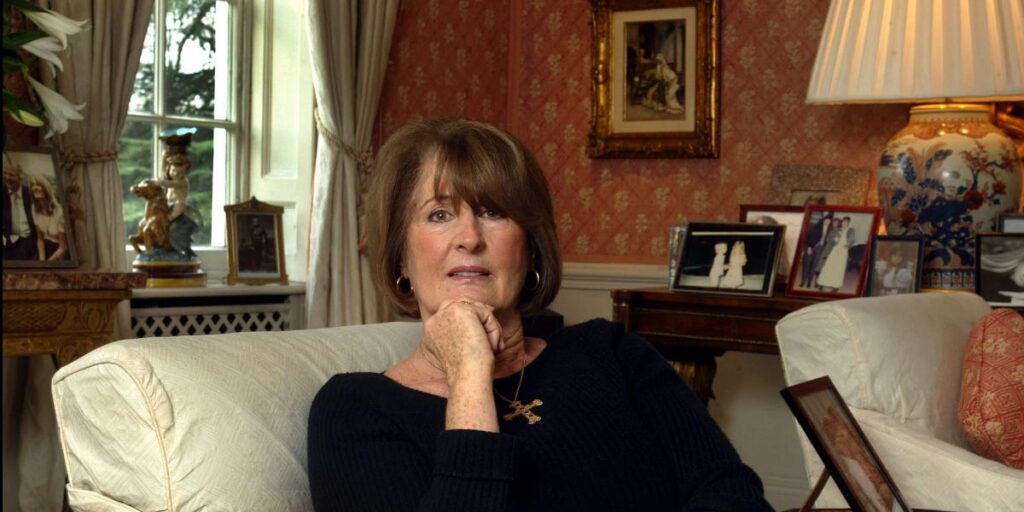
 Lady Annabel Goldsmith in her London home, Ormeley Lodge
“You have me to thank,” Lady Annabel Goldsmith said when we first met. On an evening in late January 1997, we stood in a crowded basement meeting room at St. Columba’s Church in London after a rally for the Referendum Party, the political movement led by her husband, the buccaneer financier, Sir James Goldsmith. Just six hours earlier, he and I had finished a two-hour interview at Laurent, his restaurant in Paris, for an article I was writing about him for Vanity Fair (Billionaire with a Cause). After a speedy train journey on the cross-channel Eurostar, I watched him in action that night, talking to supporters of the mission he had launched in 1994 to give Britain’s citizens the right to vote on their country’s membership in the European Union.
“He usually picks it up”
Jimmy Goldsmith was instinctively wary of the press after years of relentless negative coverage. He famously brought a libel suit against Private Eye, the British satire magazine that nicknamed him “Goldenballs,” likening him to a James Bond villain. I had been reporting my story for several months when Goldsmith’s close adviser and confidant, Charles Filmer, told me an interview would not be possible, just as Goldsmith had turned down requests from The New Yorker and other magazines. That same January day I also spoke to Arnaud de Borchgrave, a flamboyant journalist who managed to be Goldsmith’s friend as well as mine. “I just got off the phone with Jimmy two minutes ago,” he said before giving me Goldsmith’s telephone numbers—in Paris, London, Mexico, and Montjeu, his French chateau. The Montjeu number was best, Arnaud said, because the phone was at his bedside and “he usually picks it up.”
 Telephone messages delivered to me at the Dorchester Hotel in January 1997
Several days later, Annabel answered my call from the Dorchester Hotel to the London number. She courteously listened as I made my case. “He doesn’t like us giving interviews on anything about the family,” she said. But, she told me in a second phone conversation, “I will talk to Jimmy and put it to him myself. I talked to Charles Filmer, so in a sense, all is not lost.” When I subsequently called Montjeu, Goldsmith picked up as predicted, I made my pitch, and we set the date for an interview at his corner table in Laurent. “It’s better that he talk to you and not I,” Annabel said at the Referendum Party rally.
The article appeared in April, and Goldsmith considered it a fair-minded portrait that didn’t stint on his failings. Three months later, he died at sixty-four of pancreatic cancer. Both his wife and his French mistress, Laure Boulay de la Meurthe, were at his bedside when he died. During the time Goldsmith and I spent together in January, he appeared to be in the peak of health and in high spirits: soigne and self-assured, with mesmerizing pale blue eyes and a mischievous, dimpled smile.
 Lady Annabel Goldsmith with Princess Diana at a film premiere in 1989
“I miss her intolerably”
Annabel was shaken again on August 31 by the death of Diana, Princess of Wales, with whom she had a close friendship since a momentous night in 1989. “Diana and I go back a long way,” Annabel told me when I reached her in mid-November 1997. “She came every weekend for lunch. I miss her intolerably. She was like a little girl with me. I was totally invaluable to her.” Now I was doing research for a biography of the Princess of Wales, and Annabel agreed to meet me for lunch and have a conversation about her. “If it hadn’t been for the Jimmy piece, I would never talk to you,” Annabel said.