
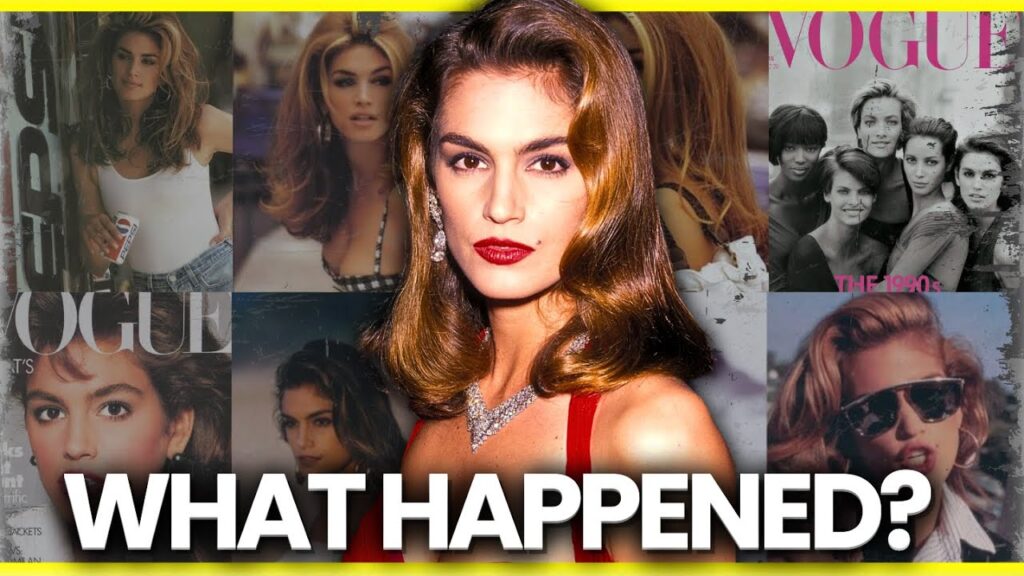
America’s Most Famous Supermodel Who Left It All Behind – Cindy Crawford
How do you become the most famous woman in America and then walk away at 34? Cindy Crawford wasn’t just a model. She was the American supermodel. The Revlon deals, the MTV show, the face on every magazine cover. I’m like, well, I mean, what do models do? Well, we wear clothes. Well, I mean, I better look good. Like, Super Bowl Sunday, 1992, one Pepsi commercial. And suddenly, she wasn’t just in fashion anymore. She was pop culture. But Cindy’s story was never just about being beautiful. It was about control. While the industry tried to treat her like a product, she treated herself like a business. And that came with a cost. She had everything. But then at 34 years old, she left. And the question nobody asked at the time was why? What makes someone walk away from the very top? Was she pushed out by an industry that was moving on? or did she see something coming that nobody else did? Cindy Crawford’s story didn’t begin on a runway in Paris or in the studios of New York. It began in Dalb, Illinois, surrounded by cornfields in smalltown America. Born February 20th, 1966, she was the daughter of an electrician and a bank teller, about as far from the world of high fashion as you could get. It was an all-American childhood, the kind that felt ordinary on the surface. But beneath that surface was a tragedy that would mark her forever. When Cindy was 8 years old, her younger brother Jeffrey was diagnosed with leukemia. He was just 2 years old. And for the next 2 years, their world revolved around hospital visits and the fragile hope of recovery. Jeffree passed away just before his fourth birthday when Cindy was 10. Decades later in the Supermodels documentary, she would reflect on what that loss meant and how the family handled it. When my brother was sick, I was a child and you don’t want to be a burden. I remember my parents saying like, “We can’t cry because if we cry, Jeff is going to know he’s dying.” So, we didn’t cry. That’s not a normal thing for a child to carry. She said she grew up with a kind of guilt, not just grief, but the feeling that surviving meant you had to earn it. In another interview, she admitted, “I needed to hear, “Yes, we’re so sad that Jeff died, but we’re so happy you’re here.” And of course, my mom didn’t know how to say that. That stayed with her. What that does to a person is important. When people later called Cindy disciplined, controlled, professional, it wasn’t just Midwest work ethic. It was a girl who learned very early that you don’t fall apart in front of people. You hold it together. You make yourself useful. You don’t cause trouble. You perform. School was where she put that. Cindy wasn’t the stereotype of pretty girl gets discovered and leaves chemistry class. She was top of her year. She graduated validictorian. She earned a scholarship to Northwestern University to study chemical engineering. That alone tells you the truth about her. Modeling was not some childhood dream. The plan was stability, a real degree, a future her parents could actually understand. Her father definitely didn’t understand modeling at first. As Cindy later put it, “My dad really didn’t understand that modeling was a real career. He thought modeling was like another name for prostitution. This was the mindset she was coming out of. Modeling wasn’t glamour. Modeling in that world sounded dangerous. The way it started was almost accidental. The summer before college, Cindy was 17 and working detassling corn. A local photographer noticed her and asked to take her picture for the newspaper. That small town newspaper photo changed everything. Agencies in Chicago started calling. Suddenly, there were offers. Not fantasy yet, but possibility. “He took my picture for the local paper,” she said, and the phone just started ringing. From there, it moved fast. She entered Elite’s look of the year competition and won. After one semester into Northwestern, she dropped out and chose modeling full-time. The girl from Dalb, who had been on track to become an engineer, packed up and left for New York City. But here’s where you see the first sign of who Cindy Crawford really was. In those first meetings, people told her to remove the mole above her lip. That mole would become one of the most recognizable features in American pop culture. But at the start it was treated like a flaw. She said no and she kept it. That might seem like a small decision, but it wasn’t. In the 80s, fashion didn’t ask who you were. It told you. Cindy was 18, fresh out of Illinois and already drawing a boundary. You can photograph me, but you don’t get to edit me. By the time she reached New York, she wasn’t some wideeyed newcomer chasing fame. She was conditioned by loss, hardened by proving herself, and already negotiating something most models never could, control. What she didn’t know yet was that fashion had its own rules. You could be smart. You could be prepared. You could be grateful. But to the industry, you were still something to be packaged and sold. And Cindy was about to find out exactly what that felt like. When Cindy arrived in New York in the mid 1980s, fashion was ruled by a European idea of beauty. pale, fragile, and untouchable. Cindy was none of that. She was athletic, confident, unmistakably American. She looked like she could sprint off the runway and run a business meeting right after. Photographer Herb Ritz saw something in her that others hadn’t quite grasped yet. His black and white portraits captured her strength and sensuality in equal measure, a quintessentially American aesthetic. She wasn’t trying to be someone else. She was just Cindy. Those photos circulated through the industry like wildfire. In a matter of months, everyone knew who she was. And so by the late 1980s, she was everywhere. Vogue, Harper’s Bizaarre, Cosmopolitan, hundreds of covers. She walked for Versace, Chanel, Dior. She became part of an elite group that would define an era. Naomi, Christy, Linda, Cindy, the supermodels. But while the others cultivated mystery and high fashion drama, Cindy projected something different. Warmth, intelligence. You felt like you could actually talk to her. And then came the moment that would change everything. MTV’s House of Style. In 1989, Cindy became the host and producer of a show that took viewers behind the scenes of fashion, interviewing designers, crashing photooots, going through closets. For 6 years, she was the guide, the voice, the cool older sister who made fashion accessible to millions of teenagers who had never seen it up close. People felt like they knew her. It made her more than a face in magazines. It made her a voice. It also changed how America saw models. No longer as silent mannequins, but as personalities with opinions, humor, and influence. But visibility always came with a price. The more famous she became, the more people believed they owned a piece of her. There was a moment early in her career that she would look back on with very different eyes decades later. In 1986, at 20 years old, she appeared on the Oprah Winfrey show with elite model management founder John Casablancas. Oprah asked her to stand up and show off her body. “Now this is what I call a body,” Oprah said. Years later in the Supermodels, Cindy reflected on that moment with a clarity that only time and distance could provide. When you look at it through today’s eyes, when Oprah’s like, “Stand up and show me your body.” In the moment, I didn’t recognize it. Only when I looked back at it and I was like, “Oh my gosh, that was so not okay, really.” She also recalled another moment that made her feel powerless when photographer Patrick Dearalier cut her hair into a boyish style without warning her first. “I was so traumatized,” she said. “I really felt I was not seen as a person who had a voice in her own destiny.” These were the lessons of the late8s. Be beautiful. Be quiet. Let others control the narrative. But Cindy was learning something else, too. That if she wanted control, she would have to take it herself. And the moment she did, everything changed. In 1989, Cindy signed a major beauty contract with Revlon, becoming the face of its longrunning most unforgettable women in the world campaign. It wasn’t just another job. It made her one of the highest paid models in the world and cemented her image as the modern American ideal. Powerful, approachable, unmistakable. 2 years later in 1991, she married Richard Gear. They were the ultimate ’90s power couple. And then came the moment that would launch her into another stratosphere entirely. You probably remember it. Super Bowl Sunday, 1992. One Pepsi commercial, 60 seconds long, and suddenly Cindy Crawford wasn’t just a model anymore. She was pop culture. The ad catapulted her beyond fashion. She became an American icon. But behind that image was strategy. Her face was everywhere, from magazine covers to late night TV jokes. Cindy understood her value and ran her career like a business. Years later, she summed it up perfectly. I am the world’s number one expert on Cindy Crawford. To really own that for myself and trust that my instincts about at least my own brand are are the only ones that really matter. She launched swimsuit calendars that sold millions. She released fitness videos that became bestsellers. She wasn’t just a face for hire. She was building an empire. But while Cindy was becoming a household name, something was shifting in the fashion world. By the mid 1990s, the industry was moving in a new direction. Heroine chic had arrived. Kate Moss, Wayfish, androgynous, Detached, the complete opposite of Cindy’s healthy all-American look. High fashion magazine started putting actresses on their covers instead of models. Nicole Kidman, Julia Roberts, Halib Berry. The perception was this. In an industry that values exclusivity and artistic credibility above all else, mainstream success came with a cost. Cindy had become a celebrity, a brand, a businesswoman. She was everywhere. And in fashion, being everywhere can make you less desirable to the inner circle that prizes rarity and mystique. By the late 1990s, she appeared less on high fashion runways, partly because the industry was changing and partly because she chose to focus on other projects. Her personal life was changing, too. In 1995, her marriage to Richard Gear ended in divorce. The fairy tale was over. A few years later, Revlon ended her contract after more than a decade, shifting its focus to a new generation of models and actresses. And then around the year 2000, Cindy made her own choice. She retired from full-time modeling. She was only 34 years old. In later interviews, she said she’d simply checked every box. Modeling no longer challenged her. She’d done every cover, every campaign, every runway. It wasn’t about quitting. It was about moving forward. What became clear by the late 1990s was that Cindy had built something far larger than a modeling career. She had built equity, not just fame. While fashion moved on to its next generation of faces, Cindy was investing in something that didn’t need anyone’s approval. In 1998, she married entrepreneur Randa Gerber. Together, they built a grounded family life and raised two children, Presley and Ka. And while fashion chased its next trend, Cindy was building something that would outlast any runway. She had been building something that didn’t need their permission to succeed. In 2004, she launched Meaningful Beauty, a skincare line created with Dr. Gene Luis Sabog. It wasn’t a vanity project. She co-owned it, helped develop the formulas, and she did it on her terms. I would rather not sell more product but be true to my vision of you know how I want to present myself or what I think is right or wrong because you know and if you do something that you believe in if it works great and if it doesn’t work at least you didn’t compromise yourself. It turned into a business worth hundreds of millions. Around the same time came the Cindy Crawford Home Collection, a furniture line that turned her name into a lifestyle brand sold across America. Her partnership with Omega Watches, begun in 1995, lasted 20 years, longer, she joked, than most marriages. It became one of the longest model brand relationships in history. And then there was Ka. Her daughter followed in her footsteps and became a top model herself. Cindy navigated the inevitable comparisons and criticism with honesty and grace, understanding better than anyone what her daughter was walking into. Over time, the story around Cindy Crawford changed. She wasn’t the relic of a supermodel era. She was its blueprint. Every model who built a business empire after her, from Jiselle Bunin to Tyra Banks, followed the path she had already drawn. What she proved was this. The choice she made in the 1990s, the one that appeared to cost her high fashion credibility, became the foundation of a legacy that outlasted every runway. The answer is simple. She didn’t lose fashion, she outgrew it. Cindy Crawford saw the shift coming and walked before it could push her out. She turned fame into ownership and never looked back. When you think of her now, what do you remember most? The Pepsi ad, the face, the attitude. And in today’s world of endless content and short attention spans, do you think someone like her could ever become that iconic again? Let me know your thoughts in the comments. Thank you so much for watching and I’ll see you in the next one.
#supermodel #cindycrawford
How do you become the most famous woman in America… and then walk away at 34?
Cindy Crawford wasn’t just a model. She was the American supermodel — the Revlon deals, the MTV show, the face on every magazine cover. Super Bowl Sunday, 1992, one Pepsi commercial, and suddenly she wasn’t just in fashion anymore. She was pop culture.
But Cindy’s story was never just about being beautiful. It was about control. While the industry tried to treat her like a product, she treated herself like a business. And that came with a cost.
She had everything, but then, at thirty-four years old, she left. And the question nobody asked at the time was: why?
What makes someone walk away from the very top? Was she pushed out by an industry that was moving on, or did she see something coming that nobody else did?
📌 Subscribe for more untold stories, forgotten icons, and the hidden truths behind fashion’s most powerful figures.
America’s Most Famous Supermodel Who Left It All Behind – Cindy Crawford”
#model #fashionindustry #cindycrawford #90ssupermodel
💼 Business Inquiries and Contact
• For business inquiries, copyright matters or other inquiries please contact us at: therunwayfable.business@gmail.com
⚠️ Copyright Disclaimers
• We use images and content in accordance with the YouTube Fair Use copyright guidelines
• Section 107 of the U.S. Copyright Act states: “Notwithstanding the provisions of sections 106 and 106A, the fair use of a copyrighted work, including such use by reproduction in copies or phone records or by any other means specified by that section, for purposes such as criticism, comment, news reporting, teaching (including multiple copies for classroom use), scholarship, or research, is not an infringement of copyright.”
• This video could contain certain copyrighted video clips, pictures, or photographs that were not specifically authorized to be used by the copyright holder(s), but which we believe in good faith are protected by federal law and the fair use doctrine for one or more of the reasons noted above.
14 Comments
Ahh… My first crush when I was 9. I saw her on the cover of Cosmopolitan Sept 1989 and was forever a fan.
Yesss n Happy Sunday TRF😀n as usual This is Gonna b so Great n Thanks🎯💐🎉🏆🎁🔥🔥🔥👍!!!….
Wow I never knew that Patrick Demarchelier chopped Cindy hair off like that. She honestly looks amazing with it but yeah that’s pretty fucked up on the photographer part.
House of style on MTV
I’ve always thought that she and Julia Roberts
She is my crush, hihi
Zero respect for anyone that posed for Playboy
One of the Favorites , Beautifull !!😍
Baby Gia.
Gravity has not been her friend 😧
that totally is NOT her with braces
This is what real runway power looks like; she doesn’t just walk, she transforms the whole atmosphere with her presence.
Zero respect for anyone who is ashamed of the human body! It's freaking almost 2026, get a fucking clue and use that 10% brain capacity.
Back to the subject matter, every single model that exists beyond the catwalk can thank Cindy Crawford for setting the blueprint on owning your own brand, controlling your own fate, say how your image was shown, and running a multi million ($425 million) dollar business your own way. Who else can say that they had their own TV show, put out their own calendar, fitness videos, furniture line, part owner of their own beauty line and all this was after gracing the cover of every major fashion and entertainment magazine and walking for the biggest fashion runaways. Fashion didn't turn their backs on Cindy, Cindy just plain out grew the industry and no one since can even be in the conversation.
Who are you kidding, with looks like that of course you will get everything and anything but only modelling will bring these folks millions. Who are you kidding, you are the winner and the others are losers. But hey, let's bring the pompous words about "hard work", and "earning it" and "stability" to the mix. Bullshit. She and the other genetically lucky ones like her are paid millions to get out of bed and show their pretty faces and asses around.