
Role Call
Role Call is a series in which Vulture talks to actors about performances they’ve probably forgotten by now, but we definitely haven’t.
Photo-Illustration: Vulture; Photo: 20th Century Fox/Everett Collection
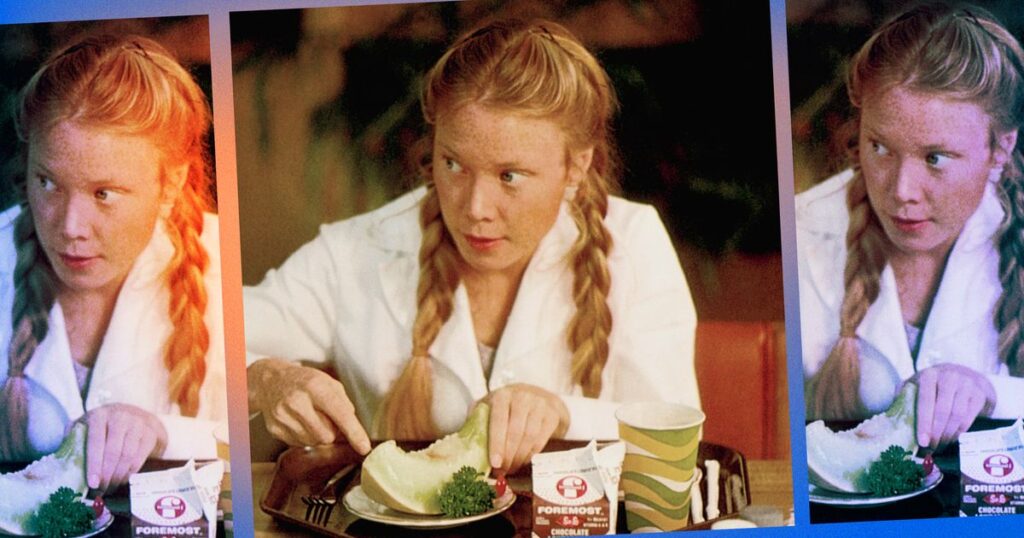
Sissy Spacek was 27 when she shot 3 Women, but she may as well have been 17. That’s how credible she is as Pinky Rose, a naïve cipher working at a rehab spa in a California desert town who behaves like a sheltered teenager. Her initial withdrawal is what makes Spacek’s gradual transformation so striking. As Pinky begins to emulate Millie (Shelley Duvall), her more established, relentlessly chatty co-worker, she takes Millie’s adultness to an extreme: She starts smoking, layers on makeup, hooks up with their married landlord Edgar (Robert Fortier), borrows Millie’s car without asking, and generally turns into a sassy pill. Spacek’s voice gets a little deeper, her mannerisms more suggestive. To think she never even got a proper script.
Spacek had already starred in Badlands and Carrie when 3 Women came out in 1977, but nothing prepared her for director Robert Altman’s free-flowing production. Despite the hyper-specific dialogue and Bergman-esque existentialism, the cast and crew mostly worked off a broad outline that Altman drew up. Spacek might not have been as unschooled as Pinky, but she got an education in unconventional filmmaking nonetheless.
Today, 3 Women looms large on Spacek’s long résumé. It’s hypnotic from start to finish, and the arty, ambiguous ending involving Edgar’s death is still as haunting as it was back when Jimmy Carter was president. Spacek essentially plays dual roles — light Pinky and dark Pinky, let’s say — and to see her mutate from one to the other (and back again) is to see a master class in characterization. Duvall got the lion’s share of the movie’s praise, including the best-actress prize at Cannes that year, but Spacek is equally mesmerizing. As the New York Times’ Vincent Canby wrote in his review, she “adds a new dimension of eeriness to the waif she played so effectively in Carrie.” With the 75-year-old Oscar winner appearing in Lynne Ramsay’s new psychodrama Die My Love, we called her up to reminisce about this all-timer of a film.
The origin story of 3 Women is that it came to Robert Altman in a dream, and you specifically were in that dream. Do you remember him telling you that?
Yes, I even have a little drawing. I usually keep a little notebook when I’m working on each film, and the main part of his dream was we were underwater in a pool and I was sitting on a couch in the bottom of the deep end of the pool. That was what my drawing was: me as a stick figure sitting on a couch. I had been doing a film with Alan Rudolph, Bob’s protégé. We did a film together called Welcome to L.A., and that’s how Bob met me. He would see the dailies, and I got inside his head. That’s when he had the dream, and that was enough for me. I was in your dream? You bet I’ll do it!
Have you ever been told that by another director: “You were in my dream and now here’s a role”?
No! I just adore Bob. We had a wonderful, wonderful, hilarious relationship. My god, talk about an actor’s director.
You can tell that just in watching his movies — the way he treats his characters, where he puts the camera.
He was the first director where you never had to wait. You always had to wait for another actor to stop talking before you started to talk, right? But he put lavalier mics on everybody. Now, that’s the way it is, but it wasn’t then. So you could talk whenever you wanted if you decided you wanted to say something.
So he comes to you with this dream, and then he writes, as I understand it, a treatment — but never a full script. What did the treatment entail?
It was the setting of each scene. It was what was going to happen and a little bit of dialogue. But it was all in shortform, and his assistant, at the end of the day, would type up what we actually did. She was making notes the whole day, God bless her. We would get the pages that we had done on that day of shooting to take and put in our script. So by the end of the movie, we had a full script. But there was so much freedom. Pinky Rose, my character, was the quiet one. I was just absorbing Shelley Duvall, God bless her sweet, sweet, wonderful soul, and wanting to be her. She had pages and pages and pages. He would write a lot of her dialogue because her character talked incessantly, and she was a part of that process. She said, “Sissy, I have to write it out 100 times.” That’s the way she learned her lines. She was so dear, but she really carried that film on her back. I adored working with her. We lost touch for a little while after she first moved back to Texas, but we reconnected just a few years ago and we talked regularly before she passed away. She was a gentle spirit.
Oh, that’s good to hear. She had, I guess we could say, a complicated journey in Hollywood.
Well, she made most of her films with Bob, who adored her. That whole team did. She had worked with Bob so many times by the time I came along to work with him, and she just took me under her wing. We had so much fun together, and she worked really hard. She had a real magic quality to her personality. She could get anyone to do anything with her Faerie Tale Theatre.
I know, what an incredible project to have invested herself in.
And she knew every young star working in film and television. We all loved her. So, Shelley, if you’re listening, that’s the way we all felt about you.
It was really moving to see all the tributes pour out when she died. She got a lot of credit that she hadn’t always received when she was alive.
She just had such a beautiful childlike quality. We share a deep, deep connection in the fact that we were both from Texas and loved Texas.
You were just talking about the dialogue in 3 Women. There was a heavy amount of improvisation, right? Usually we associate improv with comedy. That’s not what this movie is, although it can be pretty funny at times. How did the improv feel to you?
It was just smooth as silk. It was wonderful. And I was young. I hadn’t had that much experience, I guess, and those movies were more traditional. When you’re working as a young person, you just kind of go with the flow. In reality, I think Shelley did most of the heavy lifting. She wore these big, round skirts, and there’s a moment where she shuts it in the car door.
Yes, I love that.
And that was just an accident that they carried through. So it was like that.
What was your ultimate conception of Pinky and who she is at the moment we meet her in the film?
She was unformed, as most people are. I certainly was. I’d grown up in a little town. Bob based so much of these characters around who we were, and I was really just skipping along behind Shelley’s character, kind of imitating her. That’s the way young people do, I think. I remember when I moved to New York at a young age, I got off a bus and it was raining, and everyone ran over to this awning and got under the awning to dry. And I looked over and there was this beautiful girl with Twiggy eye makeup, and I just thought, I want to be her. And the next day, I was wearing Twiggy eye makeup. It didn’t work for me like it worked for that girl.
With the mimicry you’re talking about, your character essentially comes to mirror the aesthetics and tonality of Shelley’s character, Millie. Did you pick that up in real time as you were shooting?
Exactly. Pinky does attention-grabbing things like a child does, like when they were working in the geriatric area of this old-folks home in the pool. She goes completely under the water and thinks that’s funny. Then when she’s having a sandwich and a drink with Millie, she blows into the straw to make noise like a little kid would. And when they’re in a bar, she’s drinking a beer all the way down from top to bottom. Or she goes through the saloon doors like she’s seen in cowboy movies and falls on her butt. She’s trying to impress Millie, and Milie is annoyed.
With that beer in the bar, Robert Altman asked you, kind of spontaneously, to down the entire thing, and apparently it didn’t go too well on the first take. Do you remember that story?
I remember when I went through the saloon doors I fell and broke my tailbone.
Oh my gosh.
Then I walked around with one of those little circle pillows.
Okay, I didn’t know that. I was thinking of the story Altman has told about you throwing up after downing that beer for the first time.
You know what? I must have blocked that out.
He talks about it in the audio commentary on the film. Then he said, “Do you think you can do it again?” And you said yes. The things we do when we’re young, right?
Isn’t that the truth? But if he’d said, “Jump off the building,” I probably would have.
Over the course of the film, we see Pinky kind of overtake Millie — she becomes her, and then the coma happens and she reverts back to that childlike role heading into the stillbirth at the end. Because of those contrasts, did it feel almost like you were playing two different characters?
Completely. I was out shooting a gun with Robert Fortier, who played Edgar, and there was something in Pinky’s eyes that had changed. Her whole look — her whole essence — shifts. She has surpassed Millie. She conquered Millie, but then she’d gone on to become cynical and hard. I remember that Shelley in that stillbirth scene was so moving. And I don’t think she ever planned anything. She was just in the moment, so it was just, as you said, happening in real time. I learned a lot from the human being she was and the actress she was.
I am somewhat surprised to see that Bob has said outright over the years how he interprets the ending. Do you remember talking about what the ultimate meaning of the film is?
No. I don’t remember that. Tell me.
Well, do you believe the women murdered Edgar? That’s the part he’s pretty explicit about despite it being ambiguous when you watch the film.
It was probably led by Pinky, who had that hard edge. I don’t know. What do you think? You can only believe what he says, right?
That’s the thing — I can’t separate myself from what he’s said, which is that, yes, they did murder him, and his body is buried underneath the pile of tires the camera pans to in the final frame.
Oh my god! I learned something today. I wonder if that was part of his dream. Or I wonder if he led us in that direction or if it’s something he realized could be after he saw the footage.
He also talks about the more existential question of, What if the last male in these women’s lives were gone and now it’s truly just the women left? And more broadly, what if the last male on earth were gone?
Running a world of women! What a world it would be.
Tell me about the setting. You shot in Palm Springs. Everything looks so dry and arid. How did you all spend your time when you weren’t shooting?
Looking for shade. I’m very fair and freckled, so I was slathering on sunscreen and trying to match yesterday’s skin color. I remember seeing a lot of full moons there in the evening. I’d never been a desert girl. I’m from a moist northeast-Texas area, and although there are very arid parts of Texas, I was always in hats and bonnets. It really spoke to the loneliness and weirdness of the film. I have to say that I wasn’t always in on the big picture of what was in Bob’s head, and I don’t think Shelley was either. We were his happy and cooperative pawns that he played on a chessboard. He was one of the great film artists.
It’s nice to hear such resounding praise for someone so many of us revere.
We all loved each other.
That audio commentary is on the Criterion Channel if you want to hear it.
Oh, great. I will watch that with a fresh eye. To think I could have gone through my whole life and never been aware of that.
Now you know that you murdered Edgar.
Yeah! You’ve opened up a real can of worms.
See All