
The latest release of Epstein-related files by the U.S. Department of Justice has brought Andrew Mountbatten Windsor back into the headlines yet again…but this time with a jolt that feels harder to wave away.
Among the newly surfaced materials are photographs showing former- Prince Andrew in the company of Jeffrey Epstein and Ghislaine Maxwell in unmistakably royal settings. One image appears to place them at Sandringham, the private Norfolk estate that functions as the emotional center of royal family life:

Another situates Epstein and Maxwell at Royal Ascot, one of the monarchy’s most visible and tightly curated social stages:

None of these images, on their own, proves criminal wrongdoing. Andrew has consistently denied any such conduct, and it remains important to be precise about what this evidence does or does not establish.
But all the precision in the world can not neutralize impact. The optics here are deeply damaging, and not only for Andrew, whose public role is effectively over. His legacy will also linger for the institution that once enabled his access.
That brings us to the phrase that continues to haunt this story. In The Palace Papers, journalist Tina Brown revealed that Epstein privately referred to Andrew as “an idiot,” but “a useful one.”
“A senior royal, even if tainted, is always a potent magnet abroad,” Brown wrote. “Epstein confided to a friend that he used to fly the Duke of York to obscure foreign markets, where governments were obliged to receive him, and Epstein went along as HRH’s investment adviser. With Andrew as frontman, Epstein could negotiate deals with these (often) shady players.”
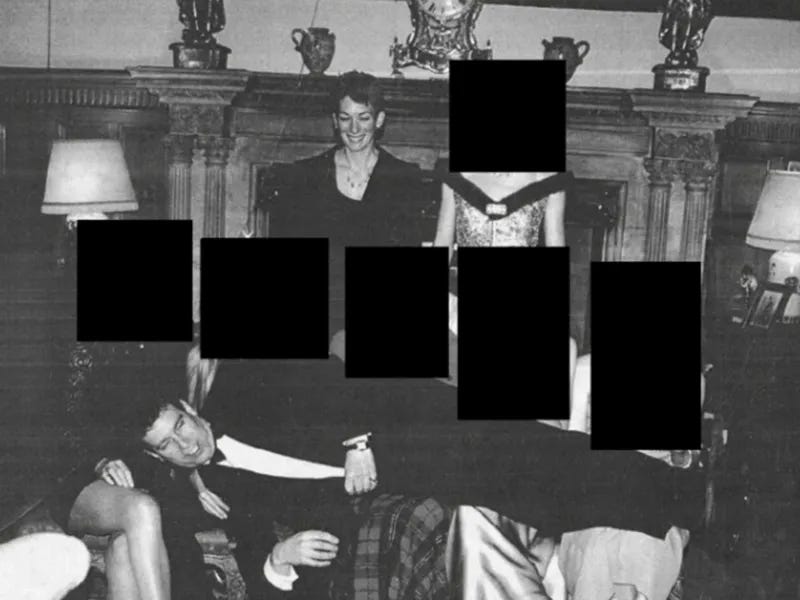
 Prince Andrew and Ghislaine Maxwell in 2000.
What these new images make undeniable is how far Epstein and Maxwell were able to move within royal orbit. They weren’t just being “paraded” by Andrew in New York or the City of London, but were confidently surfacing within the social and symbolic heart of British royal life itself.
The usefulness was simple: a senior royal, even a compromised one, confers instant legitimacy. Titles open doors. Being seen alongside a duke transforms outsiders into insiders. “Useful” is an understatement in that context.
And as for the “idiot” part? Andrew did not need to be clever, strategic, or even particularly intentional for this to work. His title did the heavy lifting. Reporting suggests Epstein exploited the obligation felt by others to receive a British prince; Andrew, for his part, appears to have welcomed the arrangement.
Remembering that he has not admitted any wrongdoing or apologized for any acts (beyond a blanket “sympathy for all victims”), what Andrew appeared to gain above all was relevance. Status. Validation. After all, his formal position within the royal hierarchy became less clearly defined in the 90s and 2000s, with higher-ranking royal heirs taking center stage. It’s easy to see how proximity to global wealth and power offered a way to reassert importance.
Epstein’s world of self-made bad apples no doubt flattered Andrew’s self-image as a serious international figure. And Andrew, for his part, seems to have mistaken that flattery for legitimacy.
 Andrew also hosted Jeffrey Epstein, Ghislaine Maxwell, and Harvey Weinstein at Royal Lodge months after an arrest warrant had been issued for Epstein in 2006. The backdrop was Windsor Great Park, as part of Princess Beatrice’s 18th birthday party.
But we can also widen the lens on this story, beyond Andrew himself, to see why his legacy will forever stain the monarchy.
For men born into the royal fold, there is an enduring tension between inherited status and earned authority. Titles confer access, sure…but not purpose. Over time, many senior male royals (particularly those not destined for the throne) have sought to establish themselves as something more than ceremonial figures. Real global influence becomes the goal.
Andrew is not the first royal to chase legitimacy beyond the narrow confines of birthright, nor the first to confuse access with authority.
Prince Philip spent much of his early married life grappling with a similar dilemma. Born into an exiled monarchy himself, Philip was keenly aware that he was expected to support the British Crown without eclipsing it…and frustrated by his lack of a clearly defined role. His solution was to channel that restlessness into institution-building on a smaller scale: the Duke of Edinburgh’s Award, patronages, and a carefully managed public persona that emphasized service (despite his social attitudes that were stuck in the past).
King Charles, too, spent decades searching for purpose beyond waiting for the throne. His forays into architecture, the environment, and alternative medicine were attempts to carve out intellectual and moral authority—sometimes to mixed reception, but (almost) always within a visible, institutional framework.

Today, we can even see a different version of that ambition taking shape: Prince William has increasingly framed himself as a global statesman. He’ can be seen engaging with world leaders, positioning initiatives like Earthshot as international convening platforms, and adopting the language of diplomacy on a global scale.
While William’s efforts are institutionally sanctioned, tightly managed, and rooted in causes rather than in private relationships, the underlying impulse to undertake something even larger than a ceremonial role is familiar. Andrew pursued that path with disastrous effect, all because he seemingly mistook “access” for “substance.”
The Epstein files, for that reason, are a reminder of how dangerous unearned and unexamined access can be. Think of how quickly borrowed legitimacy can be weaponized by those seeking power, influence, or cover. When royals are encouraged to act as global actors without sufficient guardrails, accountability, or clarity of role, things can go downhill fast.
Andrew Mountbatten Windsor did not build institutions or causes. He pursued personal prestige, and in doing so, allowed himself, his title, and his image to become pawns for people far savvier (and more dangerous) than he was. A “useful idiot,” indeed.
For the monarchy, this is the deeper headache Andrew leaves behind. As the institution seeks to project stability, relevance, and moral authority in an increasingly unstable world, it must reckon with the lesson Andrew represents: access is not granted arbitrarily. When royal proximity is seen as currency, it will always attract those eager to spend it.
That is why Andrew’s legacy cannot be disentangled from the damage he caused, regardless of how the Epstein and Maxwell investigations ultimately recede from public view. Even in the absence of new legal developments, the images, associations, and unanswered questions linger. They have become part of the monarchy’s modern record.

Andrew may no longer hold titles or perform public duties, but the stain he leaves is institutional rather than personal. It is the residue of a moment when the monarchy’s aura of legitimacy was too easily borrowed, too slow to be withdrawn. (Not to mention that his actions, for far too long, were deliberately covered up).
It is telling, too, where this story keeps returning. To Sandringham, the place meant to embody private family life and continuity. This week, the royals will once again gather there for Christmas Day. It will likely be touted as a reminder that even amid scandal and scrutiny, the rituals of the monarchy persist. But Andrew’s presence, even if behind the scenes, will forever remind the public of a breach of the boundaries that once gave the monarchy its meaning.
In that sense, Andrew is not simply a disgraced individual the royal family can only hope to outlast. He is a cautionary tale that the institution must carry forward, especially as a new generation seeks to define what royal influence actually entails.