
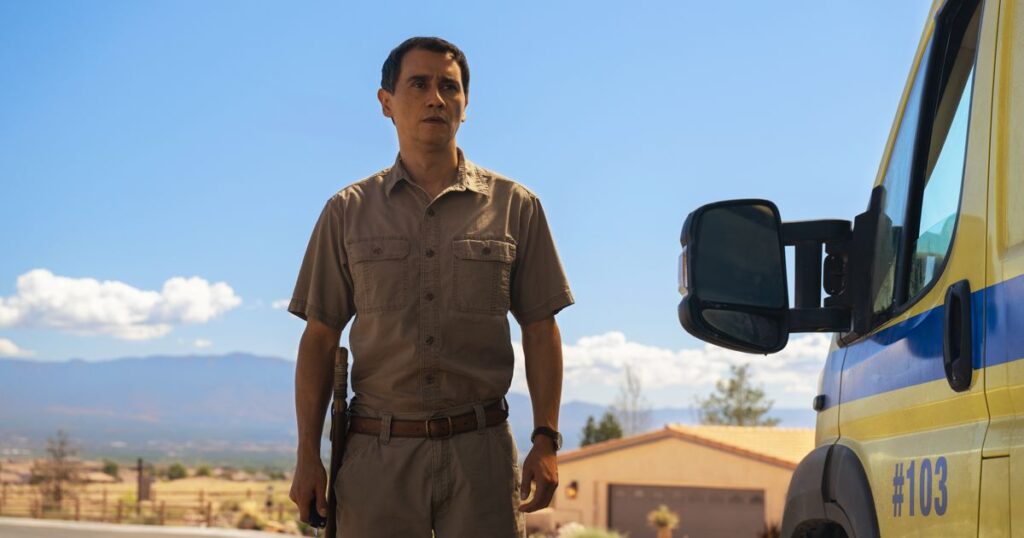
“If I had been through what he probably has been through, and all of a sudden I get a world in which there’s no violence, no segregation, no racism, no xenophobia, I’d think, I’m going to give this a shot. But he just thinks, This is wrong.”
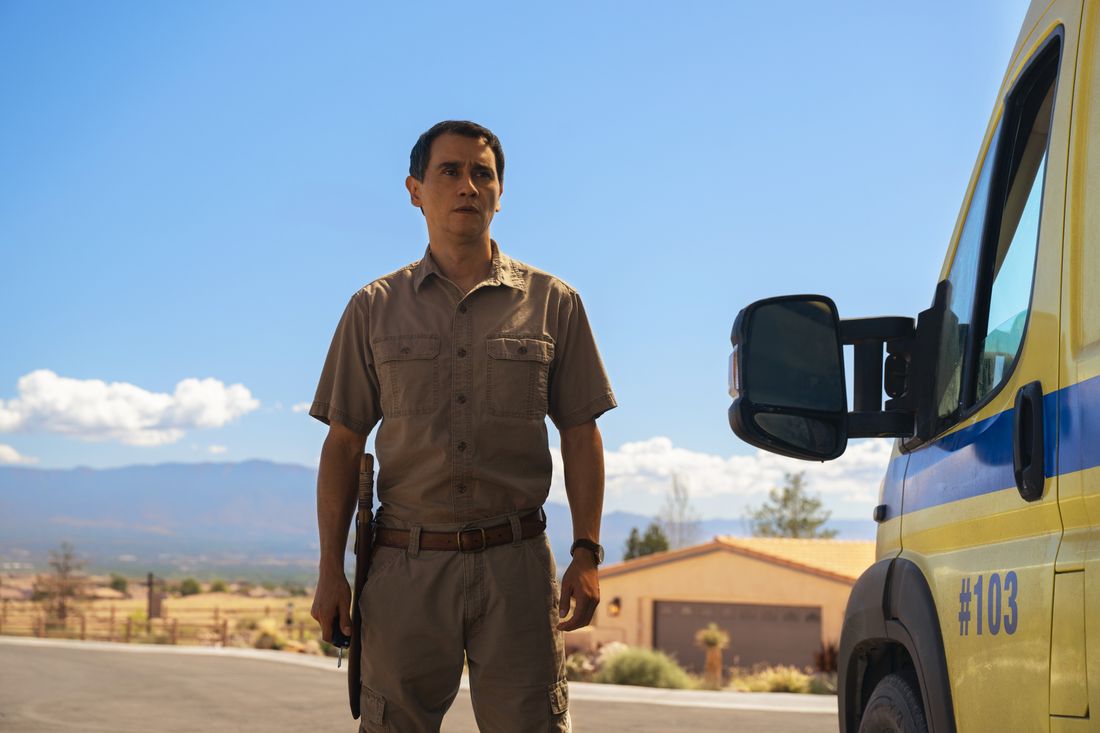
Photo: Apple TV+
Spoilers follow for Pluribus through first-season finale “La Chico o El Mundo.”
Don’t trust the Others. Manousos (Carlos-Manuel Vesga) has been saying that all season, and finally, after Pluribus’s season finale “La Chica o El Mundo,” Carol (Rhea Seehorn) has come around, realizing that her “chaperone” and lover, Zosia (Karolina Wydra), was actually party to a plan to use stem cells from Carol’s frozen eggs to turn her into one of them. It’s a massive betrayal for Carol, but for Manousos, it’s validation — the Others will never give up their quest to transform the immune, and the immune are practically obligated to fight back.
Pluribus is Seehorn’s show, and creator and showrunner Vince Gilligan built it around Carol’s contrasting contempt for other people and her insistence that things were better before the Others turned human society into one worldwide kumbaya. But as Carol has warmed to the Others, the similarly immune Manousos has remained consistently defiant. His distrust is immediately obvious in Vesga’s first onscreen appearance in “Please, Carol,” a long, dialogue-free sequence that took advantage of Vesga’s ramrod-straight physicality and expressive face as Manousos ate dog food, pillaged the storage units where he worked for resources, and rejected all outreach from the Others as they tried to befriend him.
“The fact that I had to start building a character on set, in silence, with no words, by himself — that is unheard of in television, at least where I come from,” says Vesga, who like Manousos is Colombian and has worked extensively in Spanish-language movies and TV. “It was a beautiful challenge, and as it unfolded, I was able to discover another facet of myself as a performer. For me, the way of being in control is to always keep in mind that you are an actor playing a character. You’re not a character in a story.”
Vesga maintained that remove as Manousos gave a barn burner of a “Nothing on this planet is yours” speech to the Others, traveled the infamous Darién Gap alone, and finally ended up outside Carol’s house in Albuquerque. Through it all, Vesga used a Brechtian acting approach of being constantly aware of his collaborators and the series’ audience to bring Manousos to life, which he says kept him grounded as he embodied the series’ most disciplined character. “I wish I could tell you that it was a dream come true, but this is something that I actually hadn’t even allowed myself to dream,” Vesga says of working with Gilligan and Seehorn. “When I was driving that car along the coast of the Canary Islands, I would see myself from a distance and constantly say, You are here. Do you realize that you are here driving this car, working with this amazing group of geniuses? I ended up being not only a Brechtian actor, but a Brechtian human being.”
I’m going to read you some words used to describe Manousos in recent press: “willful,” “integrity,” “determination,” “rebellion.” Looking back on the totality of the season, how do you view him?
The fact that this guy has migrated from Colombia to Paraguay, it speaks to me a lot. Migrating will always involve certain things: loss, anguish, fear, pain, hardship, trauma, hope. That informed his approach to the Joining so much. He’s been through all those things a migrant goes through — gets to another country, finds a way to make a living — and then that’s taken away from him again. That’s when he goes, “Hell no, not again. This time, I’m going to fight and do what I have to do.”
Without giving anything away from his backstory, it informs why he’s so stubborn and not willing to negotiate. It’s beautiful writing, for the arc of the character, that to get his world back he has to actually migrate again and leave behind the few things he’s built in Paraguay. He migrates through the actual route that people are using right now, the Darién Gap, which, me being Colombian, is something very present in my life. It’s an ongoing tragedy. People are crossing the Darién Gap, trying to find a promised land and that light at the end of the tunnel, and for Manousos, that’s Carol. So I completely relate to words like “stubborn,” “dignified,” “a man of principle.”
I’ve seen “ridiculous” used to describe Manousos leaving money behind to pay for everything as he travels to Carol. But his hope is for people to come back, right? It makes complete sense for him.
And the irony of it is that the world, as it was, forced him to leave his country. He comes from a world in which his individuality has been mistreated and denied. Before the Joining, he was probably a third-class citizen of the world, whereas Carol, she is a first-class citizen. Her individuality is very strong and well-rooted, and she’s had to fight for that because of her sexuality. With Manousos, his individuality has not been very well-respected during his life. I would love to know what Samba Schutte thinks about Diabaté and his individuality before the Joining because I get the feeling that if Manousos is a third-class citizen of the world, Diabaté was probably a fifth-class citizen. That explains why he indulges in all of the nice things he can get now. For Manousos, it’s a matter of justice and an injustice taking place. If I had been through what he probably has been through, migrating and losing what one loses, and all of a sudden I get a world in which there’s no violence, no segregation, no racism, no xenophobia, I’d think, I’m going to give this a shot. But he just thinks, This is wrong.
I’m curious about your read on another aspect of Manousos’s characterization, which is the religious element. “Manousos” is another version of “Emmanuel,” which is another version of “Jesus.” He’s traveling alone, he’s sleeping in churches, he refuses temptation, he’s impaled. How aware were you of that, and how do you think it came through in your performance?
I love that interpretation. Catholicism was quite an element in the equation. This guy has an image of the Holy Virgin hanging from the rearview mirror of his car, and that says a lot! Maybe he’s not praying all the time, but he grew up with that and still has a certain connection to that. Catholicism has a lot to do with suffering, and suffering as a way of purifying yourself and getting to Heaven. There’s many kinds of Catholics, but I grew up with the kind of Catholic that accepts that life is hardship and suffering and strife, and in a way, that makes it worth living. I don’t think he approaches suffering and strife in the same way as other people who haven’t had that Catholic thing given to them from birth. It’s a way of seeing life in which you go, This is hard, but life is hard.
I would be speculating, but the fact that he has had to leave his home before tells us that he’s been on the ropes. I don’t think he’s had to eat dog food before, but he probably knows about hunger. He probably knows about lacking resources and having to adapt to whatever comes up. He has been tested. And this time around, he’s trying to right a very big wrong. You could read something about martyrdom in Manousos. He cauterizes his wounds from the Chunga tree, and that image of somebody going like this [mimics holding a machete against his back, as Manousos does on the show], for a Catholic or someone thinking about Catholicism, reminds people of self-flagellation. He’s kind of a martyr for humanity, right?
I would agree. I’m sure you’ve seen that everyone has a different interpretation of what the show is about: AI or capitalism or grief. Was there a certain interpretation that was most helpful to you as you were working on the show?
I remember telling Vince that the story kept bringing me back to Brave New World and how people are controlled not through repression or fear, but through making them believe that they are happy and that their circumstances are ideal. In fact, they are actually being controlled and manipulated. This is my personal perspective, but individuality is at risk in our current world, and I don’t think the problem is something like communism. I think the problem is the way technology is going. We are being forced into a mold that homogenizes society, and it does it through very short-lasting shots of “happiness.” This has to do with the Others in the show: We live in a world that most of the time gives us what we want, but doesn’t address what we need. The Others say, “We just want you to make you happy, Carol, whatever you need,” but in truth, they are addressing whatever you want.
I remember telling Karolina that talking to Zosia is like talking to Siri or ChatGPT. I fear that human beings in the current world are being driven to that state of Oh, we are so happy, but in fact, what we are being trended into is this huge mass of numb individuals. I also remember mentioning to Vince how I kept thinking about WALL-E; they have goggles and they lie on their stretchers or whatever, and that’s all they do. That world that I fear we are being pushed toward was always very present.
There are a couple scenes from the finale I’d love to hear more about, beginning with the initial meeting between Manousos and Carol, which is so well-paced and so funny as you two struggle to communicate.
That scene was my audition scene. When we did it for the audition, we didn’t have the third actor doing the translation. We did it with a proper cell-phone translator, and I remember thinking, This scene is definitely going to have a comedic element to it. When Manousos gets to Carol’s house, there’s an urgency, but Carol is not the same Carol that sent the videotape. It’s not that pressing for her. I thought, We need to find the tone for that comedy and allow it to happen, rather than chase it. This scene is going to be tricky because either we are allowed to improvise a lot or we’re going to have to really block every interruption.
When we got to set, I was so excited; I’d been working on that scene for many, many months. We were listening to the other actor on our earpiece. At the beginning, it didn’t really flow because we weren’t sure about the interruptions. Sometimes she would interrupt in the same place and sometimes she would change. And also, I got it into my head that by then, Manousus doesn’t speak English perfectly, but he’s been studying for weeks and he gets stuff. That would prompt me to sometimes act as if Manousos understands a bit of what Carol’s saying, and it took me a couple of takes to understand that it’s better if he doesn’t understand at all and really needs the translator.
Vince told me, “You have to remember that you speak English, but Manousos doesn’t.” He also told both me and Rhea, “React to every interruption. If it’s not blocked for you, it doesn’t matter. If you hear the voice in your ear, you react to that interruption.” That implied improvisation, and I love that, because that ups the game. To me, acting is like playing a game. It’s just that you play the game seriously. When he said all those things to us, that cleared how we approached the scene.
I remember, once we were done, walking to the next scene with the most intense smile on my face. Not only did we get it right, but I enjoyed it. Working with Rhea, the best metaphor I can come up with is, Imagine you’re playing a tennis match with Roger Federer, the best player in the world. You give them your hardest balls and they give you their hardest balls, but it’s not to beat you or to beat them. It’s because of the pleasure of playing. Doing a scene with Rhea, it’s like having a play date with your best friend.
I love that. The other scene from the finale I want to hear about is when Manousos uses the radio-frequency signal that he has found on one of the Others, Rick. He’s hurting him, but he’s trying to guide Rick back to himself.
Something that came up with Manousos very early on was that he has a scientific mind and is methodical. If he finds something, he needs to put it to the test. He’s not holding on to any preconceptions. He finds that frequency and he doesn’t expect anything specific. It’s such a great scene because at first, you have zero empathy from Manousos, but then he’s talking to Rick and he’s being so gentle and so caring and so loving. The scene has many different approaches from Manousos. First you have Manousos treating Rick as the scientists in the first episode treated the rats: This is just a specimen, and I’m using it for a higher purpose. Then all of a sudden this specimen has a name and is a person he wants to save. It was quite an arc inside that scene.
Now that you mentioned Catholicism, you could say inquisitors would approach people that way. What I mean is, “I’m going to burn your feet and skin your arms and this is going to hurt, but what I’m truly pursuing is salvation for you. I’m not forgetting that you’re a person. Actually, I have you in my heart, and these are my best intentions for you. It’s just that I do it through fire.” [Laughs.] And in the case of the inquisitor, he believes if you die, you’ll get to heaven. You could read it that way. I wasn’t thinking about that then. At the moment, it was that Rick is just a vehicle for Manousos’s higher purpose, and then he’s deeply moved by the end. And also feeling like, Damn, Carol, you didn’t let me save this guy! I was so close. I know I could reach inside of him and bring him back.
Later, when we see Manousos surrounded by his books, he’s looking into loops and circuits. He now has another avenue to research what could be going on.
I honestly don’t know a thing about season two. I haven’t been told anything, but the fact that he is reading those scientific books — does it say anything about his previous life that he understands equations, mathematics, and physics? I don’t want to speculate on that, but that’s the beauty of the show, that the writers and Vince have left so many precious breadcrumbs around that you can hold on to. Even as a performer, I don’t really know what Manousos was doing before in Colombia or before the Joining. But you get to think.
See All
Off-screen actor Sofia Embid voices Carol and Manousos’s cell-phone translation app.