
Prince Harry’s armed police protection in the UK is reportedly set to be reinstated. It’s a development that, safe to say, few people had on their 2026 bingo card.
 Prince Harry, the Duke of Sussex, speaks onstage during Global Citizen Live, New York on September 25, 2021. (Photo: John Lamparski)
In early December, multiple outlets reported that Harry had written privately to the home secretary, Shabana Mahmood, requesting a full reassessment of his security arrangements. As a result, the Royal and VIP Executive Committee (better known as RAVEC) was expected to carry out its first comprehensive risk assessment of the Duke of Sussex since 2020.
As The Guardian reported at the time, “The Duke of Sussex’s security arrangements while visiting the UK are reportedly to be reviewed after a direct request from him to the home secretary.” Evidence from police, government departments, and Harry’s own team was expected to be collated and presented to RAVEC, after which its risk management board would reassess his threat level.
That review now appears to have produced a significant shift. Let’s explore how we got here, and what might come next.
Since stepping back as a senior working royal in 2020, Harry has not been entitled to automatic armed police protection in the UK. Instead, he has been offered what the government describes as a “bespoke” arrangement: case-by-case security decisions tied to advance notice of travel, rather than the standing protection afforded to working royals.
 Prince Harry at the Royal Court of Appeals in May 2025.
Harry has challenged that system repeatedly in court…and lost. Most recently, in May 2025, judges upheld the government’s position, ruling that bespoke protection based on threat levels was lawful and appropriate. Harry’s legal team was arguing that requiring advance notice of visits was itself a security risk, amounting to unfair and inferior treatment despite credible threats to his life.
“The appellant does not accept that bespoke means better,” his lawyers said. “In fact, in his submission, it means that he has been singled out for different, unjustified and inferior treatment.” They also argued that RAVEC had failed to follow its own proper procedures when first assessing his security needs.
The judges were unmoved. The judge’s ruling in May concluded bluntly that Harry’s “sense of grievance” did not translate into a viable legal argument.
In an emotional interview with the BBC immediately afterward, Harry called the outcome a “good old-fashioned establishment stitch-up.”
What’s notable here is not that Harry disagreed with the ruling (he always has), but that he evidently continued to push for a new risk assessment rather than re-litigating the old one. His argument has been consistent: security decisions should reflect current threats, and nothing else.
And there is no dispute that threats exist. Multiple individuals have been jailed in connection with plots, encouragements, or threats of violence against him and his family. Others have been released after serving sentences. This isn’t theoretical, nor hyperbolic. It’s a clear and present danger to Harry, his wife, and his children.
There’s also a looming calendar concern: the Invictus Games will take place in Birmingham in 2027, and planning inevitably begins years in advance. Harry has been clear that he will not bring his family to the UK without adequate protection, but he would undoubtedly like to.
 The Duke and Duchess of Sussex, Meghan Markle and Prince Harry, during the Winter Invictus Games in February 2025 in Whistler, British Columbia.
Add to that another factor: King Charles III’s ongoing cancer treatment. If there is any desire for reconciliation (or even simple family contact) it cannot realistically happen without resolving the security impasse first.
Here’s where I’ll be candid: I don’t believe a royal’s security designation (or ability to stand on the Buckingham Palace balcony) should hinge on whether they are deemed a “working” royal. Neither William nor Harry, their cousins, or their cildren chose to be born into this institution. Their public profiles, and the risks that come with them, stem from birth, not from hours logged on behalf of the Crown.
This is a structural problem that the so-called “slimmed-down monarchy” has yet to confront. We now have an emerging generation of royals who were, quite literally, produced to support an institution that insists it no longer needs their labor.
 The British Royal family on the Buckingham Palace Balcony for Trooping the Colour in June 2019.
And yet, the monarchy cannot disentangle itself from the consequences of their existence.
If Harry succeeds in securing automatic armed protection for his family, it sets an important precedent. Not just for him, but for future “non-working” royals who may one day find themselves similarly exposed. That includes people like Princess Eugenie and Princess Beatrice, who currently lead largely private lives with no armed security, but also future players like Princess Charlotte and Prince Louis…who will always attract media attention.
Thanks for reading The Fascinator! This post is public, so feel free to share it.
In Harry’s case, of course, there is an added, unavoidable layer: racialized harassment and threats tied to his marriage.
One of Harry’s most persistent arguments has been that the requirement to give advance notice of UK visits makes him less safe, not more. The Sussexes have demonstrated repeatedly that they can travel discreetly when their movements aren’t known in advance.
 The Duke and Duchess of Sussex before they were “involved in a near catastrophic car chase” in New York City on May 16, 2023.
The moments of greatest exposure, he argues, are when official diaries exist…and when knowledge of those diaries leaks. In June 2021, for example, Harry was chased by photographers after attending an event with seriously ill children at Kew Gardens in west London. From his perspective, a system that demands forewarning creates the very vulnerability it claims to mitigate.
Officially, governments and palaces insist they never comment on travel or security matters (for obvious reasons). But that doesn’t mean information itself doesn’t travel. Nor does it mean that subtle signaling doesn’t occur when institutions want expectations managed, pressure relieved, or narratives gently softened ahead of a formal outcome.
It’s worth remembering that royal communications today are rarely accidental. In recent days, multiple outlets have suddenly begun hearing strikingly similar “positive noises.” Sources speaking to People suggested there is growing confidence within government that Harry’s security will be reinstated.
According to those familiar with the process, RAVEC has already determined that the Duke of Sussex meets the threshold for protection; the final step is little more than procedural. “It’s now a formality,” one source told the Daily Mail. Another claimed that Home Office insiders consider security for Harry “nailed on.”
That kind of language is notable, not least because it contrasts sharply with the tone taken during Harry’s legal defeats just months ago. And so…why now?
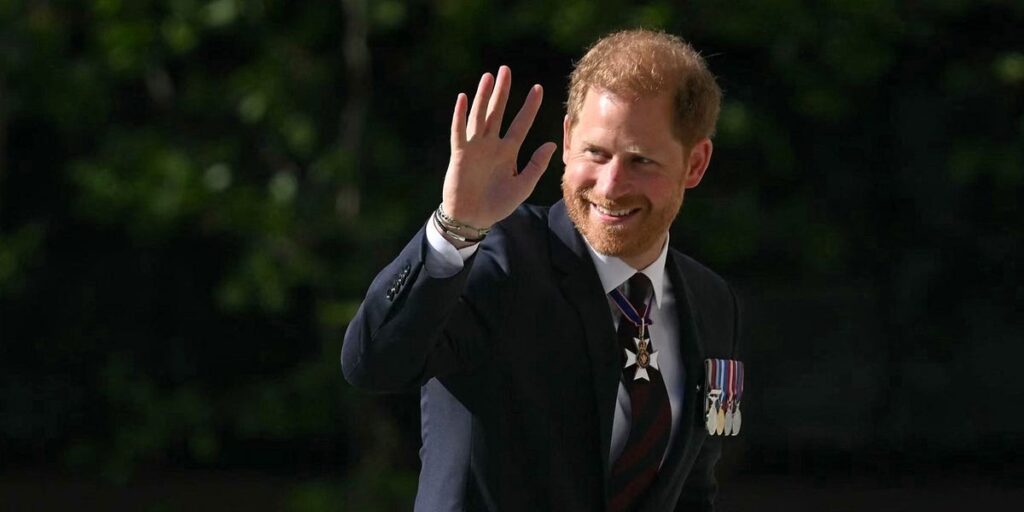
 Prince Harry arrives at a ceremony marking the 10th anniversary of the Invictus Games, at St. Paul’s Cathedral, on May 8, 2024, in London.
Some briefings have focused on family stakes rather than legal mechanics. Sources told The Mail on Sunday that the threats against Harry and his children are the reason he has refused to bring them to the UK without police protection. It would be a “win” to make it clear that those threats are likely to amount to nothing.
The Mirror, meanwhile, framed the moment emotionally, reporting that Harry is “desperate” for his children to reunite with King Charles III, and hopes to facilitate that relationship in the near future.
Taken together, these leaks do a few things at once. They normalize the reversal before it is formally announced. They recast Harry’s years-long fight not as a grievance-driven crusade, but as a rational response to credible risk. And, crucially, they soften the institutional climbdown by framing it as inevitable, responsible, and overdue.
What’s more, Harry’s security being reinstated now, after he publicly accused the establishment of stitching him up, allows King Charles to appear magnanimous rather than cornered.
To be clear: the King does not control RAVEC, nor does he personally grant or revoke police protection. But monarchs have always operated through influence; tone, relationships, and quiet alignment matter, particularly when government, palace, and public interest converge.

A benevolent patriarch, nudging the right people in the interest of family and safety versus old disputes…it’s an image the King is badly in need of after the recent, far less sympathetic decision to strip titles from his brother. In a moment where the monarchy is hungry for moral steadiness, that contrast is doing real work, whether intentionally engineered or simply well-timed.
For Prince William, too, this moment might help to close a destabilizing chapter. A brother permanently excluded from the UK on security grounds is not a sustainable long-term optic for a future king, particularly one positioning himself as a global statesman and unifier (no matter how he personally feels over his built-in foil).
Reversals like this are rarely framed as admissions of error, but rather as calm, sensible, “from on-high” evolutions. If Harry’s security is reinstated, the palace won’t say “he was right.” The message will be more strategic: the system worked as intended.
 Prince Harry in a Dior suit at the Royal Courts of Justice in March 2023 during his lawsuit against Associated Newspapers.
And whether this reassessment leads to a permanent policy shift or a narrowly tailored exception remains to be seen. Either way, it underscores that the monarchy cannot modernize without reckoning with the individuals it created, whether or not they “working” for the institution.