
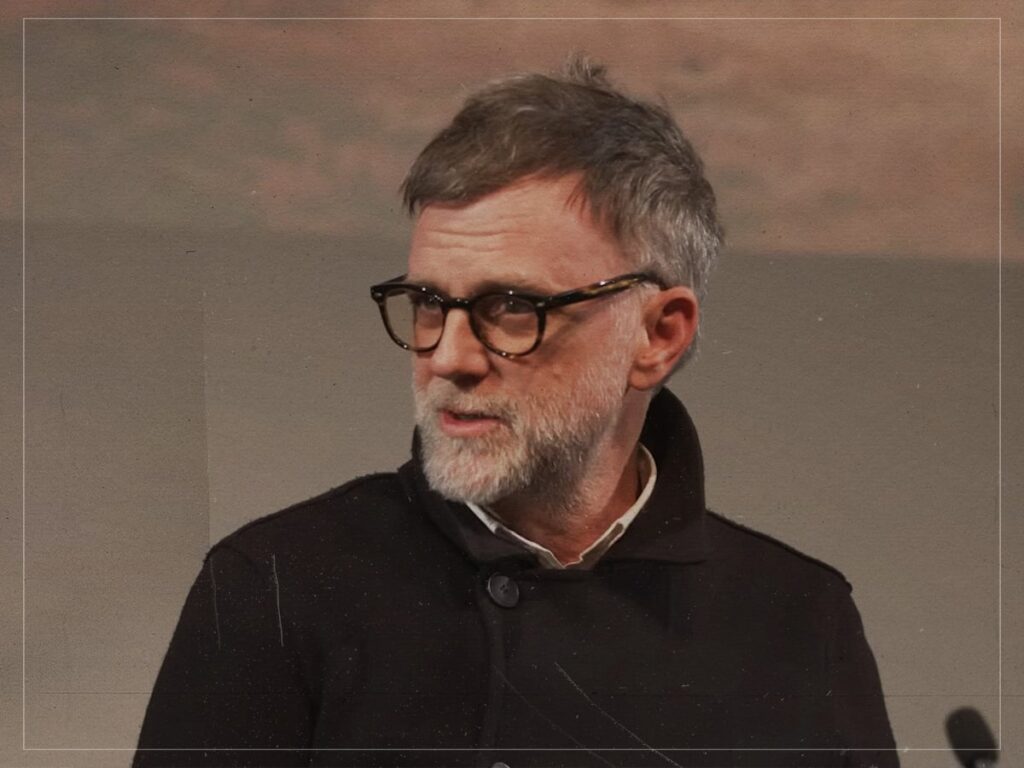
(Credits: Far Out / YouTube Still)
Mon 5 January 2026 21:30, UK
You’d think that any director who got to work with Daniel Day-Lewis, Philip Seymour Hoffman, and Joaquin Phoenix would be content to just pat themselves on the back for a job well done, but Paul Thomas Anderson is not just any old director, and depending on who you ask, he is one of the greatest, not just of his generation, but of all time, so his claims in life are also a little offbeat.
While you might argue over which of his movies is his best, you probably won’t argue that at least one of them belongs in a list of the top ten greatest movies ever made, and the man has range, too: From the tragedy-laced comedy of Boogie Nights to the modern American epic of There Will Be Blood, Anderson is nothing if not ambitious, even if he comes across as disarmingly normal in interviews.
He’s worked with some of the greatest actors in the business, and for good reason, for he’s given Day-Lewis and Seymour Hoffman some of their greatest roles, and he even managed to save Marky Mark from himself, if only for one fleeting instant.
Not surprisingly, most actors would kill to work with Anderson, but unfortunately, some of the ones he’d like to work with are too dead to try. In a Reddit Ask Me Anything thread in 2017, the director was asked to name which stars he would bring back from the grave to work with, and even within the confines of the forum, his enthusiasm was palpable.
“Oh! Oh!” he wrote, “Humphrey [Bogart]. Cary Grant. Ida Lupino. Joan Fontaine. Charles Laughton. Myrna Loy. Carole Lombard. James Mason!!!!!!! We don’t have enough time to play this game. Jason Robards!”
To some extent, the director was just listing the most famous actors of Hollywood’s Golden Age, but it’s a good lineup nonetheless. Humphrey Bogart and Cary Grant hardly need an introduction, though their inclusion is notable simply because of how different they were; where the former was wry and weary, the latter was the epitome of debonair charm and gracefulness.
On the other hand, Joan Fontaine is one of the more underrated female stars of the era, and Ida Lupino is a surprising choice, seeing that she was arguably a better director than she was an actor, and even became the first woman to direct a film noir. Charles Laughton fits a similar mould, wherein, although he was known primarily as an actor during his lifetime, he, like Lupino, has since become more revered as a director than a performer. His first and only foray into directing, The Night of the Hunter, is a seminal work of spine-chilling horror that has inspired everyone from William Friedkin to the Coen brothers.
On the other end of the spectrum, Myrna Loy and Carole Lombard were two of the greatest screwball comedians of all time, and spearheaded the genre in the 1930s, so it’s to Anderson’s credit that he named them and not Katharine Hepburn, who, although brilliant, has strangely eclipsed them in terms of legacy.
It is tempting to imagine how the director would have reshaped James Mason to his own ends, who was best known for his suave and slightly menacing Britishness in films like North by Northwest and Lolita, and would no doubt have blossomed under the type of makeover that Anderson gave Burt Reynolds in Boogie Nights. As for Jason Robards, we don’t have to imagine, as the director got to work with the Oscar-winning character actor in 1999’s Magnolia and apparently loved the experience so much that he’s desperate to collaborate again.
Related Topics