
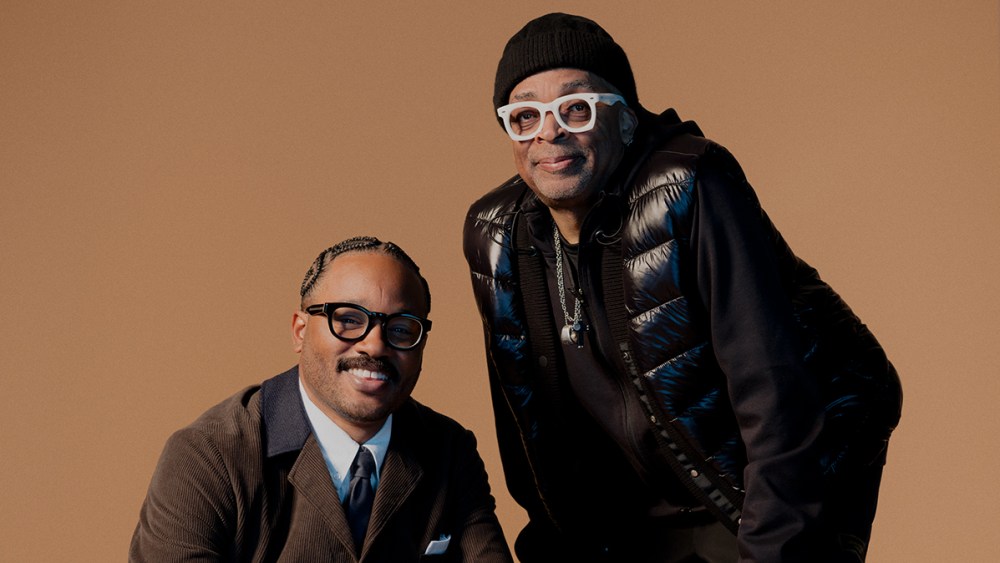
On a recent morning in midtown Manhattan, Spike Lee blows on an imaginary pair of dice before hurling them to the ground. It’s a gesture of respect for Ryan Coogler, the risk-taking director of “Sinners,” who put his “Black Panther” clout on the line to get Warner Bros. to back a $90 million vampire film set in the segregated South. Oh, and he convinced the studio to sign a deal giving him back the copyright to the film after 25 years.
“I believe in cinema,” the soft-spoken Coogler says in response.
That belief paid off — “Sinners” became one of the year’s biggest hits, as well as a major Oscar contender. But Coogler’s not the only one taking risks. This year, Lee reteamed with Denzel Washington on “Highest 2 Lowest,” putting a new spin on Akira Kurosawa’s crime masterpiece “High and Low” by moving the action from postwar Japan to modern-day New York. It’s a pretty bold move to try to outdo one of cinema’s greatest directors, but Lee insists that the chance to transport the classic morality tale to his favorite city and set it in the world of hip-hop convinced him it was a story worth telling.
In a spirited conversation, the two filmmakers compare notes on their latest work and discuss their partnerships with their favorite leading men — Washington, who has anchored five Spike Lee joints, and Michael B. Jordan, who has appeared in all five of Coogler’s movies.
Spike Lee: Let’s talk about the phone call.
Ryan Coogler: So we were at Imax headquarters in L.A., seeing the print. It’s the final check, making sure that everything is looking good.
Lee: That it’s hunky-dory!
Coogler: It’s one of my favorite places to watch a movie. And I was thinking, “It’s a waste to screen it like that, without other people to appreciate it” — because we’re sick of looking at the movie at this point.
Lee: They made a big mistake! Tell ‘em! [Lee throws his head back, erupting in laughter.]
Coogler: I wanted to show you the movie. It’s got so many inspirations, but many of them are from your movies. I was just thinking, “Man, I should just check and see on the offhand chance that Spike is in L.A.” I called you, and you were like, “Yo, I’m here.”
Lee: That’s the spiritual thing right there. Because usually I’m in and out of L.A. I’m at the JetBlue terminal at 6 a.m. at JFK, land, do what I got to do, run around. Then I’m on the red-eye that night.
Coogler: First thing you said was “You don’t want to sit next to me.”

Benedict Evans for Variety
Lee: I was giving you a warning. And I watched my brother’s film, and it’s like me sitting courtside at Madison Square Garden and we’re kicking the Celtics’ ass. I’m jumping up and down. I was buggin’. When that surreal music montage came up, I lost it, man.
Coogler: It’s a dream come true, man, to be able to play the movie for somebody who you look up to. So many of your movies affected me. I felt the same way when I watched “Highest 2 Lowest.” Can I ask: Why Kurosawa?
Lee: One of the great things about film school is that I was introduced to world cinemas. That’s when I saw “Rashomon,” and that was the basis for “She’s Gotta Have It.” In that film, there’s a rape and a murder, and various people share their idea of what happened. I just hijacked that idea and made a film about this woman, Nola Darling, who has three boyfriends with different perspectives. Jump many decades later: The phone rings, and it’s Denzel. And he says, “What’s up, Spike? I’m going to send you a script.” So when the FedEx truck pulled up the next day, I was waiting.
Coogler: You ran up on it before he got out of the car.
Lee: “Give me that thing.” [He pretends to grab a package.] So I read it. But here’s the thing: Even before I hung up the phone, I knew I was doing it, because Denzel was calling me. He knows what my wheelhouse is. But it wasn’t until we were doing press that journalists alerted us that our last film, “Inside Man,” was 20 years ago.
Coogler: Felt like yesterday? But you guys are in each other’s orbits.
Lee: Here’s the thing: We don’t really hang out. You can have a great relationship without being in each other’s mug every single minute. When you have the foundation of love and trust, the sky’s the limit. Boom shakalaka. After I read it, I said, “Number one: You’ve got to change the title so it’s ‘Highest 2 Lowest.’ Number two: We have to do a reinterpretation, not a remake.”
Coogler: What’s the difference between a reinterpretation and a remake?
Lee: Kurosawa’s film was set in postwar Japan. This is the current day. The Toshirô Mifune character was a factory owner. In this one, Denzel’s a music mogul; he’s like Berry Gordy. That’s my thing, music. And we’re shooting in New York.
Coogler Those magic details — the setting, the cultural shift.
Lee: What we kept from Kurosawa’s film is this idea of morality. What will you do for money? What will you do for your friend? Denzel’s character says, “All money ain’t good money.”
Let me ask a question: There were several studios that turned “Sinners” down. What was the issue? What were you asking for that a lot of studios said, “Nah.”
Coogler: Man, it’d be hard to get into all the details. I mean, to be honest, man —
Lee: Final cut? Ownership? Let’s hear it! Ownership.
Coogler: That was a part of it, man. But truthfully, we were fortunate that a lot of people wanted the project.
Lee: On certain conditions. In other words, it’s fucked up.
Coogler: I’m not going to say that.
Lee: I can say it.
Benedict Evans for Variety
Coogler: I’m happy we were able to find a home with Warner Bros. And just that people came out, which is something that you can never control, right? It’s a risk. I’m willing to bet on a good story. I truly believe that there isn’t any experience like a movie in a theater, you know what I’m saying? Especially at this time, when we’re disconnected from each other. I can get groceries delivered to my house. I can order food from my favorite restaurant to my house. I can buy clothes from my house. All of these experiences are things that we used to go out and do in public.
Lee: Pros and cons.
Coogler: But for me going to sit in a movie theater, the best thing for me is not being able to press pause or stop it. Because the first thing I do, especially when I’m watching something scary, or I’m watching something that’s too funny or too shocking, if I’m at home, I press pause and give myself a chance to catch up.
Lee: Talk about your brother, Michael B.
Coogler: I had decided I was going to do “Fruitvale Station,” about this young man, Oscar Grant, who had been murdered by a transit cop. We needed an actor that looked like him, because I was thinking the movie was only going to play in the Bay Area. But I figured if the actor didn’t look like Oscar, people would write the movie off as being BS out of the gate. So I literally was like, “Man, who could play this guy?” And I started thinking about Mike B. I met with him, and just we really got along, bro. And then when we got to work, that’s when it really lined up. He’s a great actor in that you don’t see the work. He just is the thing that’s in front of you.
Lee: He ain’t lyin’.
Coogler: And while we were making “Fruitvale,” I was meeting with Stallone to see about getting “Creed” done. And then Stallone and Mike met, and they got along. So it was two movies back-to-back like that. And so vastly different from each other.
There was some spiritual connection. On “Creed,” he had a whole month that was just fights. We didn’t have one stunt double. It was phenomenal, man. And for “Sinners,” it just started to make a lot of sense for him to be these twins and to stretch himself. For me, it was also a test of how far we could get the audience to go, because Mike’s so endearing and charismatic. And these guys are … these are bad dudes. One is a coldhearted killer, and the other is a manipulator. Seeing these guys unapologetically portrayed by an actor whose superpower is the audience is always with him was interesting.
Lee: You flipped the script.
Coogler: Each time we get together, I’m trying to challenge him, and he’s trying to challenge me.
Lee: How does he challenge you?
Coogler: When he’s trying to get to the truth of a moment, when he’s trying to find it. He’ll also demand a lot of me. For instance, in “Sinners,” he’s basically got to hold himself as one brother dies in the other brother’s arms. So he’s got to give a dying performance with a huge blood prosthetic coming out of his neck, and then he’s got to turn around and hold himself.
Lee: That was done the same day?
Coogler: Yeah. And with a lot of technical specifications. He’s on the ground, and he’s saying [to me], “Hey, man, I need you. I need you right here. Keep talking to me. Keep reminding me of where I am.” I pride myself on being there for actors. And because he can handle it, I want to make sure that I’m providing him with great roles.
I feel like you do the same thing with Denzel. I don’t know if he gets a “Mo’ Better Blues,” a “Malcolm X,” a “Highest 2 Lowest,” if it’s not for you existing as a filmmaker.
Lee: Here’s the thing: We’re both very blessed to have our leading men. That’s what our job is; we’ve got to do what we can to get the best out of our actors. What we do is based upon love and trust. That’s the foundation. You don’t have that, then you’re up the creek.