
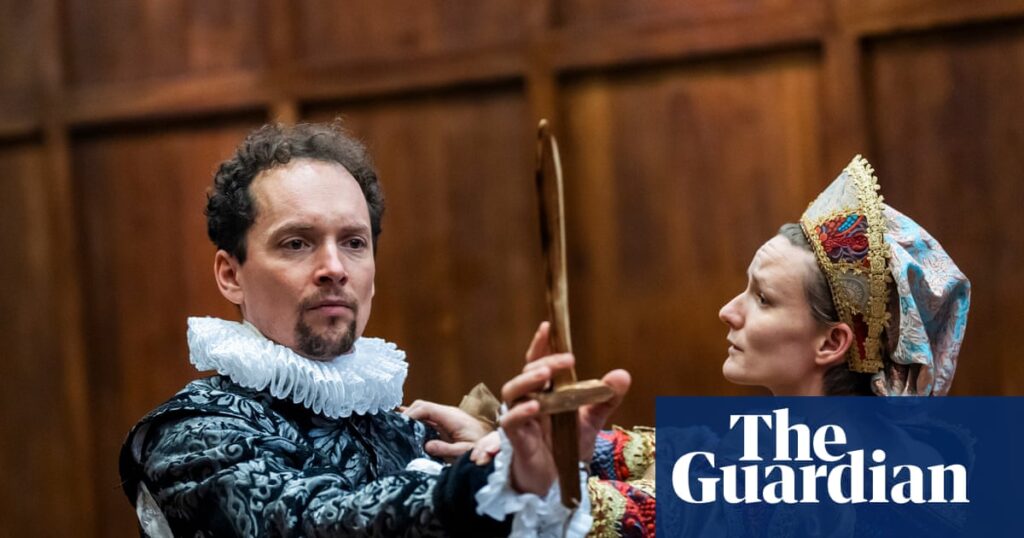
Carlo Gesualdo wrote some of the most darkly sublime music of the late Renaissance. He also savagely murdered his wife and her lover in their bed. Now be honest: which would you like to discuss first?
The art will always be secondary to the atrocity, however magnificent the madrigals and sacred music. Gesualdo, Prince of Venosa, had been cuckolded by the Duke of Andria in a long-running tryst that had become the scuttlebutt at court. The premeditated double murder of 1590 was a truly grisly affair, concluding in the public display of their mutilated bodies on the steps of the palazzo for several days.
Gesualdo’s biography is often reduced to this act, yet his own end, too, was harrowing. Twenty years on, the prince had retreated to his estate to indulge in a life of ritualistic agony, reportedly employing servants to beat him thrice daily to ease sleep and constipation. This domestic nightmare included the presence of two concubines accused by his second wife of witchcraft against him. Their ghoulish testimonies, elicited under torture, suggest a household that had descended into a gothic psychosis.
Carlo Gesualdo da Venosa (1566 – 1613), painted by Francesco Mancini. Photograph: DEA/A. DAGLI ORTI/De Agostini/Getty Images
The composer’s sheer repugnance is so colourful that I was surprised to be approached by St Martin-in-the-Fields, who asked if I might create a piece of music theatre about his life. This year marks the central London church’s 300th anniversary, and next week my new work, Death of Gesualdo, opens as a tribute to the venue’s bold artistic independence. It features the phenomenal ensemble the Gesualdo Six, who long ago adopted the troubled prince as their namesake (the first piece the group sang was the composer’s Tenebrae Responsoria). And so we have all now become enmeshed in the handling of his dark materials, and must confront the sticky relationship between the creator and the crime.
Gesualdo wrote madrigals, but not the sunny pastoral ones that defined his English contemporary Thomas Morley (Now Is the Month of Maying, It Was a Lover and His Lass). Were those kind of compositions his, we might successfully disentangle the art from the artist. Yet Gesualdo was a musician whose sombre works (Ahi, disperata vita – ah desperate life; Moro, lasso, al mio duolo – I die, alas, in my suffering) could easily score a film of his own sordid life. The music and the man easily form a singular, haunting synthesis – the aural diary of a degenerate.
Taraash Mehrotra, Markus Weinfurter, David Tarkenter, Imogen Frances and Sian Williams rehearsing Death of Gesualdo at St Martin-in-the-Fields, London. Photograph: Tristram Kenton/The Guardian
At this juncture I was forced into a moment of moral pause. Is it appropriate to half-valorise a murderer whose music and stature would be obliterated online today?
For me, the art is almost always separate from the artist, odious or not. We can’t locate antisemitism in Wagner’s actual scores. To eliminate Guernica from the canon because of Picasso’s abuse of women is a punishment unbefitting of the crime. To take a less extreme example, if I’m upset by JK Rowling’s stance on trans issues, banning her books from my daughter’s bedroom only closes a door for both of us. We know way too much about artists today – we are swimming in their private biographical details – and are thereby unwittingly complicit in this contamination of their art. To make matters worse, the facts and the fictions are increasingly blurred – an artist who is young and famous today will be forced to consider that someone may have already created deepfake pornographic material of them.
Allow me to present myself as an example. In my production, I attempt to tackle these issues by mapping Gesualdo’s tortured harmonies on to the painful episodes of his life, connecting his musical hallucinations with his descent into psychosis. Patterns are fun to find and dots thrilling to join. Of course, I vainly hope this reveals something new and valuable about him.
But high art at best is a Rorschach test – an ink blot. It isn’t meant to reveal the artist, it is meant to reveal us. A staging of Hamlet tells us little about Shakespeare, frankly. It hardly tells us much about Hamlet. If it’s an excellent production, it might remind me that it’s been 17 years since I’ve lost my dad, and I really, really miss him.
This is what makes Gesualdo such a valuable case study in 2026: here was that rare artist before celebrity culture taught us how to obsess. Centuries before the internet, this great-nephew of Pope Pius IV was born into a life of transparency. His second wife was Eleonora d’Este of the prestigious northern Court of Ferrara, a “Music City”, and a cultural nexus of 16th-century Europe. All murders aside, his nobility, wealth and role as a leading composer made him the subject of constant gossip – about his sexuality, intelligence and more – for his entire life.
The homicides were a festering scandal, yet perhaps more shocking is they were perfectly legal; for an Italian prince of his day, an “honour” killing was an expected rite of restoration. This is why he evaded punishment and formed a second strategic alliance with the Court of Ferrara. But there the whispers intensified, and perhaps as a result, he devoted himself to the solitude of composition. His later years were marked by another retreat – this time by a fixation that he was being hunted by the families of his victims.
In my work, Death of Gesualdo, the composer’s fragile psyche forms a toxic alchemy with the public glare that fuels his psychosis even as it yields astonishing music. His final years culminated in the Tenebrae Responsoria of 1611 – an apparent self-requiem that conflates Christ’s suffering entirely with his own. One hears guilt, atonement and isolation in the sublime dissonances of this haunting masterpiece. He died two years later, a man broken by the very status that had protected him.
‘Erasing art is the wrong lesson from the 2020s’ … artistic director Bill Barclay rehearses with Imogen Frances. Photograph: Tristram Kenton/The Guardian
But are any of these connections true?
Truth be told, Gesualdo’s chosen forms – the madrigal – were quite typical for his day. He was not among the avant garde in Florence, nor was he inventing opera with Monteverdi in Mantua, he was writing mannerist madrigals, a late form on its way out. Mannerism relied on artificiality, complexity, chromaticism and dissonance. No one understood that assignment better than our dark prince. A musicologist must be honest that “psychopathic composer” is an irresponsible elision. But we have allowed his bloodlust to define his music, haven’t we, and that is the problem and the opportunity.
In travelling my own road through this commission, I have concluded that punishing odiousness in artists by erasing their art is the wrong lesson from the 2020s. Artists must realise there is a sharp danger of their work becoming contaminated with their reputation. Audiences must realise that double-clicking on another’s suffering is a step too far. As for Death of Gesualdo, it may reveal nothing about him. It could reveal something about me. If it’s any good, neither should matter, because it will reveal something truly important about you.
Bill Barclay is the writer and director of Death of Gesualdo at St Martin-in-the-Fields 16-17 January; York National Centre for Early Music 18-19 January; and St John the Divine, New York, 13 February.