
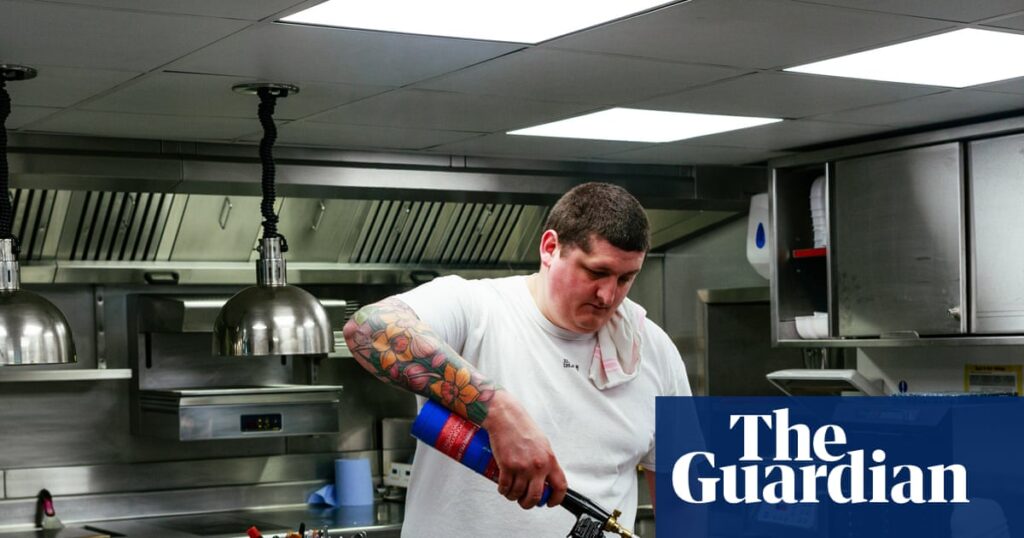
According to a critic who has eaten at every three-star Michelin restaurant in the world, Gareth Ward, the star chef and owner of Ynyshir, on the southern edge of Eryri national park, is a groundbreaking visionary.
“He knows which rules to break and when,” Andy Hayler wrote. “He’s like Picasso; if you look at his early still lifes, they’re unbelievably perfect.”
Food safety officers at Ceredigion county council clearly do not agree. Ward’s two-Michelin-starred establishment was given a one-star hygiene rating in a recent inspection, which means it is operating below minimum legal standards.
Ward reignited debate over fine-dining culture this week by claiming he was “not embarrassed” by the poor score, which he said was the result of inspectors’ concerns about the use of raw and aged ingredients.
According to the report on the Food Standards Agency website, Ynyshir’s management of food safety required “major improvement”. It said the cleanliness and condition of facilities and the building also needed “improvement”, and “hygienic food handling” was rated “generally satisfactory”.
Ynyshir (pronounced Un-is-heer) serves a 30-course tasting menu starting at £468 a person, which changes daily but heavily features beef and traditional Japanese raw fish known as sashimi, as well as oysters, duck liver and caviar. Meals are served in a black-painted dining room, accompanied by occasional clouds of birch smoke and an in-house DJ’s techno mixes to “take diners on a playful culinary journey around the globe” over five hours.
Welsh wagyu rib at Ynyshir. Photograph: Francesca Jones/The Guardian
The food critic Giles Coren sprang to Ward’s defence on Wednesday, telling the BBC that health and safety rules “don’t really apply” to elite restaurants such as Ynyshir, which was named the UK’s best restaurant in 2022 and 2023.
“It’s not about your fridge and ‘have you put the roast chicken from last night next to the raw chicken’, which can lead to bacteria. It’s a different sort of world,” Coren said.
“They are clearly doing enough to prevent the spread of bacteria but if you imagine a hygiene inspector, in his white coat, with his pen in his top pocket, expecting to see a neat provincial fridge, I can see that he would lose his mind.”
Coren’s comments were met with outrage by the Chartered Institute of Environmental Health (CIEH), which said Coren risked giving the impression that food hygiene rules were “optional, subjective or old-fashioned”.
Una Kane, CIEH’s food advisory panel chair, said in a statement: “Many restaurants offer a unique experience for diners while meeting the standards of food hygiene legislation … It’s insulting to those restaurateurs to imply you can’t do both. No food business should see itself as above the law.”
Ward’s outspokenness has raised eyebrows before. He answered “fuck that” to the suggestion chefs should cook for customers, rather than themselves, and has defended his high prices by saying Ynyshir should “probably be more expensive”. In 2023, a diner claimed he had challenged her husband to a fight. The restaurant did not comment on the specific allegations, calling the boss “a gentle giant”.
However, Ward has acknowledged that the food safety officers were “not 100% wrong”, and has since installed an additional hand-washing station in the fish preparation area. He also claimed overwhelming paperwork was part of the problem.
Tomono Davies, the London-based founder of Tomono Sushi Party, which provides sushi-making experiences, said she found the UK’s food safety rules “shockingly difficult”, but sashimi preparation in itself should not affect a hygiene rating.
“I don’t know whether the food rating was fair, I haven’t been there or talked to them, but I did find it strange when he mentioned it was because of handling raw and aged fish,” she said. “So many restaurants handle raw food, steak tartare has even stricter rules.
“The regulations are much kinder in Japan than here. I think it’s a cultural difference, because the level of cleanliness and chef discipline in Japan is higher. Here, it’s more about saving yourself because you don’t want to get sued or go out of business.”
James Lowe, the chef-owner of Michelin-starred Lyle’s in east London, which closed last year, said his establishment had once received a two-star hygiene rating.
“One inspector was more senior, the other was introduced as a trainee. The trainee freaked out at a label on a cheese that said ‘unpasteurised’, she thought it was dangerous. That’s when I thought, ‘Oh my God, this is going to be difficult.’
“Another time, after the cheese fiasco, there were five sheep carcasses hanging in the walk-in fridge and [the inspectors] refused to go into the fridge. They were also horrified by pork that had been aged in salt for two months. They told me to throw it away.”
Hackney council did not immediately respond to a request for comment.
For now, Ynyshir must follow Welsh law by displaying its one-star hygiene certificate in a prominent place in the entrance or dining room. The business said it has requested a re-inspection, but no date has yet been set.