
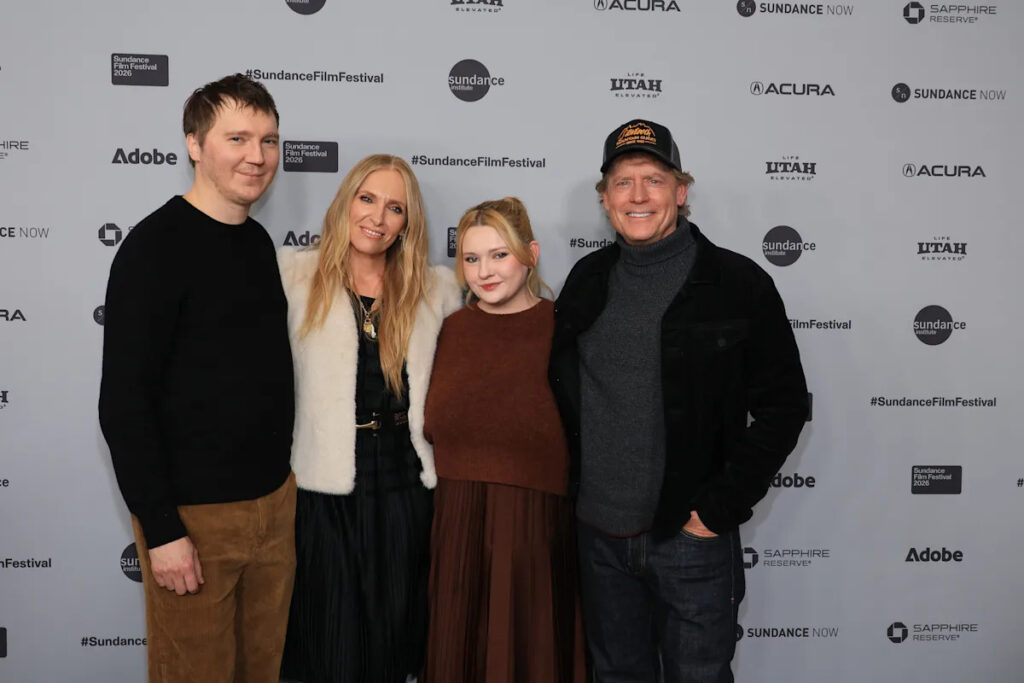
Sundance shined a light on Searchlight’s Little Miss Sunshine Wednesday night by hosting what turned out be an electric 20th anniversary screening inside Park City’s Eccles Theatre.
And some of those rays fell on Paul Dano, who made his first public appearance since Quentin Tarantino shocked the internet by criticizing the actor’s work in Paul Thomas Anderson’s There Will Be Blood, opposite Daniel Day-Lewis, by labeling him the “flaw” of the film and dissing Dano as “weak sauce, man.” In the weeks since, filmmakers, peers and countless fans have shown their support.
More from The Hollywood Reporter
But it wasn’t until this week that the actor addressed it himself. During a Little Miss Sunshine press event at Sundance ahead of the screening, Dano told Variety that fielding the love “was really nice,” adding, “I was also incredibly grateful that the world spoke up for me so I didn’t have to.” When asked about the controversy, Little Miss Sunshine co-star Toni Collette also told Variety, “Are we really going there? Fuck that guy [Tarantino]. Who does that?”
Back to the screening. Dano and Collette joined co-stars Abigail Breslin and Greg Kinnear and their director bosses Jonathan Dayton and Valerie Faris at the screening. The showing was part of Sundance’s Park City Legacy program to highlight standout films from the festival’s past before it moves to Boulder, Colorado.
Little Miss Sunshine debuted at Sundance on Jan. 20, 2006. The film centers on the Hoover family, including dad Richard (Kinnear), mom Sheryl (Collette), a suicidal uncle Frank (Steve Carell), a teen boy who’s taken a vow of silence Dwayne (Dano), the perky daughter Olive (Breslin) and a sexed-up drug addict grandfather (Arkin). They pile into a Volkswagen bus bound for California to support Olive in a bid to win the Little Miss Sunshine Contest. The sanity of everyone involved is stretched to the limit as the group’s quirks cause epic problems as they travel along their interstate route.
Sundance festival director Eugene Hernandez had the honor of welcoming the creative team to the stage following the screening, which was the final festival event ever to be held at Eccles. “The funny thing is they say that lightning doesn’t strike twice, but watching this movie again in this theater, I can’t help but feel like it fell 20 years ago at this festival,” Hernandez said, noting that it had its world premiere inside the same venue. “What a great audience you were.”
He then introduced Dayton and Faris, who received a standing ovation, which kept going as Hernandez welcomed each actor to the stage one by one, saying that “every one of them deserves an ovation” and predicting that “I think it’s going to get louder and louder as I say them.” The applause volume did indeed increase as Collette, Kinnear, Dano and Breslin walked out. But the applause was especially warm and raucous for Dano.
A few moments later, after Hernandez had introduced the entire roster of panelists — the filmmakers and actors were joined by Little Miss Sunshine’s Oscar-winning scribe Michael Arndt (who revealed that he wrote 100 drafts of the screenplay) and producers Albert Berger, David Friendly, Peter Saraf, Ron Yerxa and Jeb Brody — the group took their seats on stage. As they did so, two audience members loudly exclaimed, “We love you, Paul!” The actor looked surprised and touched by the response.
“To have everyone together after all this time, this is a miracle,” Dayton said to start the conversation. “And thank you guys for helping make it happen.”
It happened on a night when much of the industry and Hollywood attendees had left Park City already. In an interesting twist, when Hernandez asked the audience how many people hadn’t seen the film, at least half of the audience raised their hands. “There’s a whole bunch of people who saw it for the first time, which is amazing,” he noted, to which Collette shouted, “What’d you think?”
Hernandez prompted her to answer her own question. “Everything was just more,” she said. “It was more moving, more joyous, and I noticed things that I didn’t notice 20 years ago. And I think 20 years of growth allows you a completely different perspective. … There were just so many moments that just blossomed even further than they did 20 years ago. I’m glad. I’m so happy to be here. I’m jet-lagged out of my fucking mind, but I’m so happy to be here.” [Collette flew all the way from Australia for the screening.]
Hernandez turned his attention to Dano by acknowledging “an amazing couple of decades” he’s had since the film came out, working both in front of and behind the camera. “What are you thinking about as you’re in this room?” he asked.
“Well, I feel so grateful,” Dano answered. “The first film I ever did, I was 16 and it came to Sundance. I don’t even know that I knew what an independent film was, and I don’t know that I thought I could be a film actor. The doors for me really opened here.”
Dano revealed that he first auditioned for Dayton and Faris at age 18, but the movie kept getting pushed. The $8 million project took more than five years to make, and by the time it got a greenlight, Dano was 20 and about to have a birthday. “Luckily, I was not too old by the time they made it. In fact, I turned 21 while we were shooting it and hid it from everybody. Even though it’s meant to be a birthday, you’re supposed to go out and celebrate. I remember being so nervous that I was turning 21 during the shoot of the film and thinking, what’s going to happen? Am I too old? Are they going to fire me?”
Nobody lost their jobs. Quite the opposite, really, as the film was acquired by Searchlight out of Sundance for $10.5 million. It went on to earn north of $100 million at the box office and earn four Academy Award nominations. Arkin won for best supporting actor while Arndt picked up best original screenplay.
Asked to wrap up the panel with final thoughts, Dayton offered this: “These things don’t happen very often, but to all the filmmakers out there, stick with it. Our agent’s assistant was getting promoted and he told the new assistant about all the projects that his agent was working on with different clients. He said his whole pitch and then he ended with, ‘And just remember, Little Miss Sunshine will never get made.’ That was his note to his successor. So, don’t give up. It can happen.”
Best of The Hollywood Reporter
Sign up for THR’s Newsletter. For the latest news, follow us on Facebook, Twitter, and Instagram.