
This review is based on a screening from the Sundance Film Festival.
Beth de Araújo’s Josephine — which won both the Grand Jury Prize at Sundance as well as the festival’s Audience Award — is as visceral as it is delicate. The story of an eight-year-old girl who witnesses a violent sexual assault, and her parents who don’t quite know how to help her cope, the movie’s difficult story, and its rough, raw aesthetic approach, create some of the most challenging parameters for a child actress in recent memory. However, the young performance at its center is as miraculous as the film that slowly coheres around it, resulting in a freight train of emotional impact.
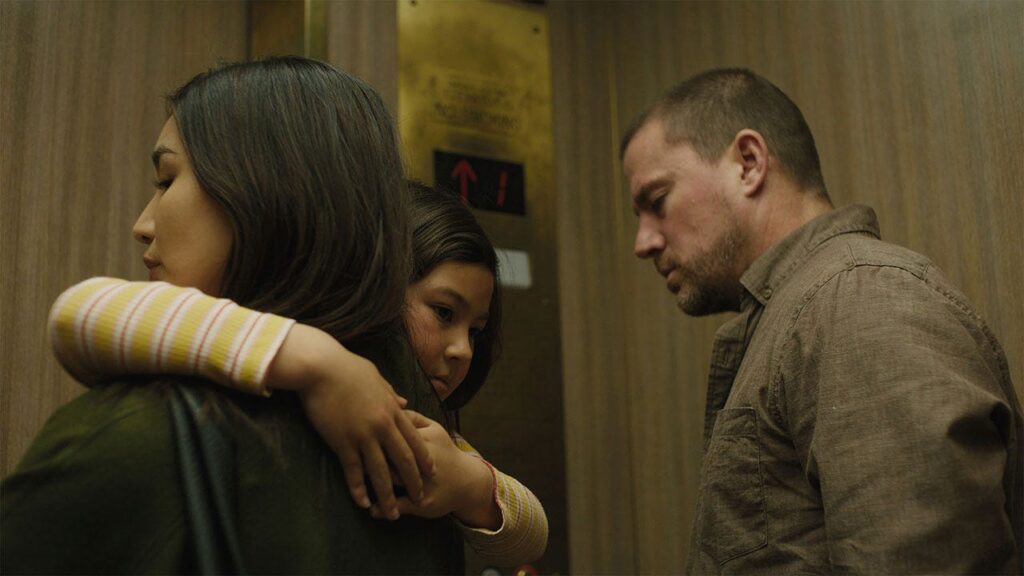
Early one morning in San Francisco, when Josephine (Mason Reeves) and her father Damien (Channing Tatum) go running in Golden Gate Park, they’re briefly separated, and the second grader watches from afar as a mysterious assailant in a green t-shirt (Philip Ettinger) overpowers and assaults an unsuspecting jogger (Syra McCarthy). In a horrifying moment, both victim and perpetrator lock eyes with the young girl, before the attack is broken up and the man is chased and arrested. However, neither Damien nor his wife Claire (Gemma Chan) can decide on the right way to explain to Josephine what she saw, leaving her emotionally adrift as she grows more confused, more resentful of authority, and more violent towards her classmates. As the days go by, she even begins picturing the attacker in the spaces around her — even in the safety of her bedroom.
De Araújo’s frank, unflinching approach to this event stems from having witnessed exactly such an attack at a similar age, imbuing Josephine with an autobiographical quality. Its contours are gradually shaped by the parent characters, and their expertly rendered performances, which lean into Tatum and Chan’s broad types in pursuit of unexpected layers. Damien, although playful at times, is a tough-love kind of parent whose words fail him, but who demands a stiff upper lip from Josephine while trying to navigate the event and its legal aftermath (the victim moves away, leaving Josephine as the only eye witness). Tatum’s comedy has often tapped into a meathead, frat boy persona, and de Araújo’s film is no different, only it captures the difficult domestic eventuality of that masculine mode in the form of a father whose solution to helping his daughter understand the world is stern silence and self-defense classes.
Reeves, who de Araújo discovered at a farmer’s market a few months before filming, brings a shocking naturalism to the part of Josephine.“
Chan’s gracefulness, on the other hand, informs Claire’s approach in discomforting ways as well. A dancer and an artist, she searches for ways to talk Josephine through this trauma, but falls back on platitudes, and can’t find ways to answer her daughter when she inevitably asks if she’s ever been a victim of a similar assault. There’s no prescribed perfect age for sex education, and certainly none for explaining, to a pre-adolescent, the grey areas of human sexuality — the attacker’s defense attorneys claim the encounter was consensual non-consent — let alone the definition of “rape.” There’s certainly no handbook for what to do when the ideal time for this discussion slips into the past, for reasons beyond a parent’s control. But unlike Claire and Damien, who each fall back on their own parents’ imperfect, cyclical approaches to supposedly taboo topics, Josephine has the internet at her disposal, though the explanations she finds online only confuse her further.
Reeves, who de Araújo discovered at a farmer’s market a few months before filming, brings a shocking naturalism to the part. Josephine is the masculine “Jo” to her father, and the cutesy “JoJo” to her mother, roles which the character and the actress alike effortlessly oscillate between, as they try to find a sense of stability while the floor is pulled out from under them. Josephine’s growing unease is reflected in daring fashion by the young newcomer, whose growing uncertainty — surrounding both human sexuality and human morality — seeps into her mood in the form of subdued frustrations. Reeves holds these close to the chest, until they eventually boil over. She’s practically a ticking time bomb; it’s as magnificent a debut performance as you’ll ever see.
These emotional pieces are all fitted into place by de Araújo’s deft and careful hand, yielding a film with a psychological complexity (surrounding issues of childhood sexual trauma) on the level of Gregg Araki’s Mysterious Skin. The director’s conception of San Francisco adds to the imposing nature of the story, between its winding streets and the crisscrossing power lines and metal bridge beams that seem to press down on the characters from above. The camera weaves in and out of Josephine’s point of view as though the young girl were being pulled outside herself before being pushed back in, an emotional whiplash further stoked by the use of space. For the most part, de Araújo and cinematographer Greta Zozula place us at eye level and employ telephoto lenses to blur the details of the larger, more imposing adult world in unbroken takes that build in pressure, as though Josephine’s purview were slowly being enveloped by fog. The color green begins to enter her field of view more and more, and eventually, the filmmakers break from their aforementioned blurry approach — with wide lenses that expand space and warp movement — during brief, imaginative moments when Josephine starts to picture the green-shirted attacker in her bedroom, as a specter of the confusion growing in her mind.
The Best Movie of 2025
Ettinger plays this imagined version of the character with care and caution. He is, at times, an imposing presence, but he can also be ghostly and melancholic, almost sympathetic. He raises questions of what his eyes meeting with Josephine’s in the park may have done to her, and the ways in which her interpretation of the event — and of what led to it — might be forced to change over time as well, when her parents can’t seem to figure out how to connect with her long enough to comfort her. This moment of primal identification with the rapist causes her to turn inward, and to wonder whether she herself has the capacity for evil. That she begins to wear green nail polish goes unremarked upon, but it’s one of the film’s many stark, unmissable details that might cause you to squirm in your seat.
The movie nestles broad philosophical questions within the perspective of a child, which — in tandem with Miles Ross’ brilliantly breathy and propulsive score — inject a terrifying undercurrent into moments of dramatic simplicity. This is centered around the magic of a young performer guiding us through the story’s silent developments by getting lost in thought and self-loathing, and the adult characters who aren’t emotionally equipped to meet her gaze. All this combined makes Josephine one of the most powerful, shattering works of drama to emerge from the modern American independent scene.