
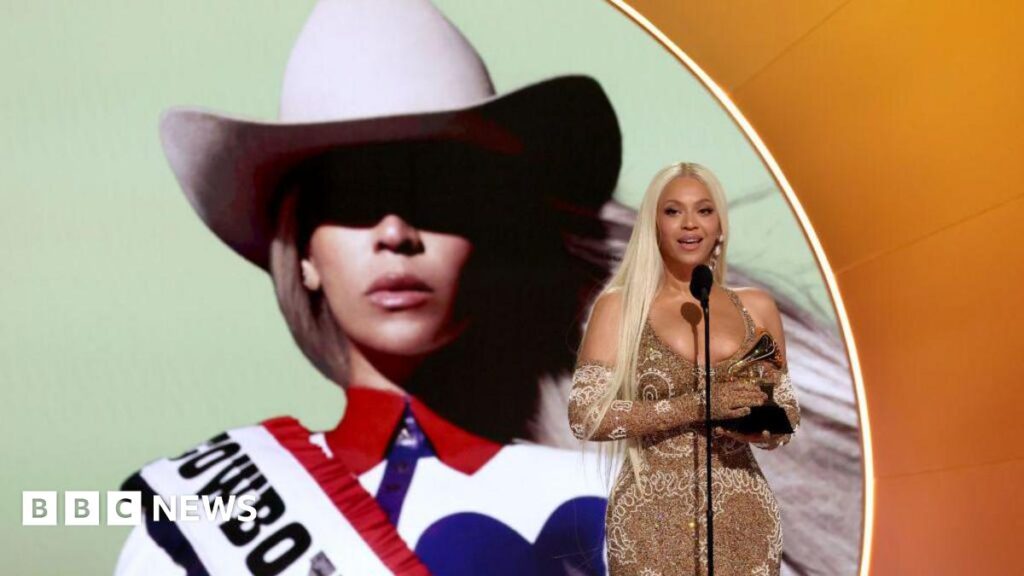
But the controversy around Beyoncé’s win – and the need to separate the category – has also highlighted long-simmering racial tensions within the genre.
Some say country music erased black people’s contributions to the tradition in the 1920s when traditional Appalachian music was segregated into “hillbilly records” – a precursor to country and western music – marketed to white people.
Meanwhile, “race records” – that also led to blues, gospel and R&B – were geared toward black people. The two often overlapped stylistically and black performers contributed to both, but were often overlooked, especially during the Jim Crow Era and segregation.
“Country music has always been a highly diverse form – merging and mixing black, indigenous, Mexican and other traditions – and yet, country music has struggled to accept its essential diversity,” King said.
Before Beyoncé, black country music acts – Darius Rucker, Mickey Guyton, Kane Brown, The War & Treaty – had transcended these assumed racial divisions, finding mainstream success in the genre. Their work and popularity has been part of a greater push for more black voices in the field.
On Cowboy Carter, Beyoncé showcased the black roots of the genre, even bringing on Grammy Award winner Rhiannon Giddens to play banjo on Texas Hold ‘Em.
The Texas singer, who grew up listening to country music before rising to fame with the R&B girl-group Destiny’s Child, said that the album was born from the feeling of being unwelcome in the country music space.
The same year she won the Grammy for best Country Album, Nashville’s Country Music Association (CMA) Awards shut her out without a single nomination, even with her chart-topping country hit Texas Hold ‘Em.
But others have found success. In 2019, Lil Nas X became the first openly gay black artist to win a CMA award for his trap-country crossover hit. In 2023, Tracy Chapman won the CMA for Song of the Year for her hit Fast Car – which was released in 1988 – after country artist Luke Combs covered it, making it a chart-topper for a second time.
King added that the change at this year’s Grammy Awards could open the door for other honours to change as the genre does.
“The Recording Academy might lead the way in terms of these other organisations, you know,” he said.
“Making changes that are necessary to really, truly reflect and also cultivate the kind of diversity that’s necessary for country music to continue.”