
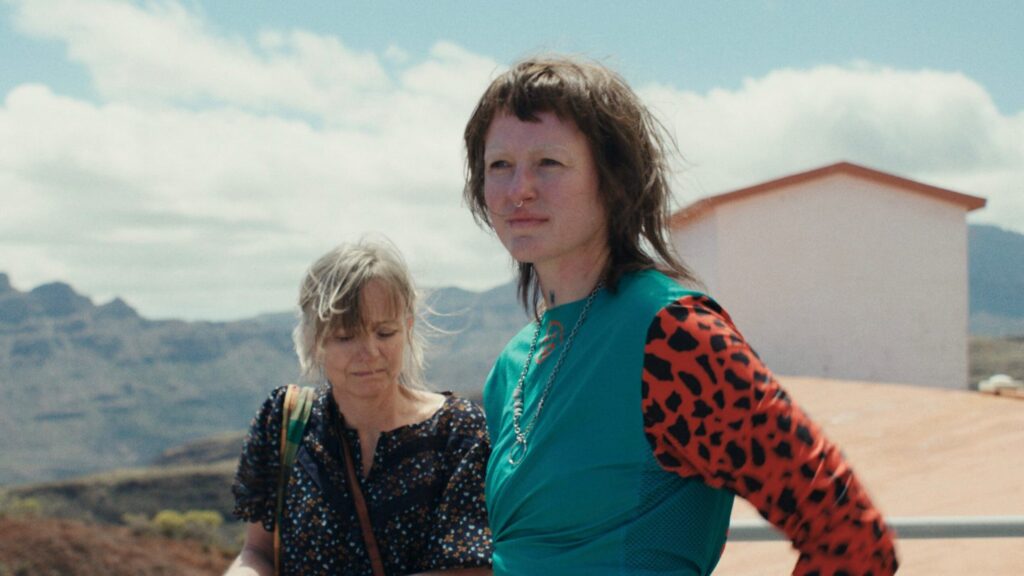
How is this elevator pitch? The film’s title is Butterfly, its setting is Gran Canaria, and its ensemble cast includes none other than best actress Oscar nominee and Sentimental Value star Renate Reinsve. If you’re not sold yet, let us mention this plot outline: Two very different and estranged half sisters, laughable performance artist Lily and the much more quiet and restrained Diana, are forced to reunite in their childhood home in Gran Canaria after their parents’ deaths, only to inherit an unfinished resort and an esoteric retreat. After all, their uninhibited mother, Vera, worked as a hostess at the resort.
The second feature from Norwegian writer-director Itonje Søimer Guttormsen (Gritt) just world premiered in the Big Screen Competition of the 55th edition of the International Film Festival Rotterdam (IFFR). Reinsve’s The Worst Person in the World co-star Helene Bjørneby, Numan Acar, and Lillian Müller also star.
For Søimer Guttormsen, it marks a return to IFFR five years after her fiction debut screened in its Tiger Competition. Protagonist Pictures is handling sales on the movie from Mer Film, Quiddity Films, Zentropa International Sweden, and Nord Film and producer Maria Ekerhovd.
Butterfly explores “one of contemporary culture’s persistent habits: talking nonsense about ourselves, inventing images and narratives of our lives and even our pasts that may be fanciful at best and often hollow,” notes IFFR festival director Vanja Kaludjercic. And she adds that the filmmaker “finds humor within darker currents, teasing out the vanity, absurdity and everyday strangeness that shape the stories we tell about who we are.”
In an interview with THR, Søimer Guttormsen discussed her inspiration for Butterfly, working with Reinsve and her other cast members, bringing back Gritt lead Birgitte Larsen – yes, as Gritt! – and developing her own film universe, taking on traditional gender roles, and what’s next for her.
Where did the idea to tell this story of the family of this butterfly woman, who leads an alternative lifestyle come from?
It came to me very much from above, like ‘bang!’, in 2008. The idea was the story of two sisters being very different, and their mother’s crazy journey as they grew up. I started wondering why they were so different. The two sisters came to me very clearly, and then I realized that they grew up in a very strange situation to which they responded very differently.
It’s funny, though, because I have no relationship with this kind of tourism at all. For holidays, we never went to these places. But Gran Canaria is the most visited place for Norwegians. There’s a Norwegian community there. There is a Norwegian church, a Norwegian school. So this is where people either go on holiday or they go there when they’re older to [spend their retired] life there.
Does Gran Canaria have a certain reputation in Norway?
It’s very common for Norwegians to go there, but a lot of people tend to hide the fact that they go there. They’re a bit embarrassed because it’s seen as a bit trashy now. But when I came up with this idea, for me, it was obvious that this woman, coming from the harsh Norwegian working class in the ’70s, felt like going there to live a more glamorous life and be a part of this tourism machine that in the ’70s was quite glamorous.
Things didn’t quite remain all that glamorous for her…
Yes, she had this breakdown with alcohol. Being very addicted to the male gaze and being this party queen with two children felt adequate. But the funny thing is that when I started go there to research, I met so many women in their 70s now – blonde, beautiful – who really came there as tourists and hosts in their early days, and ended up living in the mountains, being cavewomen and healers. So suddenly, this journey of the mother that I had invented, I found to be quite plausible.

‘Butterfly’
Did you meet any people on the island who ended up in Butterfly?
I really wanted to go and work with real people, and work with the island and find people there. So, the film is full of people who played themselves. They are real people. The film is a collage of all of those impulses.
Also featuring in the film is Gritt from your first movie. How early did you know that she would be part of Butterfly?
When I worked on that film, it was a long process, 11 years. We made it first as a short film and then had many attempts before the full feature film came out. I felt this is a woman I want to follow until she’s old. So, she will be a part of my universe. I want my different films to be in the same universe, so that I can never use the same actor in a different role. So if, let’s say, Lily or Diana show up in another feature film, they will be played by the same actress.
When I was doing my field work and went back and forth to Gran Canaria for three years, writing this story, I found this location with horses up in the mountains. And I just saw Gritt sitting there, making her embroidery in a chair, with my inner eye. So it was just obvious to me. Also, I had planted a seed in the [first] film that Gritt’s mother lives in Gran Canaria.
Tell me a bit more about this amazing cast, led by Renate and Helene!
That was an amazing process. I like to write for certain actors instead of doing it all in a casting process. When we started the casting, I had just seen The Worst Person in the World. And, of course, I thought Renate was amazing, but I thought she was not hard enough. She was so charming and soft. And I was looking for something else for Lily. So we went through 55 great actors and models, but when I met Renate, I felt differently about her. She definitely gave off a little Lily vibe. And then she really connected with the script and the character.
This is very Norwegian of me, but I was resisting using such a famous person, although she wasn’t that famous back then. I was doubting if this was good for the fiction. So, it took me a long time, three rounds.
With Helene, it was different because she starred in my graduation film. So we had worked together. I knew that she was an exceptional talent, but she lives in a different place, so I kind of forgot about her a bit. So, I wrote the role for someone else, but then Helene appeared for a screening of Gritt, and we reconnected, and she was just brilliant. And, of course, the two of them had such amazing chemistry.
Watching Butterfly, I thought about the difference between the family you have when you’re born and the family you choose, but also trauma related to sexuality, and more themes that all feel interrelated…
There are so many themes that have been important for me over time. So I’m curious about which themes you see and the ones the audience notices. But it’s all about all of these things.
I was taught in film school to be precise – there has to be about one thing, there has to be one line. But no, I don’t think so, not so much with the films I make. Life is complex. It’s all intertwined. At the core, the film is speaking about belonging and mercy and, when you think everything is fucked, the possibility to heal and change and [leave behind] your old truths and reach new [views] of yourself and the other. So it’s maybe a film about reconciliation and community.
And transformation?
Yes, they are very different people at the beginning and at the end. As the mother dies, through her death, I feel she’s mothering them post mortem. We don’t have to go and reconcile with our mother at the deathbed.
Itonje Søimer Guttormsen
Courtesy of Ingrid Eggen
Butterfly includes very timely references, including news reports about U.S. President Donald Trump, refugees, amd supply chain issues due to the war in Ukraine. How important was it for you to root the film in this day and age?
Thank you for bringing that up, because it’s so important to me. During the edit process, people would suggest we could take out some of that. But for me, it’s so important to lean into this reality, this crazy world we’re living in now. This crisis is the backdrop of the film.
My biggest wish is for this film to give some courage to live. I want people to feel like they want to go and build something together, or have a party or a gathering, invite strangers to dinner. We are in such unstable times, but there is also a possibility to create something new. And in this chaos and cracks, and who knows what’s going to be happening next, we can come together and start anew. What we should we do is not focus on this apocalyptic feeling, but celebrate life. That’s the best reaction to these stupid, insane men ruling the world now and trying to grab and dominate the world. Have joy, have fun, come together and do not be paralyzed by fear.
You mentioned men, and I felt the film commented on the patriarchy and the male gaze. Can you touch on that a little bit?
In my previous film, Gritt wants to defeat the patriarchy and capitalism. That’s her very outspoken mission. In this film, it’s more subtle
Vera is a mother who, as this blonde beauty, was trapped in the role of the pleasing woman. She was very much thriving in the male gaze and addicted to the male gaze, and she transmitted that to her daughters in different ways.
Lily is turning into this dark heroin chick, but she’s also living off her beauty, and she’s also living off men, being the muse for an artist in Hamburg etc. And then you have the other daughter, declining sexuality altogether, being [nearly] allergic to sexuality. This is what they inherit from their mother.
Chato, the male in the film, is talking about this mother wound as a poisonous notion of being an object instead of a subject, which is part of the patriarchy. He is a catalyst, which I find very positive, because it is not ruling out the men, because I think we need men and women in this healing of the patriarchy.
Do you have any new project in development?
I have a stage production in the early stages that will be a ritual, because I run this performance group called Lilithistene (The Lilithists), which is inspired by Lilith, the first woman in the Genesis who is [known as Adam’s first wife who left Eden to explore the unknown] and was thrown out.
I’m also working on a new film, which is like a response to this one, which is all over the place and has a lot of dialogue. So this new film takes place at a silent retreat. But it is in the early stages, so I think it will develop – and there will be some speaking.