
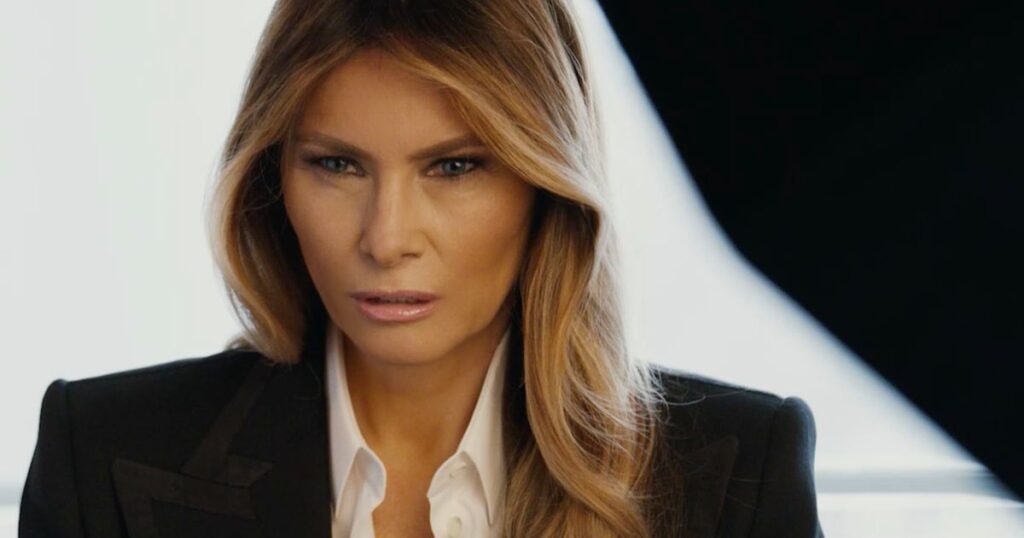
This is what we get for putting up with all those subject-approved portraits of famous people.
Photo: Amazon
We did this to ourselves. Not the second Trump presidency, though our representative democracy, however flawed, would hold that that’s on us as well. It’s Melania I’m talking about, the film about Slovenian-American fashion model turned First Lady Melania Trump, which arrived in theaters yesterday on a wave of infamy. Melania — made by Brett Ratner, a Hollywood hack who hasn’t directed since 2014 due to multiple allegations of sexual assault that emerged at the height of the MeToo movement — attracted a lot of attention for the $40 million that distributor Amazon paid for it, an unprecedented amount for a documentary even before you take into account that the company spent almost as much again on marketing. That eye-popping price looked less like an investment and more like a hefty tribute offered up to a corrupt strongman. Melania doesn’t stand a chance of making that amount back at the box office, but it doesn’t need to. It could play to thousands of empty houses all weekend and still be a success by the perverse metrics that led to its production.
The theater at my Union Square multiplex last night was maybe 40 percent full, and judging from the bursts of applause and occasional jeers, the crowd was made up with as many Donald Trump fans as hate watchers. This shouldn’t have come as any sort of surprise. Melania, which tracks its subject over the 20 days leading up to the 2025 inauguration, isn’t a MAGA screed arriving with raised middle fingers aimed at everyone who isn’t ready to get on board with its gilt-rimmed regime — though it can’t resist a few digs at the outgoing Biden administration by way of shots of a dazed-looking Joe and an exasperated Kamala Harris. Its aims are quieter and more insidious. Instead of leaning into the political, it insistently takes the form of a glossy celebrity documentary, a genre that’s become omnipresent and that we’ve been increasingly primed to accept even though it often consists of brand building exercises masquerading as movies. (The Beckham family docs, Lady Gaga or Selena Gomez’s projects, Arnold.) It attempts to enshrine Melania as the kind of figure everyone is so desperate to get more of that they’d endure this extravagantly boring experience made up of endless treks from black car to private plane to meeting to black car.
“Everyone wants to know, so here it is,” Melania says at the start of Melania, kicking off a wooden narration full of awkward platitudes. This is a fascinatingly bold claim from a woman who showed no discernible signs of public personality throughout her husband’s first term in office, and whose legacy from that period consists mainly of goth Christmas decor and a confoundingly named public interest campaign with aims no one she meets with on screen appears to understand. And what, precisely, does everyone want to know? That Melania has very exacting taste in blouse necklines? That she loves white and gold as a color combination? That she’s a fan of Michael Jackson? This is the sort of previously forbidden knowledge that Melania deigns to let us in on. There’s a formula here, one that’s been ingrained into us by countless hours of accepting hagiographic movies and series offering subject-approved glimpses into the private selves of various famous people. These properties make promises about unprecedented access, but of course, everything we see is highly controlled and mediated, and in exchange for overlooking that fact, we’re treated to a few carefully doled out instances of real vulnerability.
That’s the bargain Melania nominally tries to strike as well, though it’s unable to offer convincing proof that there is anything going on beneath Melania’s impeccably manicured surface. Her voiceover is a numbing litany of meaningless observations and claims like “For me, it’s important that timeless elegance shines through every element of the inauguration’s decor, style, and design.” She is never seen in anything less than full hair and makeup, and she appears to only be capable of two facial expressions — a professional smile and a neutral face. At one point, Ratner shoots her watching news of the Los Angeles fires, and zooms in on her eyes as though he could create visible emotion there through sheer force of will.
Ratner, who never appears on screen, does sometimes speak up behind the camera, and during one especially surreal moment, goads Melania into singing along to “Billie Jean” with him during a car ride with desperation that speaks to how little workable material he realizes that he’s getting. An attempt to humanize the First Lady by showcasing her grief over the loss of her mother the year before instead ends up feeling mystifyingly unconvincing, maybe because the scene in which Melania visits St. Patrick’s Cathedral to light a candle is so slickly filmed that it looks like a commercial. When one of the priests offers Melania a blessing, she accepts with the exact tone someone would use when offered a warm towel on an airplane.
The gap between Melania’s insistently anodyne tone and what’s happened in the year since it was filmed can become downright vertiginous, especially when Melania intones observations about her immigrant journey and how “everyone should do what they can to protect our individual rights.” But the people who’ll seek out Melania aren’t going to care about how distant it is from or contradictory it is to our brutal realities, or care about how little it delivers in terms of manufactured intimacy. Because the sort of celebrity documentary that Melania has been made in the image of aren’t made for general audiences — they’re made for fans who treat the experience of viewing them as another act of devotion to their idols.
Melania can’t, despite its efforts, make its subject look like the movie star it tries to pretend she is, but she’s not the reason people will buy tickets. They’ve come to see her husband, who saunters in occasionally and, I hate to admit it, considerably livens up the proceedings because he knows how to play to a camera. There’s small consolation to the fact that Trump, who’s posted about having seen the movie twice, surely finds it as tedious an experience as I did. Melania has been described as having an audience of one, but that intended viewer’s taste runs more toward Ratner’s earlier work, and Rush Hour 4 is going to be a lot harder to manifest than this vanity project.
Sign up for The Critics
A weekly dispatch on the cultural discourse, for subscribers only.
Vox Media, LLC Terms and Privacy Notice
See All