
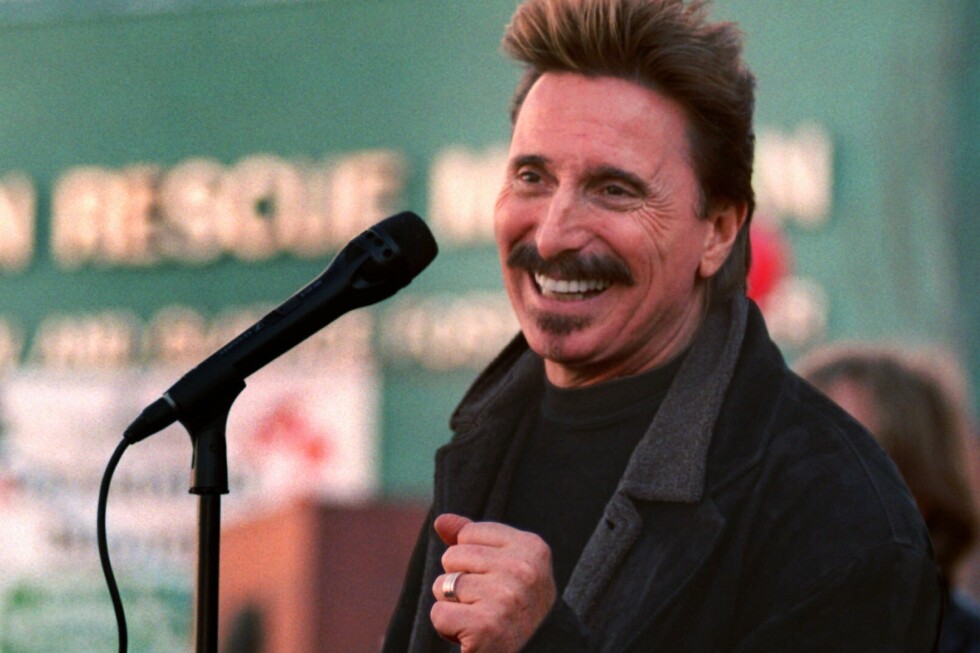
NEW YORK (AP) — Chuck Negron, a founding member of the soul-rock sensations Three Dog Night who sang lead on such hits as “One” and “Just an Old Fashioned Love Song” and hollered the immortal opening line “Jeremiah was a bullfrog!” on the chart-topping “Joy to the World,” died Monday. He was 83.
He died of complications from heart failure and chronic obstructive pulmonary disease at his home in the Studio City neighborhood of Los Angeles, according to publicist Zach Farnum.
Negron and fellow vocalists Cory Wells and Danny Hutton were Los Angeles-based performers who began working together in the mid-1960s, originally called themselves Redwood and settled on Three Dog Night, Australian slang for frigid outback weather. Between 1969 and 1974, they were among the world’s most successful acts, with 18 top 20 singles and 12 albums certified gold for selling at least 500,000 copies.
The group contributed little of its own material, but proved uniquely adept at interpreting others, reworking songs by such rising stars of the time as Randy Newman (“Mama Told Me Not to Come),” Paul Williams (“Just an Old-Fashioned Love Song”) and Laura Nyro (“Eli’s Coming”). No matter the originator, the sound was unmistakably Three Dog Night: The trio of stars worked themselves into a raved-up, free-for-all passion, as if each singer were attempting to vault in front of the others. “The Kings of Oversing,” the Village Voice would call them.
Three Dog Night was so popular, and so in demand, it released four albums within 18 months. In December 1972, the band hosted and performed on the inaugural edition of Dick Clark’s “New Year’s Rockin’ Eve.”
“We were really on a roll and very prolific,” Negron told smashinginterviews.com in 2013. “We were in the zone so to speak and really putting it out there. Back then, I don’t think it hurt us. It started hurting a little after that when there was just too much product. We were going to towns too many times a year. I remember getting off a plane in Dallas and thinking, ‘Wait a second. Weren’t we just here?’ Just thinking, ‘Oh, God, how are we going to sell out?’”
Well, hello Jeremiah
Negron himself stood out for his drooping mustache, in contrast to his clean-shaven peers, and for his multi-octave tenor. He helped transform “One,” a Harry Nilsson ballad, from a breakup song to a cry of helpless solitude. And he helped convince Wells and Hutton not to pass on what became their most famous song.
“Joy to the World,” written by Hoyt Axton, shared the title and little else with the 18th century English hymn. Axton’s novelty anthem was a secular blessing — “Joy to the fishes in the deep blue sea, joy to you and me” — with carefree asides about women, rainbow-riding and the friendship of a wine-guzzling bullfrog named Jeremiah. According to Negron, the other singers had twice turned down “Joy to the World” in his absence before Axton played him a demo.
“When he started, I liked it immediately. I thought we could have some fun with it,” Negron told forbes.com in 2022. “We had some free time later, so we started jamming ‘Joy’ for fun. We didn’t have to be so cool all of the time, right? That opening line had to be screamed. Did that guy just say, ‘Jeremiah was a bullfrog’? I got up the scale to D, which is pretty high, and just screamed it out. When the band heard that, they went, ‘Holy crap, that’s great.‘”
No one seemed to care what “Jeremiah was a bullfrog!” was supposed to mean; it became a catchphrase of the era. “Joy to the World” outsold all other songs in 1971, received two Grammy nominations and lived on through oldies radio stations and movie soundtracks, notably for “The Big Chill” and “Forrest Gump.” The song caught on so fast, and for so long, that Three Dog Night performed it at back-to-back Grammy ceremonies.
Their other hits included “Black and White,” “Celebrate,” “Shambala” and “Easy to Be Hard.” But by the mid-1970s, the band was burned out, feuding and self-destructing. They broke up in 1976, attempted the occasional reunion and settled in as an oldies act, with Hutton the only remaining original singer. Wells died in 2015, while Negron had dropped out for good in the mid-1980s, when his drug problems led to his being fired.
Negron would call his memoir, published in 1998 and reissued 20 years later, “Three Dog Nightmare.” Chapter titles included “Making Millions and Stoned All the Time” and “Threw Up My Guts and Loved It.”
After decades of estrangement between him and Hutton, the two men reconciled last year.
Negron was married four times, most recently to his manager, Ami Albea Negron, and he is survived by five children His previous wives include Julie Densmore, former wife of drummer John Densmore of the Doors.
Surviving a rock star’s life
Born Charles Negron II in 1942, he was a New York City native who was still a toddler when his parents broke up: For a time, Negron lived in a foster home because his mother couldn’t afford to raise him and his twin sister, Nancy. He initially dreamed of playing basketball, but his life changed in adolescence when his best friend convinced him to try singing. He won a school talent show, and was soon singing professionally, at the Apollo and other venues around New York.
After graduating from Hancock, a junior college in Santa Maria, California, Negron performed in clubs in Los Angeles and met Wells and Hutton, whose friends included Brian Wilson of the Beach Boys. They nearly signed with the Beach Boys’ Brothers Records before Wilson’s bandmates, worried that their leader was using up his talents elsewhere, intervened. Negron, Wells and Hutton ended up at ABC-Dunhill, and recruited a backing band, including Floyd Sneed on drums, Joe Schermie on bass and Jimmy Greenspoon on keyboards.
In his post-Three Dog Night years, Negron released several solo albums, including “Joy to the World” and “Long Road Back,” a companion to his memoir, and otherwise dedicated himself to helping others struggling with substance abuse. Before cleaning up in the 1990s — Sept. 17, 1991 — he had been so addicted to heroin and other drugs that he nearly died numerous times, lost his family and all of his money and descended from a luxurious villa in Hollywood Hills to sleeping on a mattress in a vacant lot.
“That’s what drugs do. I don’t care if it gives you a hit song. What does it matter?” he told smashinginterviews.com. “The point is not if it helps you create, the point is it kills you! Are you willing to die because you wanted to try drugs to try a new experience? That’s the question. I’m in a town here where there are many who ain’t the same and never will be.”
___
Associated Press writer Beth Harris in Los Angeles contributed to this report.