
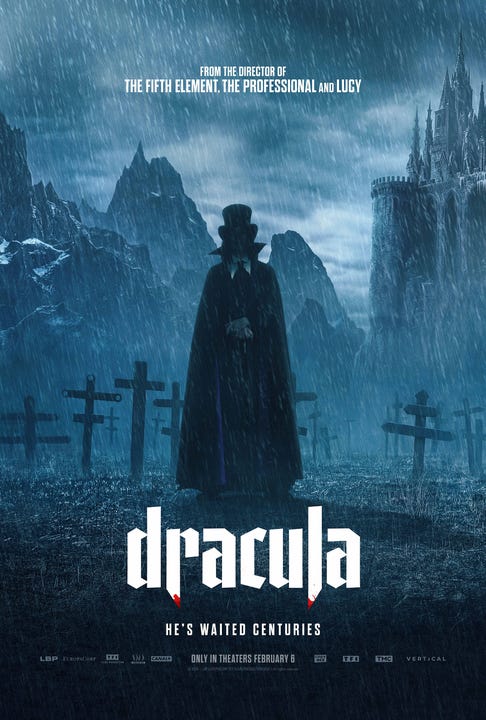
Dracula will be released in theaters on February 6.
At last, they’ve done it! They’ve made a movie based on Dracula! Oh, wait, what’s that? They are making Dracula movies all the time? Almost constantly one might argue?
Look, Dracula is an all-time great story anchored by an all-time great horror villain that has given us a ton of memorable films and TV shows since it debuted in 1897. But lately, it feels like there was some sort of bet between studios and producers to see how many different versions we could get close together.
Since 2023 alone, we’ve had Renfield, The Last Voyage of the Detmer, Abigail, Nosferatu, and Abraham’s Boys – all of which were derived from the original Dracula story to some capacity, whether it be using specific story elements or characters or by creating their own sequel scenarios. And now we have yet another film, which is going simple on the title level and leaving it at Dracula.
And the movie is… fine. But it feels like if you’re going to do this story again, especially right now, fine isn’t quite enough.
Written and directed by Luc Besson, this version is a more direct adaptation of the novel than other recent takes on the story (Nosferatu’s name-changed version aside), with Caleb Landry Jones starring as our not-so-good count. But where the credits only say the film is based on Bram Stoker’s novel, it sure seems like they should have thanked screenwriter James V. Hart and director Francis Ford Coppola as well, because wow does this version owe a lot to their 1992 film Bram Stoker’s Dracula.
It was Coppola’s movie that directly introduced the idea that Mina, the girl Dracula is targeting in Stoker’s original story, is the reincarnation of his great love from when he was human. Besson’s film uses that concept as its central conceit, even echoing some of the structure changes that movie added to the story, with a similar opening where a pre-vampire Vlad returns from war, only to find he’s lost Elizabeth (played here by Zoë Bleu, who also plays Mina) – albeit with the specifics changed up of how and why this occurred.
This is an aggressively weird film at times, which leans into comedy more than you might expect.“
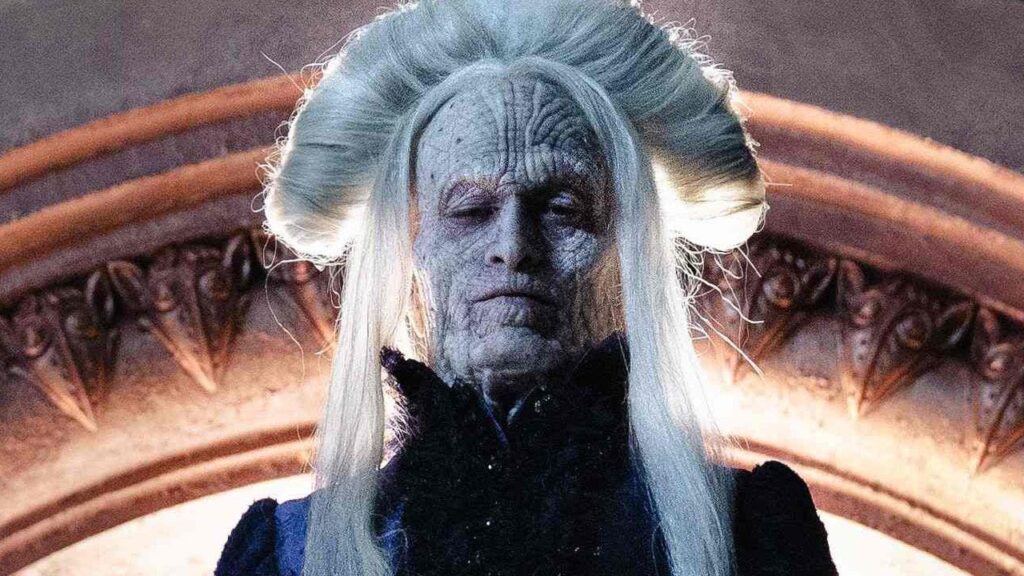
Also riding the line between loving homage and blatant copying is the look of the decrepit Dracula when Jonathan Harker (Ewens Abid) goes to his castle, which is very clearly modeled after Gary Oldman’s memorable makeup and white wig in the 1992 version, which at the time was a very new spin on Dracula. All of which makes this a Dracula movie with an uphill battle, because on the surface, rather than justifying its existence with an interesting new take on Dracula, it’s mimicking someone else’s interesting take on Dracula.
And yet there are points where the movie was winning me over. This is an aggressively weird film at times, which leans into comedy more than you might expect, and some of it is legitimately strangely funny. That includes the scenes between Jonathan and Dracula, in which the unaware lawyer is fumbling with his papers and keeps missing “You’re with a vampire!” red flags like the Count killing a mouse and draining its blood into a cup to drink or using the telekinesis powers he leans heavily on in this movie to rid himself of a potential weapon that could be used against him. There’s also a moment where a vampire is decapitated that includes a rather hysterical physical comedy beat that felt like it was out of a Sam Raimi/Bruce Campbell Evil Dead movie in terms of bonkers, cartoon-style zaniness mixed with gore.
If the movie had just fully committed to this sort of tone, it probably would have been for the best, but it also seems like we’re meant to take its central love story – and how Dracula’s adoration for Elizabeth has kept him going for hundreds of years until he meets Mina – and be truly invested in it. But that never really clicks in, because it’s all too heightened and plays too silly from the start. This goes for an opening montage of Vlad and Elizabeth in their oh-so happy days before he’s sent to war that has so much grinning and frolicing – they’re gleefully jumping around! They’re having a playful food fight! – that it feels like it’s from The Naked Gun.
One of the most curious yet intriguing elements of the movie is its choice of lead actor. Caleb Landry Jones is extremely talented, as proven in projects like Get Out, Twin Peaks: The Return, and Nitram. But as much as it’s great to see actors stretch themselves in different types of roles, there’s a reason Landry’s been cast as so many quirky characters – whether they be troubled, outright villains, or goodhearted – and that’s because there’s a certain aura he projects and excels at.
Little about his presence or physicality is a great fit for the early scenes in Dracula where we’re meant to believe he’s the greatest, most skilled warrior on the battlefield in his prior human life. And despite being in his mid-30s, Jones also still looks quite boyish, which makes him an odd fit for the would-be debonair, sophisticated version of Dracula who seeks to woo Mina. Still, Jones is always compelling on screen, and he excels in offbeat scenes like the ones in which Dracula is toying with Jonathan – including when he lets out one hell of an amazing wild and wheezing extended laugh when the lawyer manages to amuse him.
What’s funny is that Besson has basically said this version of Dracula exists because, after working with him on 2023’s Dogman, he was so taken with Jones that he crafted his script with the actor in mind. Besson has had a lot of misfires and duds in recent years, and he’s never been able to consistently recapture the strength of his early output in the 1990s when he was delivering films like La Femme Nikita, The Professional and The Fifth Element. With Dracula, he shows he still has a good eye and, while the movie strains within what is clearly a restricted budget, often looking smaller than you feel it’s meant to, there are some clever visual flourishes, such as the image of an army standing across a burning horizon. But then there are the little CGI gargoyles who serve as Dracula’s minions, which are among a few baffling additions.
Perhaps the oddest addition to the Dracula lore here is that rather than simply giving him the power to enthrall, he uses a special perfume that magically puts women under his sway, which is represented by a full blown dance number montage of women adoring him. That sequence is sort of fun, but it’s also kind of dumb, and it feels rather random like much of the film. I suspect its randomness will work better for some than others, because there is something to be said for going this wacky at times. But it never feels all that cohesive and never truly takes off.
The supporting cast are all solid, led by the great Christoph Waltz as this film’s version of the vampire hunter Van Helsing – here reimagined as a never-named priest who’s seen it all. It’s not exactly a challenging role, as Waltz is given plenty of semi-snarky comedic throwaway lines, the likes of which he can deliver in his sleep at this point, although it is funny that the actor has now appeared in new versions of both Frankenstein and Dracula within just a few months of each other.
25 Best Vampire Movies of All Time