
Last year’s Oscars narrative might have been more about the little films that could, from The Brutalist to Anora to Emilia Pérez, but this year has become closer to the opposite with big-budget films like Sinners, One Battle After Another and Frankenstein all leading the way.
It’s therefore not quite as easy to explain why some of Hollywood’s biggest stars, from Julia Roberts to Dwayne Johnson to George Clooney to Emily Blunt to Adam Sandler, found themselves removed from the race. So here goes …
The Smashing Machine Photograph: Everett/Shutterstock
It was Safdie versus Safdie this past autumn with the directing duo splitting to do their own thing even if their own thing ended up being kind of loosely the same. The brothers both picked to make a sports biopic just not in the way many of us traditionally expect – A24-released, focused on a figure many of us don’t know, more vibes than arc-led – and it seemed like Benny might have the more obvious awards play with The Smashing Machine. He had a Hollywood heavyweight in Dwayne Johnson doing the serious transformative thing the Academy have long loved, he had Oscar nominee Emily Blunt in support and a big Venice film festival premiere complete with a 15-minute standing ovation and a leading man in tears. But the film was a little too inside baseball, not just for the public (it staggered to a puny $21m global gross) but for critics and voters who brushed it aside for Josh’s still unconventional but far more grabby Marty Supreme. Johnson will return in Jumanji 3.
After the Hunt Photograph: Amazon Content Services LLC/PA
After both Challengers and Queer failed to seduce enough of the Academy, it seemed like director Luca Guadagnino would be on safer ground with After the Hunt, an older-skewing, campus-set drama about a #MeToo fallout. Weinstein reportage drama She Said might not have set the Oscars alight but this one was led by Oscar-winning American sweetheart Julia Roberts, supported by Oscar nominee Andrew Garfield and The Bear’s awards magnet Ayo Edebiri. It also had a Venice premiere, and with its provocative subject matter there was an expectation of impassioned debate on the ground. Sadly the main question being asked was less how could she/he? and more huh? The film dropped out of the race almost immediately, an equally unimpressed audience greeting its New York film festival premiere before audiences showed zero interest in getting involved (the $80m production couldn’t even make it to $10m worldwide). Roberts might have scored a Golden Globe nod but her Oscar chances were dead in the water and Guadagnino remains out in the cold for the Academy.
A House of Dynamite Photograph: Netflix
If the majority of reactions from Venice were to be believed, Kathryn Bigelow had another slam-dunk on her hands with clammy nuclear weapon thriller A House of Dynamite. It was showered with praise and seemed like Netflix’s surest awards play given the director’s history with the Academy, winning an Oscar for The Hurt Locker before Zero Dark Thirty received five nods. But then it landed at the New York film festival with a thud, a notorious press screening that led to laughs and groans and suddenly its chances started to fade. It eventually had a similar reaction on Netflix, baffling those who bothered to watch the whole thing, and the streamer’s overall campaign strategy started to de-prioritise the film which deservedly ended up with zero nominations.
Deliver Me from Nowhere Photograph: Macall Polay/PA
This should have been one of the easier wins of the season – or at least nominations. A Bruce Springsteen biopic made by a director who previously led an actor to a win (Jeff Bridges for Crazy Heart) starring someone with a history of impressing awards bodies (The Bear’s Jeremy Allen White) released the year after another drama about an older musician was a critical and commercial success (A Complete Unknown) pushed by the same studio (Disney) and launched at a prestige festival (Telluride). So how did Deliver Me from Nowhere fail? The film, later given the panicked IP-aware retitle of Springsteen: Deliver Me from Nowhere received polite reviews upon its premiere, polite enough to suggest White would be in the race but it fell fast, never giving fans enough of what they wanted (it made a shocking $22m in the US, over $50m less than the Dylan biopic) while also failing to transcend well-known formula. In a year that saw initial best actor predictions revised right after the fall festivals, this was one of the more surprising misses.
Christy Photograph: Eddy Chen/Black Bear
In the overly schematic strategy of Sydney Sweeney’s career, a film like Christy made perfect sense. The Euphoria breakout had graduated to small, well-reviewed proof-of-talent drama Reality to glossy romcom Anyone But You to final girl horror Immaculate and inevitably, an awards play was next. Christy managed to tick a number of go-to boxes – true story, de-glammed transformation, boxing – and after a fall festival premiere was set, at the more commercially leaning Toronto, and with a best actress category that was, at that stage, lacking in surefire contenders, it seemed like a win for Sweeney (and after that American Eagle ad, she really needed one). Some initially, over-excitedly, labeled her a contender but the film was a box office disaster, one for the history books, and with some middling reviews, she couldn’t even score a nod at the more celeb-thirsty Golden Globes. As the best actress race became more competitive, she become a distant outsider.
Jay Kelly Photograph: BFA/Alamy
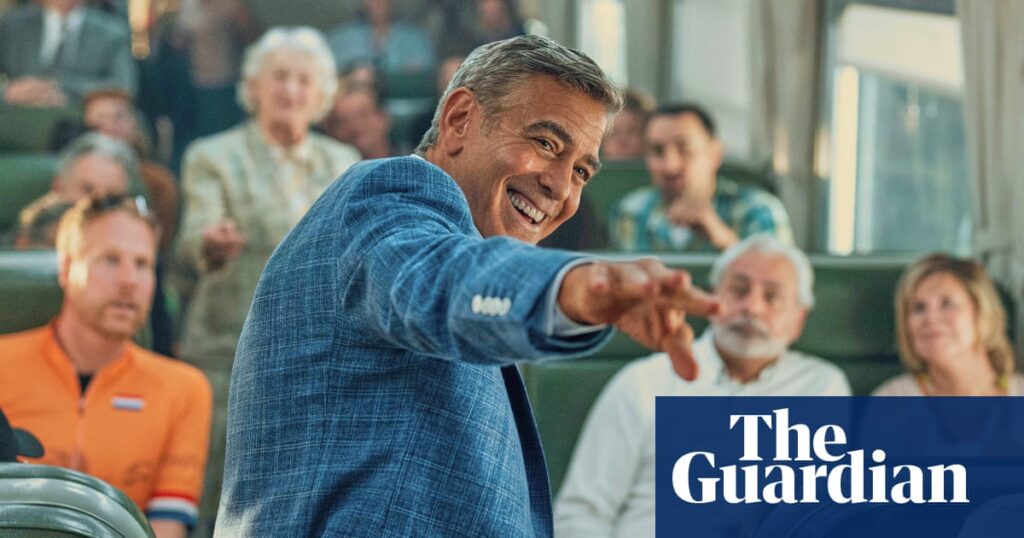
While The Squid and the Whale might have scored Noah Baumbach an Oscar nomination for best original screenplay, the writer-director did not make for an obvious Academy darling. His following films Margot and the Wedding and Greenberg, which found him at his most sour, pushed him even further away and it took his most personal film, and arguably his best, Marriage Story, to suddenly turn him into a real Oscar favourite. The film was nominated for six, winning one for Laura Dern, and while White Noise might have landed with a thud, Baumbach was nominated once again for his Barbie screenplay with Greta Gerwig. Jay Kelly, with a starry cast led by George Clooney, film industry plotline and splashy Venice premiere, seemed like it could help Baumbach get his first Oscar and maybe Adam Sandler his first. But reviews were mixed with some more scalding (the Guardian’s Peter Bradshaw opted for one star) and the Clooney comeback narrative folded, a film of old-fashioned American sentimentality that failed to impress the new, more international Academy.
Wicked: For Good Photograph: Universal Pictures/AP
While Wicked might not have swept the board last year in the way that many ardent fans had hoped, the coulda-gone-either-way big bet was still a major contender, nabbing two wins and another eight nominations. It was naturally assumed that the follow-up, released a year after, would do the same and even after reviews were less enthused, downgraded expectations still had experts predicting Ariana Grande would secure her second best supporting actress nod in a row along with recognition in a ton of craft categories. But the film was entirely shut out, a staggeringly precipitous fall that had some questioning whether releasing the films so close together was such a great idea after all (the sequel was also down $250m on the original’s global box office). It was in some ways reassuring, voters refusing to automatically, and lazily, put a lesser sequel on the ballot just because (there was also a 22% drop on Rotten Tomatoes), allowing for some less by-the-book picks instead.
The Ballad of a Small Player Photograph: AP
No one quite saw Edward Berger’s All Quiet on the Western Front coming. The third adaptation of Erich Maria Remarque’s anti-war novel was given a quiet Toronto premiere from Netflix in 2022 and in its awards campaigning that year, the film was de-prioritised in favour of The Good Nurse, White Noise and Blonde. But it slowly became their safest bet with 14 Bafta noms and nine at the Oscars (it ended up winning four). Berger became an in-demand director and all eyes were on his adaptation of Robert Harris’s papal thriller Conclave. But again no one expected that to be the force it ended up becoming, making $128m globally and garnering eight Oscar noms (it won one for best adapted screenplay). Could he make it three for three with The Ballad of a Small Player? Despite everything in place – Oscar nominee Colin Farrell, Oscar winner Tilda Swinton, Telluride premiere – the film just didn’t connect – too flashy, too loud, too messy – and almost immediately became a low priority for Netflix and voting bodies.
Is This Thing On? Photograph: Searchlight Pictures/PA
When Bradley Cooper first broke out, even his most supportive family members could not have predicted that the guy who mostly played jockish dudebros would become a 12-time Oscar-nominated actor-writer-producer-director. His directorial debut A Star Is Born was a $436m-grossing award-winning smash and even if his follow-up Maestro didn’t find as many fans, it still received seven Oscar nods and it seemed like whatever he went on to make would automatically be in the conversation. Except no one ended up saying much about his smaller-scale third film, divorce comedy drama Is This Thing On? which premiered at the New York film festival and couldn’t make enough noise at a time when the race was seeming to firm up. It was lost within the fall festival circuit before it was lost within the December stampede of qualifying releases, another tough break for Searchlight, which couldn’t find love for this, The Testament of Ann Lee or …
Rental FamilyRental Family Photograph: Entertainment Pictures/Alamy
The Brendan Fraser comeback narrative was powerful enough in 2023 to score the actor his first Oscar for a film that was otherwise deemed a bit of a disaster. The Whale, a film the Guardian’s Peter Bradshaw generously called “vapid, hammy and stagey”, gave Fraser an Academy-friendly transformation and his off-screen story was persuasive enough, although his inevitable Oscar-primed follow-up couldn’t quite make the distance. Rental Family, which premiered at Toronto, was a more obviously feelgood story and actually scored better reviews than The Whale, but in a best actor category that was becoming increasingly competitive, Fraser – like Clooney, Johnson, White and Farrell – was another well-known name who didn’t feel like an indispensable part of the race.