
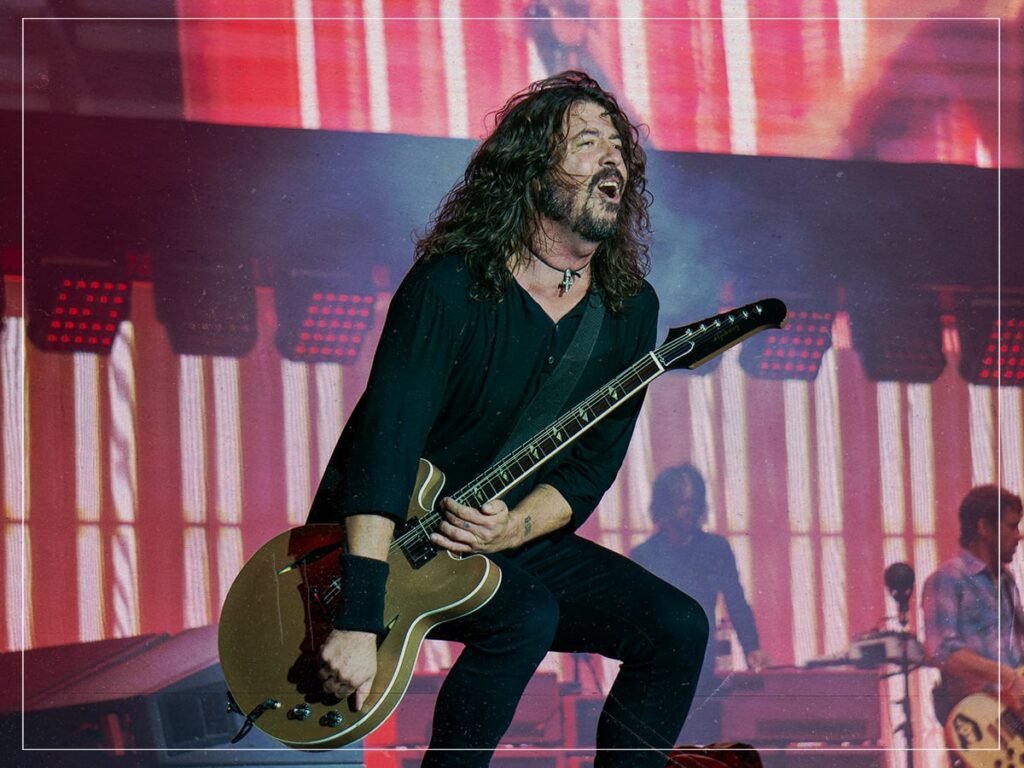
(Credits: Far Out / Raph Pour-Hashemi)
Fri 6 February 2026 17:15, UK
Dave Grohl was born to play drums from the minute he started taking music seriously.
There are plenty of times where he proved to be one of the greatest songwriters of his generation, but there’s something about him pounding out the rhythm that made him feel right at home whenever he tore through those old Nirvana classics. But even when he swapped over to the frontman role, he was always listening out for how the entire band sounded whenever Foo Fighters took the stage.
After all, he wasn’t going to spend his time working on a record if he felt that there was a weak link in the mix. He had already been through the trouble of watching William Goldsmith quit halfway through The Colour and the Shape, but after Franz Stahl didn’t click with the rest of the group, there had to be some fans wondering if Grohl was being a little bit too controlling over what he wanted the band to sound like.
It’s not like Foo Fighters was ever a democracy, but Grohl’s ideas were about far more than calling the shots. ‘Everlong’ would have never been a classic without that phenomenal drum part, and even when he was building pieces of ‘The Pretender’, every single guitar played off each other perfectly whenever they locked in with the drums. But even in a band this solid, the bass player is always the secret weapon of the group.
Nate Mendel might not get the same kind of praise that the rest of the band does, but the bassist normally has all the power in the context of a band. They get to be both a melodic instrument and a rhythm instrument at the same time, and if they decide to veer off track every now and again, the rest of the band would fall apart. And that fact was nowhere more apparent than the minute Grohl started working with John Paul Jones.
All of those Zeppelin basslines were incredible when Jonesy first joined the band, but in a band like Them Crooked Vultures, there was a lot more heavy lifting going on behind the scenes. Any trio like that would need to be able to support each other perfectly, but apart from the brilliant keyboard lines and orchestrations that he did, Grohl was only too flattered to be working with one of the legends of the low end.
Any rhythm section needs to be joined at the hip, but Jonesy’s mojo on the four-string wasn’t lost on Grohl the minute that he sat behind the kit to play tunes like ‘New Fang’, saying, “I’m like, ‘Oh my God, Josh [Homme], John Paul Jones from Led Zeppelin, he wants to come over and jam.’ We set up a time for him to come over and jam with us. Josh plays the drums. He plays the guitar like a drummer and John Paul Jones is the greatest rock’n’roll bass player in the history of music. When we sat down to start playing, it was about 30 seconds to a minute and we realised this is a real band.”
But what makes Them Crooked Vultures work so well is how different it is from everything that any of the three members have ever done. Homme clearly brought that sinister edge of Queens of the Stone Age into the picture, but throughout the record, it feels like the kind of album that would have been one of the biggest bands in the world if it were released circa 1979, especially with the massive riffs on ‘Gunman’.
And if nothing else, the Vultures only served to prove the kind of musical juggernaut that Jones always was back in the day. Grohl might have already been a surrogate John Bonham for anyone to pick up two sticks in the 1990s, but the gut punches that they packed into this record only served to remind people that the bassist was the same guy that made tunes like ‘Black Dog’ back in the day.
Related Topics