
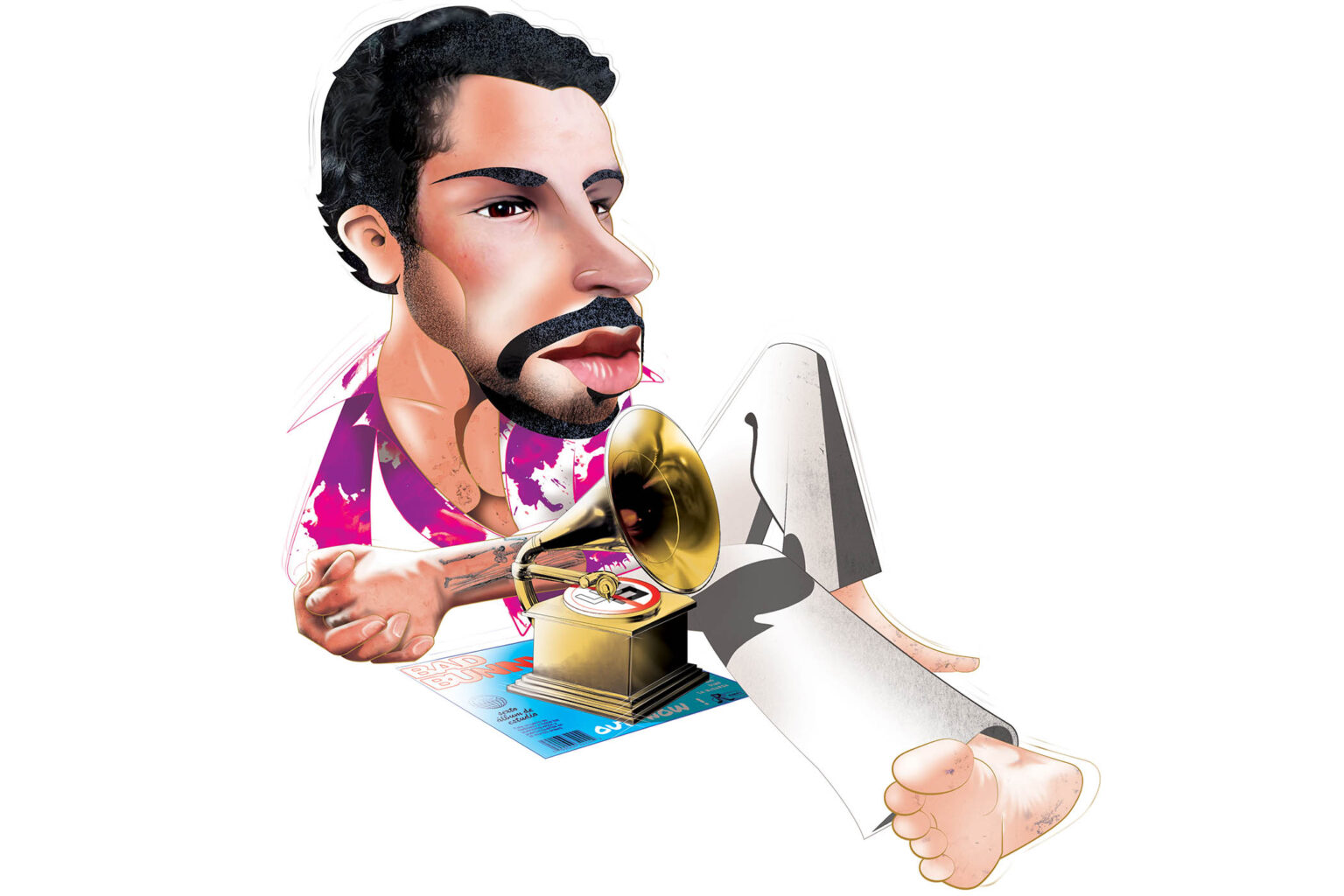
Bad Bunny has been busy. On Sunday the Puerto Rican musician (real name: Benito Antonio Martínez Ocasio) will be the first male Latin performer to headline the half-time show at the NFL Super Bowl (Gloria Estefan headlined in 1992 and Jennifer Lopez, with Shakira, in 2020). Staged at Levi’s Stadium, Santa Clara, California, the game between the Seattle Seahawks and the New England Patriots could attract an audience of 120 million in the US alone.
Expected to draw huge numbers of new Latin viewers, Bad Bunny’s Super Bowl has evolved into a culture war flashpoint. A Quinnipiac University poll showed 74% of Democrats approving him as a headliner and 63% of Republicans disapproving.
President Trump, who won’t attend, decried Bad Bunny headlining as “sowing hatred”. An alternative Super Bowl “All-American Halftime Show”, headlined by Kid Rock, has been organised by Turning Point USA, the hardline rightwing group founded by the late Charlie Kirk.
Last week there was more controversy for Bad Bunny when the “King of Latin Trap”, and Spotify’s most-streamed artist in four of the past six years (outperforming Taylor Swift in 2025 with more than 20 billion streams), attended the 68th annual Grammy awards.
Winning album of the year for Debí Tirar Más Fotos – a first for a Spanish-language composition – Bad Bunny generated global headlines by declaring: “ICE out”, referring to US Immigration and Customs Enforcement, who were responsible for the deaths of Renée Good and Alex Pretti in Minneapolis in January.
Referencing his fellow Puerto Ricans, Bad Bunny said: “We’re not savages, we’re not animals, we’re not aliens. We are humans and we are Americans.”
Agnes Lugo-Ortiz, associate professor of Latin American literature at the University of Chicago, contextualises the events surrounding Bad Bunny as a national “moment of crystallisation”.
His activism has been passionate, revolving around sociopolitical issues faced by Puerto RicoHis activism has been passionate, revolving around sociopolitical issues faced by Puerto Rico
America, she says, “is generally contemptuous of anyone not identified as white – whatever white might mean in their mind”. The Super Bowl, Lugo-Ortiz feels, “complicates the notion of Americanness”, while “the Grammys puts in the foreground the values, music, and aesthetic power of Hispanic culture”.
Bad Bunny, 31, was raised by a former schoolteacher mother and truck-driver father in the seaside town of Vega Baja outside Puerto Rico’s capital, San Juan. A shy child, he was making music from the age of 13, uploading tracks to SoundCloud, influenced by Latin performers Marc Anthony and Ricky Martin, and reggaeton artists such as Tego Calderón and Daddy Yankee.
He was still at college, bagging groceries for money at a supermarket, when the track Diles was picked up by a Puerto Rican label, going on to garner millions of plays.
NewslettersChoose the newsletters you want to receive
Clear, calm analysis on the stories driving the day’s news.
The very best of our journalism, reviews and ideas – curated each day.
A dispatch from The Observer’s kitchen table – from Nigel Slater’s recipes to interviews, features and hot tips.
For information about how The Observer protects your data, read our Privacy Policy
Since his 2018 debut album, X 100pre, the musician – “the most-listened-to Latin artist on Planet Earth”, according to Rolling Stone – has become celebrated for promoting reggaeton, salsa, bomba y plena and other Latinx disciplines.
Winning multiple Grammys, among other awards, he’s collaborated on English-speaking hits with artists such as Cardi B (I Like It) and Drake (Mia). However, Bad Bunny increasingly works in the Spanish language, rejecting the industry template for crossover acts: that they must conform and work in English – become culturally absorbed, as it were – to achieve global success.
Bad Bunny’s activism, like his music, has been passionate and prolific: revolving around sociopolitical issues faced by Puerto Rico (a US colony where the US citizens play US taxes but can’t vote for the US president), and his devotion to his island homeland.
He denounced the US federal response to 2017’s Hurricane Maria on The Tonight Show With Jimmy Fallon. He performed a 30-date residency in San Juan that boosted the local economy, Swift-style, by an estimated $200m, according to the Puerto Rican tourist board. He dropped US dates from his ongoing world tour, which started in November and finishes in Brussels in July, fearing ICE would target fans. His songs – including Nuevayol (criticising anti-immigration sentiment) and DTMF (musing about diasporas) – are frequently politically front-loaded.
“What I find powerful is that Bad Bunny doesn’t try to be anybody else,” observes Danielle Roper, associate professor of romance languages and literature at the University of Chicago, “He doesn’t tone down the fact he’s predominantly a Spanish-speaking artist in a moment where there’s pressure to assimilate, to not ruffle feathers.”
Somehow, the tireless creator finds time for acting: his films include 2022’s Bullet Train and Darren Aronofsky’s Caught Stealing. He’s also engaged in professional wrestling, allying with Damian Priest to become a WWE 24/7 champion in 2021. Moving to Los Angeles in 2023, he once had a high-profile relationship with Kendall Jenner, but he’s currently single.
Bad Bunny’s work has been criticised for being sexist and vulgar: Diles focused on females preferring certain sexual positions. Contrastingly, he’s known for sporting a striking style signature of neon suits, Crocs and painted fingernails, and exploring ideas of ambiguous masculinity and queer aesthetics.
One video, for the 2020 track Yo Perreo Sola features Bad Bunny provocatively dragged up, chiding men to leave women alone. Many hailed him as a queer icon; others, as a straight-boy opportunist. He defines himself as sexually fluid, telling the LA Times: “One never knows in life. But at the moment, I am heterosexual and I like women.”
Is Bad Bunny going to lead an anti-Maga Super Bowl? Some predict he will at least deliver a Spanish-language performance in honour of his roots. At a press conference last week, he teased: “It’s going to be a huge party.”
Roper views him as defined by politicised defiance. “He refuses to pretend he’s not who he is.” Lugo-Ortiz calls him “extremely brave… The safe thing would have been to cross over, sing in English, remain neutral, not be outspoken. He decided to affirm his cultural values, beliefs and Puerto Rican roots… He took that risk.”
What’s certain is that Bad Bunny will take to one of the largest global stages as someone who refused to downplay his Latin heritage, and, in that sense, single-handedly rewrote the script for crossover artists.
Benito Antonio Martínez Ocasio, AKA Bad Bunny
Born Bayamón, Puerto Rico
Work Musician, actor, wrestler
Relationships Dated Kendall Jenner, currently single