
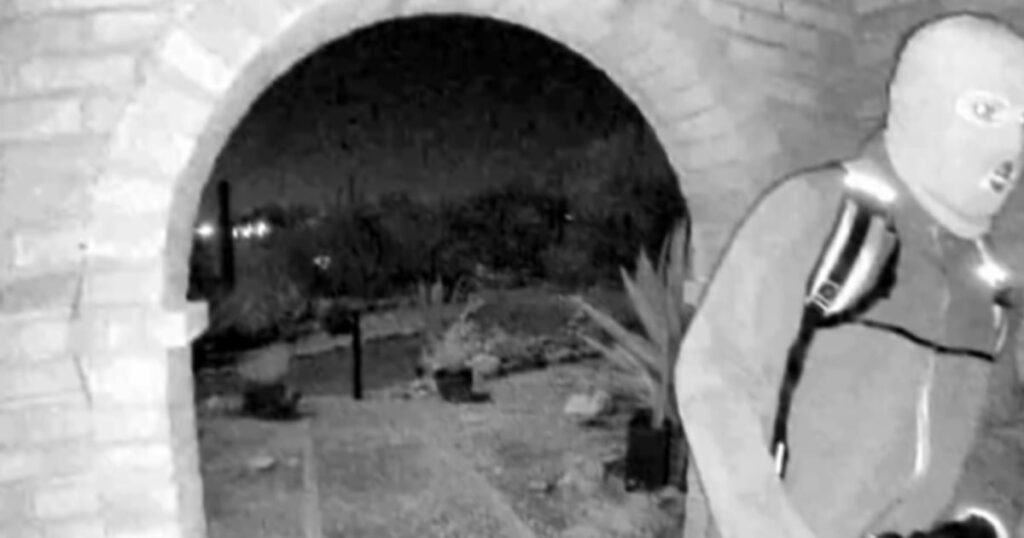
After an excruciating 10 days without much to go on, authorities looking for Nancy Guthrie finally have a potential big break: video of an armed, masked person at her doorstep the morning she went missing.
The black-and-white video captured by Guthrie’s doorbell camera, which the FBI and the Pima County, Arizona, Sheriff’s Department shared Tuesday, gives investigators clues that could help their search.
“When you get video, it opens up many new avenues and details,” said Eric Draeger, a former Milwaukee police detective who specialized in high-tech tools. “Detectives hope to get something like this in a case like this.”
Bryanna Fox, a criminology professor at the University of South Florida, agreed. “This is the game changer we were waiting for,” she said.
Tips have dramatically increased since the images and video were released, an FBI source told NBC News.
Guthrie, 84, the mother of “TODAY” co-anchor Savannah Guthrie, was reported missing by her family in Tucson around noon Feb. 1 after she did not show up for virtual church services. She was last seen the previous evening, after having had dinner at daughter Annie Guthrie’s home, according to the sheriff’s department. Savannah Guthrie posted one of the new video clips on Instagram on Tuesday: “Someone out there recognizes this person. We believe she is still out there. Bring her home.”
The videos show a person in a ski mask, gloves, a dark jacket and light pants, wearing a backpack and a front-holstered gun, approach Nancy Guthrie’s front door and tamper with the doorbell camera.
The most obvious clues are the clothing, starting with the backpack, which has reflective strips, pockets and stitching that could help investigators figure out the manufacturer and where it might have been purchased — or someone watching the video might recognize it, former police investigators said. There are enough discernible details on the jacket that it, too, might be identified.
Draeger said that while he was watching the videos, he noticed that the person did not immediately move to the doorbell camera, instead looking to the camera’s left before facing it and fiddling with it with a gloved hand. That suggested to Draeger that the person was not a regular visitor to the home.
The person then walked back toward Guthrie’s front yard, grabbed a handful of plants and tried to cover the camera with it. That move struck former investigators as possibly an improvisation by someone who did not plan things out very well.
“He’s trying to conceal his identity, but he’s not exactly a ninja here,” Draeger said. (Authorities have not released the person’s gender.)
Christian Quinn, former deputy chief of the Fairfax County Police Department in Virginia, said the way the person approached the front door rather than another entrance, appearing to move nonchalantly without blocking the camera, indicated that it was not a sophisticated operation. “It’s not well thought-through,” Quinn said.
Howard Ryan, a former New Jersey State Police crime scene investigator, said he expected authorities to try to enhance the video in an attempt to use facial recognition on the person’s eyes and mouth.
Another detail former investigators focused on was the person’s gun, hanging in a holster under the front waist — a way of carrying a firearm that could stick out to someone who saw the person that evening.
“That alone might give somebody pause to recall that they have seen someone like this at a public gun range or have a friend who they’ve seen do this, and then they’ll make a phone call,” said Jim Bueermann, a former detective and police chief in Redlands, California.
Jim Cavanaugh, a retired special agent of the Bureau of Alcohol, Tobacco, Firearms and Explosives who is now an NBC News law enforcement analyst, said holding a gun that way is known as an “appendix carry,” which some people find comfortable. “This is a very, very, very popular way to carry guns in the concealed carry world,” he said.
Cavanaugh said the ATF personnel who work in the firearms and ammunition technology division could probably identify the gun based on the handle.
Even if the details do not lead investigators to the person, the videos might help someone else identify them, Cavanaugh said.
“What you really need is that tip — ‘My husband has a backpack like that, and he wasn’t home Saturday night,’” Cavanaugh said. “This will lead them to solve it. This guy is identifiable to people who know him. Once they get the right tip, they’ll be able to close the circle.”
Michael Alcazar, a retired detective who spent 30 years with the New York Police Department, said the images have enough detail that someone could recognize the person.
“The way he walks, his gait, how he’s hunched over — all of these things are invaluable,” said Alcazar, who is an adjunct professor at John Jay College of Criminal Justice in New York. “We may not be able to identify him because we don’t know him, but somebody who has had contact with him would.”