
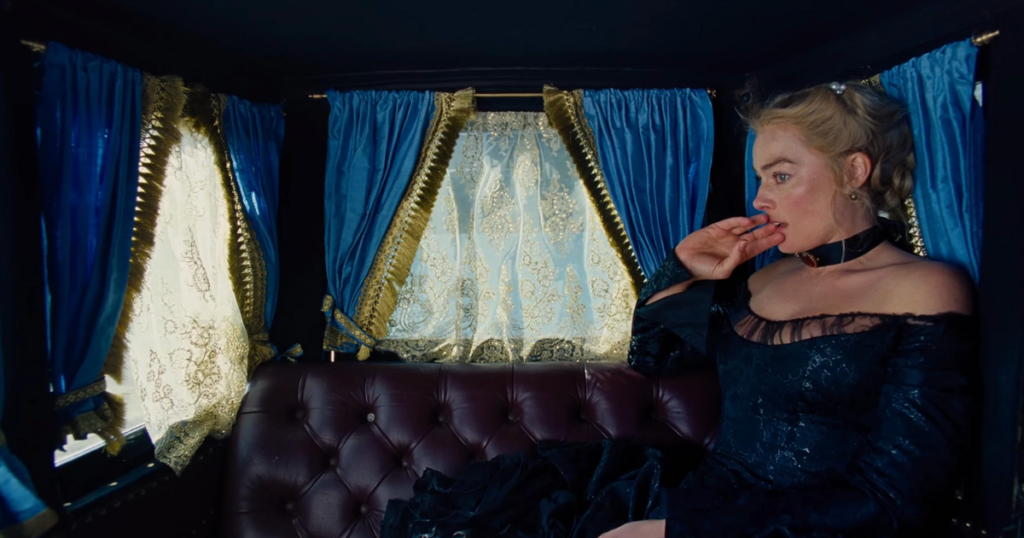
The literacy crisis is real, but watching one horny movie adaptation without experiencing the source material is not a crime.
Photo: Warner Bros.
Emerald Fennell’s adaptation of Wuthering Heights is already controversial, and it’s barely premiered. The movie officially opens in theaters on Friday, but a mix of press and branded screenings have opened the floodgates for reviews from critics and influencers, some of which are quite positive while others are not. The discourse had been brewing long before Fennell’s movie began releasing erotic trailers, with faithful-adaptation boosters questioning Jacob Elordi’s casting and worrying over Fennell’s ability to tell complicated stories about history and class without “washing” a beloved plot. The implication: If this is a younger generation’s introduction to the Gothic romance, are they going to be fed too much horny aesthetic and not enough intellectual value?
Curious minds have only a few days to read the 416-page Penguin Classic before Wuthering Heights is officially in theaters near you. But if you find yourself genuinely wondering if it’s worth skipping work to consume a fairly substantial 19th-century novel in a timely fashion in order to effectively enjoy and perhaps even extract enlightenment from the movie, our critics and editors are here to weigh in: Should you read Wuthering Heights before seeing Wuthering Heights?
Kathryn VanArendonk: Let’s get this out of the way: If you want to read Wuthering Heights, by all means check it out from the library and have a great time. But my knee-jerk reaction to this question, without having seen the movie: Don’t do that! So much of the fun of a cultural event like this is everyone freaking out together about some huge, divisive, horny, shared cinematic experience. Adaptations will always be colored by which version of a classic story we experience first, and there is truly no way to know in advance what that will mean for each individual person and every new example. But getting hung up on the purity of beginning from the beginning is more likely to be a stumbling block than a source of pleasure.
Alison Willmore: As the one here who took on the task of reviewing the movie, I will say that I always think adaptations should be taken on their own merits, for sure. But also, the first and last time I read Wuthering Heights was in high school, and, while I’m aware this is an incredibly self-serving or at least convenient claim, I think retaining only a vague recollection of the book is the ideal way to go into the movie. Emerald Fennell’s take on Emily Brontë is, with full intention, something like a teenager’s first encounter with the classic, filtered through all the adolescent angst and other hormone-driven longing that person might be experiencing at the time. It is based less on Wuthering Heights than on a memory of reading it at a very specific age. Which is to say, if you’ve never read the book, you can just prep by reading the Wikipedia summary and getting confounded by the whole second-generation dramas that are confined to Volume II (which Fennell’s movie does not bother with anyway).
Jackson McHenry: I have also seen the movie. And for the sake of variety, I wish I could go professorial and insist that everyone must have those family trees memorized and at least three arguments at hand about postcolonial readings of race in the novel, but it’s fine to just go in with a vague memory of what happens in the novel, or none at all! Though the latter isn’t really possible. Wuthering Heights is so influential as a cultural artifact, there’s no way you haven’t at least encountered one of its many heirs in media, whether Twilight (which was big when I read it in high school) or Fifty Shades (fruit of the same tree) or stuff like Gone With the Wind or Black Narcissus (big influences on Fennell here).
All you need is that general awareness of the Zeitgeist and you’ll get the gist. Because this is not a movie where it’s hard to get the gist. I would say I got the gist in the first 30 minutes and then just sat around bored. Maybe that’s when it’s in your favor to have read more of the novel, because then you can entertain yourself by noting the places where Fennell has diverged from it. What’s the effect of her cutting Cathy’s sadistic brother? (To me, as it turns out, less of a sense of Cathy’s own cruelty, because Fennell seems to soften the character in general.) What’s going on with the way Nelly is more meddlesome? (An opportunity for Hong Chau to have more to do!) Why is Isabella Edgar’s ward instead of his sister? (I’m not sure, though it does unwind some of the book’s insistent incestuousness.)
Julie Kosin: Jackson, I have not seen the new movie, but I did, in fact, read the book in high school because it inspired Stephenie Meyer to write Eclipse, but then I read it again as part of a wider Brontë course in college. I revisited it last summer mostly because I knew Fennell’s take would inspire discussion, but also because I remember the book being so weird and wanted to revisit that feeling. I can’t help but think that those who are encountering the story through Fennell’s lens are missing out on all of that.
While the book is weird and jagged, the movie is outlandish and … moist. It’s very much its own thing.
J.M.: So much weird stuff! I’d forgotten that the book begins with the narrator showing up to Wuthering Heights decades into the story line and sensing, “Hmmm … the vibe is off here,” before Nelly the maid explains everything to him. Very, very reasonably, most adaptations of the book cut the frame device and the book’s second half because it eddies through cycles of violence and is tough to handle. (Once, I saw a stage version of it that didn’t, and man, did its second act drag.) I do wish Fennell incorporated more of the book’s misshapen wildness. Fennell goes for more explicit sex and romance and the sense that this is all playing out on a soundstage, and I’d be down for an adaptation that channels more of the tangle of weird Northern England atmosphere and its economic and historical reality, how the book’s plot’s all buffeted by the 19th-century currents of industrialization and globalization. The book’s obsessed with money and all the new ways that people can suddenly lose it (gambling) or make it (mysterious adventures afar).
Give me sheep, I guess. This movie only has one taxidermied sheep.
A.W.: It’s very much just the aspects of the book that were of personal interest to her — this insistent, doomed love between these two incessantly extra people who exude drama, some general thoughts about the link between sex and death, and lots of sublimated and then very literal horniness. Which, honestly, fine by me! All adaptations do this to some degree, but there’s something genuinely fascinating to me about how stripped-down and narrowed Fennell’s take is, even if it softens the characters a little, or at least makes them less asshole-ish than they are on the page. While the book is weird and jagged, the movie is outlandish and … moist. It’s very much its own thing.
K.V.A.: Yes, all of this is further reason why there’s no need to prioritize getting the book finished before seeing the film. Going from the film to the novel will feel like an expansion rather than a contraction, and it will be just as disorienting and bizarre and overwhelming! But in ways that have more texture and historical sweep. I also think Wuthering Heights is a great book to carry around with you for a few weeks rather than attempt to gulp all at once, because its turns and narrative switchbacks will hit you even harder that way.
J.K.: The social-media backlash to the movie has obviously begun — and I want to get to some of those complaints — but the one question I’m seeing a lot of is, “Why adapt Wuthering Heights and not some other bodice-ripper?”
A.W.: I have a lot of trouble understanding that complaint — like, if the only adaptations you can countenance are very faithful ones, you have to be so outraged all the time! Also, there are so many other adaptations of Wuthering Heights out there to look toward! It’s fine to feel that what Fennell does is missing some essential quality of the book, most notably when it comes to the sex, the very presence of which will be entirely taboo for some fans of the Victorian source material. But her film clearly speaks to what appeals to her about the novel, whatever anyone else’s thoughts on that may be (and people are definitely going to have a lot of thoughts on this one). Her Wuthering Heights certainly isn’t a strict page-to-screen translation, but it’s not so wildly far off from the novel that it shouldn’t even count. If watching the film sometimes feels like an act of delirium, it’s mostly because it gives you the strange feeling of getting a glimpse into someone else’s head canon.
I hope Heated Rivalry can shake more legitimate romances loose from Hollywood’s perpetually annoying impulse to do genre but elevated!
K.V.A.: My sympathy for that perspective is that I do think there’s a dearth of bodice-rippers. A horny-romance Wuthering Heights might be less frustrating if we were living in a decade with more options for onscreen, running-across-the-moors, man-emerging-from-a-body-of-water romances with people sneaking into bedrooms by candlelight and pining for each other while staring through wavy glass windows. And as it is, it’s a little annoying from both sides of that equation. For the Wuthering purists, it’s like, ugh, why are you polluting our serious novel! (Get over it.) For romance nuts, it’s — can we not have something that just admits it’s a romance from the beginning? Have we not shown up for Outlander enough all these years? All I can say is that I hope Heated Rivalry can shake more legitimate romances loose from Hollywood’s perpetually annoying impulse to do genre but elevated!
J.M.: I was colder on the movie than a lot of my co-workers, but the most frustrating thing to me was how it fell between a lot of those impulses. It’s half just freely a bodice-ripper and then occasionally tries to be a little more serious (when it usually falls apart). On the romance side, it gestures toward kinky stuff but doesn’t really embrace it in a way that’s maybe appropriately adolescent for Fennell’s aesthetic universe but unsatisfying if that’s what you’re here for. Go whole hog! Make Cathy and Heathcliff really embrace some sex games! There’s a reflexively buttoned-up quality to the movie, because Fennell can’t unburden herself of the canonical weight of the novel, even as it’s going for air-quotes revision and provocation.
J.K.: Alison, you called this Fennell’s dumbest movie, but this is not a dumb novel! I can’t help but feel bummed that the movie excises the second half of the story. To me, you can’t have Wuthering Heights without the effect losing Catherine has on Heathcliff, and how he takes that out on his children and hers. Just because this hasn’t been adapted well doesn’t mean it can’t be. Do I need to just get over myself?
A.W.: I have not actually delved into this myself — this would be a better question for Bilge Ebiri, who is wrapping up a year’s worth of watching Wuthering Heights adaptations from around the world for a giant ranking — but my understanding, based on my own more limited samplings, is that most screen interpretations of the novel leave out the second half. The generational aspect is too complicated and covers too much time and complicates how to handle casting for a story spanning so many years in certain characters’ lives (the new movie already strains a bit when it first makes the leap from child Cathy and Heathcliff to the very grown Margot Robbie and Jacob Elordi playing what I guess would then be teenagers).
But whatever you think of the new movie, I wouldn’t say that the book has never been adapted well. If you’re yearning to see the whole story onscreen, there’s a 1992 version from Peter Kosminsky starring a young Ralph Fiennes as Heathcliff and Juliette Binoche as both Catherine Earnshaw and her daughter, Catherine Linton. If you want something more naturalistic, there’s the 2011 Andrea Arnold adaptation, which our colleague Roxana Hadadi is a fan of, and which also engages with Heathcliff’s much-discussed and -debated racial ambiguity with the casting of James Howson. There is a French take on the novel, a Japanese one, a Filipino one, a Bollywood one, a modern-day 2003 MTV one with Erika Christensen. Whatever you’re longing for, it is entirely possible there is a Wuthering Heights out there for you!
J.M.: Like the crosstown bus, you won’t have to wait long for another Wuthering Heights to come along to delight, beguile, or befuddle you! Which probably speaks to both the novel’s enduring power and its multifaceted quality. No one screen (or play, or opera) adaptation is going to capture the book’s massive and, at times, contradictory tonal breadth from Victorian generational drama to Gothic romance et cetera., so it’s probably for the best for everyone to focus on the sliver of it that most interests them and pass it along to whoever wants to take the next swing at their Heathcliff and Cathy five years or so down the line.
K.V.A.: Julie, we have a term for the thing you’re longing for: limited series. There’s a new PBS Forsyte Saga adaptation this spring! We can build it, we have the technology!
J.K.: So what you’re all telling me is Emerald Fennell’s adaptation of Wuthering Heights is not, in fact, emblematic of a serious crisis in literacy?
A.W.: Sorry, I’m still stuck on the adaptations. Look at Tom Hardy’s hair in this 2009 ITV miniseries! What is going on with it!
K.V.A.: The literacy crisis is manifold and probably responsible for the dramatic dissolution of American democracy, but I do not think one horny movie adaptation should be held up as a symbol of this human tragedy. People have been picking out all their favorite bits of a story and then making spicier versions forever and ever! There are so many better emblems out there, anyhow — look at any Netflix series that needs to state what’s happened in very explicit dialogue at least three times every episode! Leave Emerald Fennell’s skin room alone!
J.M.: Or just reckon with the skin room on its own terms, love it or hate it, but provide some supporting evidence as to why the choice works, with arguments that incorporate specifics from the film and the novel, with MLA citations, and remember to always deploy topic sentences. File your work to me over email by the end of the day Friday.
See All