
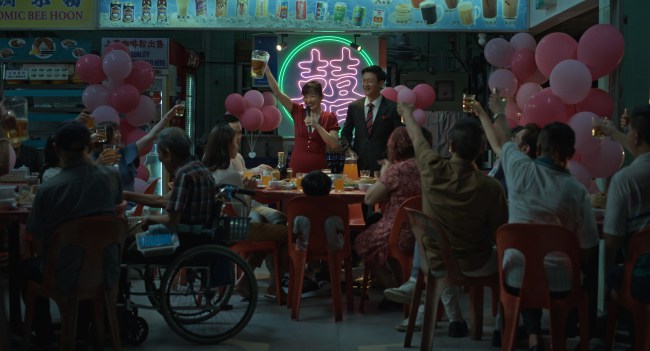
A moving tableau vivant of a few years in the lives of a fractured but ultimately compassionate Singaporean working-class family, filmmaker Anthony Chen (“Ilo Ilo,” “Wet Season”) returns with a fifth feature that’s as emotionally generous as it is frothily melodramatic — in ways that are addictively entertaining, frustrating, and ultimately too empathetic to shun. We know what cold feels like at a festival like Berlin, replete with arch, chilly European exercises in nihilism; it’s a cold that invites us to appreciate the sheer warmth of Chen’s touch, with the first Singaporean film ever to play in the event’s main competition.


In the aptly titled “We Are All Strangers,” Chen introduces us early on to a cook, a bartender, a schoolgirl, and her classmate, a newbie army conscript — all of whom emerge as both found and literal family in this overflowingly emotional saga. The arthouse references might sound arcane, but this is Chen’s most accessible and borderline commercial effort to date.
Here is a Singapore where live-streaming medical supply sales and unregulated social media ecommerce are a means of living, where Hokkien noodles are not only a delicious, chewy recipe at every food stand, but also a way of survival. Where military service is compulsory, and may only disappoint our best or even worst men, but can be interrupted, thank god, by life’s hairpin turns.
Boon Kiat (Andi Lim, a gentle performance with a light touch) has for years run a noodle stand in the bustling Singapore capital city, serving up wok-fried prawns to daytime and late-night customers. At the stand to his left, Bee Hwa (Chen regular Yeo Yann Yann, disarmingly funny and wounding often in the same scene) serves beer to drunken patrons, working for tips while living with her brother and his small child. Zooming out, Boon Kiat’s son Junyang (Koh Jia Ler, now more than 10 years older than he was in “Ilo Ilo”) is headed for life in the Singapore army even as his girlfriend Lydia (Regene Lim) must watch him go. Until she receives some unexpected news that you could predict from the logline, which sends the rest of the movie into motion.
While Junyang and Lydia’s relationship curdles under the weight of adult responsibility, Boon Kiat and Bee Hwa strike up a romance late in life. One night, she’s beyond hammered, and he walks with her to her home, and then later proposes a sweet date on the bus ride during her commute. Chen’s openhearted movie makes great use of the Singapore setting, showing for example, how with a public transportation meet-cute, a connection with someone can bend the structure of your environment around you. Bee Hwa, of course, eventually becomes Junyang’s stepmother, which is how we learn that both he and Lydia come from single-parent families where the other parent has been missing (for different, pained reasons) for a long time. “We Are All Strangers” keeps driving back toward this point about found family, which are often the people right in front of you.
Boon Kiat, Bee Hwa, Junyang, and Lydia are soon all shacked up in a cramped flat with only one bathroom, and barely a partition to separate other people from your business. And so the harsher realities of life start to float inward, though early on, Chen punctuates the anticipation of possible misery with a glorious sequence that turns out to be a fantasy: Junyang imagines being in a luxury hotel with Lydia, her family credit card footing the bill, a weekend of dancing and swimming ahead of them. It’s the reprieve before the storm of grown-up demands about to inundate Junyang like a firehose burst. Who will pay for this tiny apartment? “Some people are terrible husbands, but at least they’re better fathers,” Lydia tells him during a moment of particularly sharpened crisis.
“We Are All Strangers” caps a “growing up” trilogy Chen started with “Ilo Ilo” and “Wet Season.” When the characters are forced to grow up, and the circumstances grow increasingly tragic, is when the melodrama starts to bubble up at its sudsiest. Shot by cinematographer Teoh Gay Hian with a straightforward eye for the refreshingly well-lit, the movie suddenly takes a hard right into the realm of the crime drama!
Due to yet another life change, Junyang and Bee Hwa must stoop to — well, it feels low at first, until then it becomes quite a giddy high — peddling over-the-border OTC medicine on social media, Bee Hwa baiting live-streamers with her life story. And with multiple fake tears placed in the eye just out of frame. There’s, in fact, a lot of narrative chaos in the movie’s last third, from a pyramid scheme that ruins Junyang’s professional ego to the fact that Lydia, once she’s given birth, is basically cut out of the picture. But Chen keeps it moving smoothly, even as the film teeters on the edge of sentimentality — but why shouldn’t it? In the end, we realize, “We Are All Strangers” is dedicated to the filmmaker’s family.
The takeaways here, other than this movie should play very well around the world and could even emerge as Singapore’s Oscar contender, include that among the converging and careening characters, Yeo Yann Yann is the heart of “We Are All Strangers.” She’s a woman desperate for a connection she doesn’t realize she wants, and then must take command of a family as a stepmother and caretaker to a frankly lazy, entitled kid (who does eventually grow up). She is the centerpiece beacon of hope in a movie with no shortage of it.
The class issues in Singapore that Chen aims to characterize and critique mostly come at us from a bird’s-eye view, with a deeper interest in characters and their truth and feelings. Once the film hurtles off the cliff into an underworld crime drama of loan sharks and unpaid debts, you yearn for the simpler times before. Just as Junyang may be holding onto that earlier vision of a gleaming hotel. But this is a wholehearted, emotional rush of a movie that holds you in the palm of its hand throughout.
Grade: B+
“We Are All Strangers” premiered at the 2026 Berlin Film Festival. It is currently seeking U.S. distribution.
Want to stay up to date on IndieWire’s film reviews and critical thoughts? Subscribe here to our newly launched newsletter, In Review by David Ehrlich, in which our Chief Film Critic and Head Reviews Editor rounds up the best new reviews and streaming picks along with some exclusive musings — all only available to subscribers.