
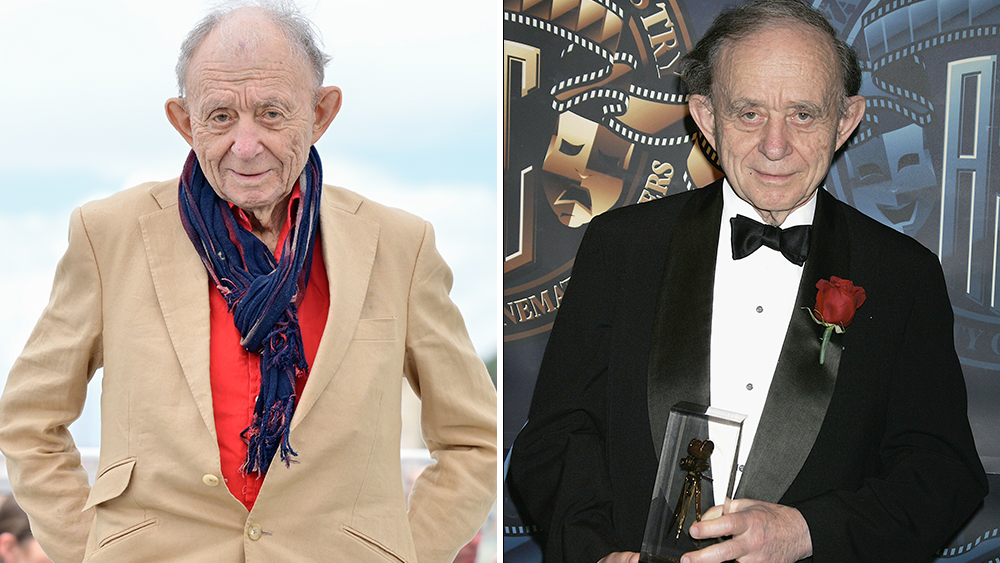
Frederick Wiseman, the renowned and prolific documentary filmmaker who focused his lens on all parts American society and its institutions for almost 60 year and was given an honorary Oscar in 2016, died Monday. He was 96.
The news was revealed by his family through his production company Zipporah Films, which has distributed Wiseman’s films since 1971.
Wiseman made about one documentary a year over his career, which began when the then-lawyer made his first film, 1967’s Titicut Follies, about the conditions inside a Massachusetts state hospital for the criminally insane. It was banned from being shown for 24 years after its New York Film Festival debut on grounds it invaded the privacy of the inmates.
It eventually aired on PBS, a longtime home for Wiseman’s films, which included Emmy winners Hospital and Law and Order, helping define Wiseman’s style, as Deadline’s Documentary editor Matthew Carey describes it, as “embedding himself in hospitals, schools, theater and dance groups, neighborhoods, and towns across the U.S. and occasionally Europe, he uncovers human drama, pathos, and psychological detail that escape the eye of the ordinary observer.”
Wiseman made 30 films over one 30-year period exploring what Zipporah called a record of the western world. Zipporah was the name of his wife, a noted lawyer who he met at Yale Law School and married in 1955. She died in 2021.
As for Wiseman, a 2025 retrospective mounted at Film at Lincoln Center spoke to the breadth of his work, with titles like High School (parts 1 and 2), Hospital, Public Housing, Welfare, Juvenile Court, Domestic Violence, Deaf and Blind. His later works were some of his most revered and showcased his vigor: ones centered on his beloved New York, including 2015’s In Jackson Heights (marking his 40th doc) and 2017’s Ex Libris: The New York Public Library, and France with 2013’s La Danse: Paris Opera Ballet and Menus-Plaisirs Les Troisgros, his most recent film about the workings of three-star Michelin La Maison Troisgros in Loire.
His Titicut Follies, Hospital, High School and the Wiseman-produced The Cool World are a part of the U.S. Library of Congress’ National Film Registry.
Wiseman, in recently discussing the whole of his nonfiction work, said he was troubled by the notion that it was truth, saying “cinéma vérité is just a pompous French term, which you can’t take seriously.”
Instead, he said, “I’m satisfied with saying I make movies. I don’t like ‘observational cinema’ because it’s too passive a phrase. Because you’re not just sitting in a corner shooting what’s going on. You’re moving around all the time. You’re shooting at every possible angle that you can think of because you want the coverage for the editing, and there are all kinds of different compositions. So observational cinema, to me — it may not be fair to the people that invented the term or the people that use it seriously — suggests just sitting in a place and observing what’s going on and shooting it. For my movies, we’re moving all the time.”
In addition to the honorary Oscar, Wiseman was honored with lifetime achievement awards from the International Documentary Association in 1990, the News & Documentary Emmy Awards in 2010 and the Venice Film Festival Golden Lion in 2014 among other accolades.