
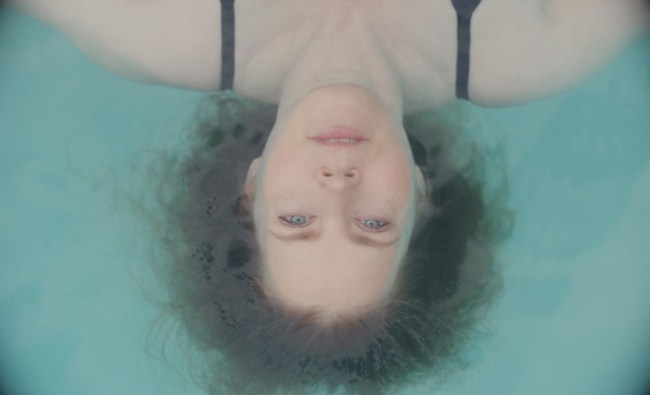
The wait for Amy Adams to regain her sparkling 2010’s form goes on in “At the Sea”, a woozy, heavy-lidded melodrama from Hungarian director Kornél Mundruczó, with a screenplay by his partner Kata Wéber. Derived from Wéber’s personal experiences, it follows the trajectory of a breakdown precipitated by a midlife crisis: its prehistory and the shattering central event, and then the acknowledgement of it, and gradual hopes of recovery. Mundruczó and editor David Jancsó relate the events linearly, honing in on Adams’ character’s gradual readmission to her old life, with snatches of quick-cut, wordless fragments providing swift, if vague, exposition of the past.


Each piece of the film’s intricate construction is too lopsided: the film’s narrative timeline gives an overly closed-off sense of this chapter in her recovery; the eventual explanations are too cursory, sometimes struggling to convince on the severity of what’s happened; and Adams, if not miscast, can’t find the most charismatic register in her performance range to carry it on her shoulders.
Taking place on the monied and sedate Massachusetts coastline, after its predecessor “Pieces of a Woman” opted for inner-city Boston grit, the setting also generates the film’s deflated feeling, and slots what could be a cathartic purge for Adams’ character Laura Baum, an eminent dance choreographer, into an array of other characters’ first world problems. We first glimpse her being discharged from an upscale rehab clinic, the actress offering one of her tarter line readings as she hopes never to see the consultant doctor again, should the treatment proves successful. But, whilst being introduced to her immediate family, we discover the “long sabbatical in Bali” cover story — an explanation for the time-out to her circle of friends and colleagues.
Suspicious of her mild-mannered husband Martin (Murray Bartlett), a talented but under-recognized figurative painter, both for his lack of day-to-day trust in her, and the possibility he was unfaithful in her absence, a key motivation of Laura’s is re-establishing a healthy proximity to her two children: the college-bound Josie (Chloe East), and pre-teen Felix (Redding Munsell). Her attitude about the former has an air of jealousy, with the sexual experimentation and partying she enjoys in the sun-kissed milieu making her worry she won’t reinvigorate her own, mature life. Simply, she needs to re-articulate her sincere love and attachment, aware how she couldn’t convey it previously. As Josie snaps back late in the film, “Don’t worry about how I am. You spent your whole life worrying about how you are.”
Her relationship with Felix, still only a kid, is most consequential as to why the breakdown occurred, and her later inpatient care. In the sole sequence where Mundruczó is able to summon real dramatic tension, Laura takes him to the beach, where despite their caution and awareness of the danger, Felix is stung by a swarm of beached jellyfish, requiring a routine hospital trip – an echo of the breakdown’s key inciting incident, which the film finally unveils at this point. Whilst her son recovers in the ward, Laura has a chat over some French fries with a helpful, and romantically promising stranger named Keegan (Brett Goldstein), whose gig as a kite salesman we glimpse, with a air of twee symbolism, before they stepped earlier onto the beach.
This kite motif is a good segue into discussing Mundruczó’s own authorial perspective, and his various, sometimes striking, visual and tonal choices. In a slight echo of “TÁR” (which is commanding so much influence in 2020s cinema), Laura has assumed control of her influential, troubled late father’s dance company, whose brilliance also dovetailed with abusive behavior towards his cast. Laura’s existential crisis hinges on if resigning from it might empower her, but with its New York cultural eminence, there’s a whole company of employees waiting to work again, coupled with her role as the family breadwinner. Even though we never forget the frame of Laura’s personal journey, the second half of “At the Sea” concerns the fate of what on earth will happen to the skeletally rendered company, with the boardroom intrigue transposed to a flashy beach-side dinner party. Critic David Edelstein (who’s intriguingly credited on the film’s story) makes a cameo as a lofty yet principled art critic at one table, the subplot’s welcome note of self-awareness and mischief.
The Hungarian national cinema where Mundruczó started is known for its long, choreographed takes, often achieved by steadicam, and that’s maintained for dialogue coverage here, although not with the dynamism of “Pieces of a Woman.” Far less persuasive are the uses of spontaneous modern dance sequences, whether in the flashback montages, or when Josie suddenly dances forcefully first to spite her mother whilst arguing in her studio, and later in a reconciliation scene. It’s clearly meant to to be a great flourish of troubling absurdity, but scans as goofy. Indeed, the title “At the Sea” solidly encompasses Laura’s existential state, but altering it to “all at sea” doubles as a harsh description on the film itself.
Grade: C
“At the Sea” premiered at the 2026 Berlin Film Festival. It is currently seeking U.S. distribution.
Want to stay up to date on IndieWire’s film reviews and critical thoughts? Subscribe here to our newly launched newsletter, In Review by David Ehrlich, in which our Chief Film Critic and Head Reviews Editor rounds up the best new reviews and streaming picks along with some exclusive musings — all only available to subscribers.