
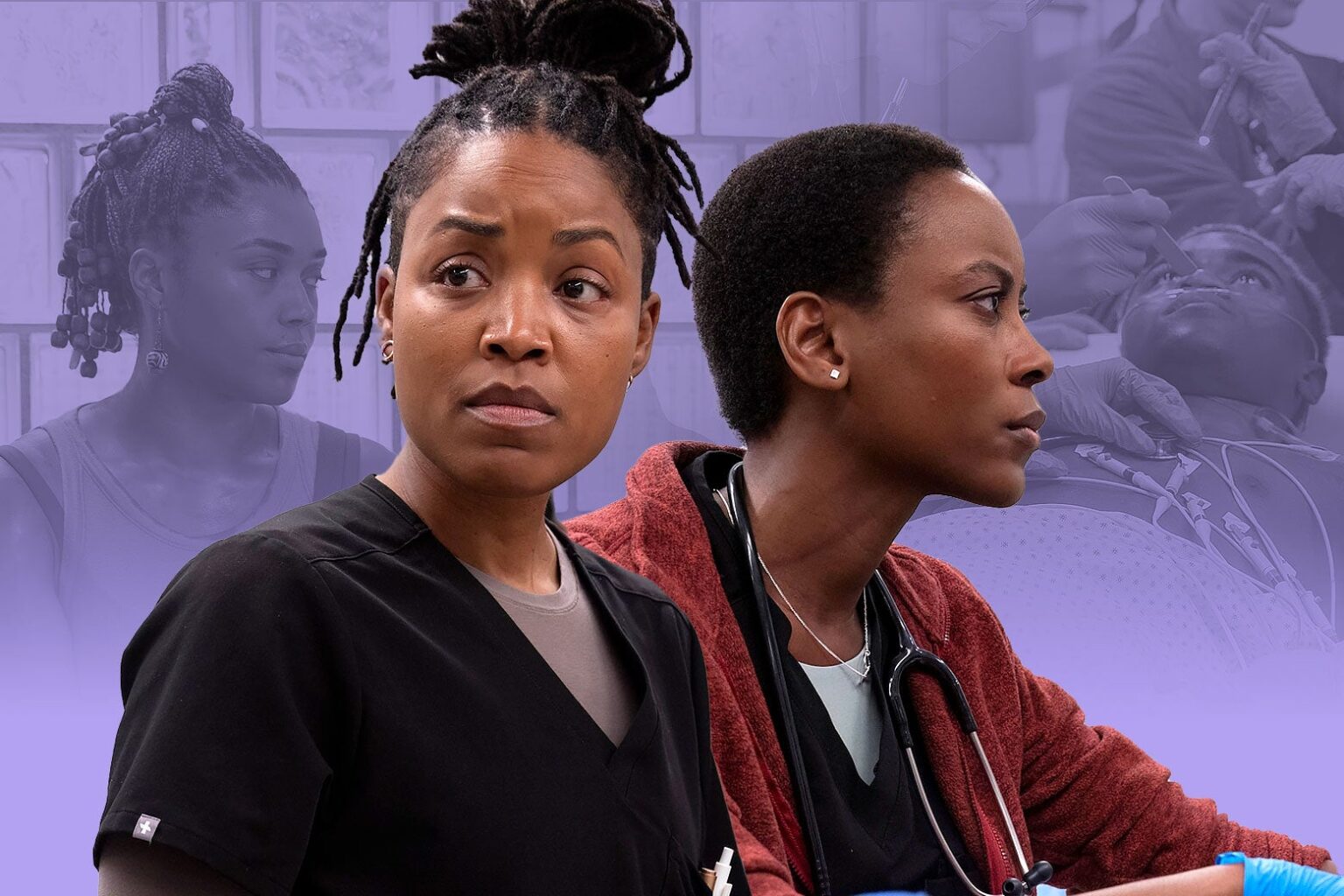
The Pitt, HBO Max’s hit series that follows the staff of an emergency room at a Pittsburgh hospital, has become beloved for being perhaps the most realistic medical procedural on air. Critics and fans alike have flocked to the show for its medically accurate gruesomeness, its humanity, and its lessons about the injustices that both medical professionals and their patients face within our health care system. In its award-winning first season, for instance, The Pitt showcased the startlingly high rate of violence against health care workers, the warning signs of sex trafficking, and, in a standout episode, how emergency rooms transform during mass casualty events. Season 2, which premiered in January, has touched on the 2018 Tree of Life synagogue shooting, the pros and cons of health care workers implementing A.I. into their workflow, the problem of newborn abandonment, and more.
One of the things that the show is particularly good, if a bit on the nose, at tackling is the racial disparity that Black patients and doctors face in the American health care system. But, where last season handled this topic with nuance, this season’s attempts at diving deeper into these disparities feels like it’s missing one critically important piece—and this week’s episode proves it more than any other so far.
Part of what made The Pitt excel at exploring the myriad health care–related issues Black Americans are statistically more likely to face was the character of Dr. Heather Collins, a Black senior resident played by Tracy Ifeachor. Last season, Dr. Collins played an important role in the care of some Black patients, like when she successfully navigated a high-risk birth carried out by a Black woman in an episode that highlighted both that Black women have the highest maternal mortality rate in the U.S. and that the rate of newborn mortality in Black babies is lessened significantly when they are cared for by a Black doctor. Beyond her medical competence, Dr. Collins was also a well-written, rounded character who went through high and low arcs of her own. She had to contend with workplace drama stemming from a romantic history with the attending physician and lead protagonist, Dr. Michael “Robby” Robinavitch (Noah Wyle), and her own struggles trying to get pregnant, all while handling her patients and still being a resident. Dr. Collins carried a particular weight of the show as the main Black physician—the night shift has another Black female physician named Dr. Parker Ellis (Ayesha Harris), but because the show is primarily focused on the day shift, we don’t see her often—giving audiences insight into not only what Black patients may face, but what Black physicians, especially women, must go through in the medical world.
That is, until Dr. Collins effectively disappeared for the latter part of the show’s first season. Raised eyebrows at her absence skyrocketed into alarm when, during the break between seasons, Variety announced that Ifeachor would no longer be a cast member. Bad blood was implied by reports that the decision was made by the show’s “creative team” and not one Ifeachor made “of her own accord.” There was speculation aplenty about why a well-written, well-liked character would be written off, with one rumor pointing to Ifeachor’s alleged connection to Jesus House, an evangelical British church with a commitment to pro-life values and a history of homophobia. Fans posited that there might have been tension between the British Nigerian actress’s presumed values and those of her character, who, in Season 1, dealt with abortion, miscarriage, and a gay couple using a surrogate. (Ifeachor’s publicist denied this explanation, deeming it “completely incorrect, defamatory, and hurtful.”)
Dr. Collins’ departure left a big hole in The Pitt, even as its second season hasn’t stopped trying to spotlight how many Black patients struggle when it comes to health care. In an early episode, a Black woman with pneumonia is found to have an eating disorder that would have gone undiagnosed if it weren’t for Dr. Mel King (Taylor Dearden) catching it and explaining that Black women are statistically more likely to have eating disorders go undiagnosed. Another nuanced storyline involves an emotional saga that begins in Episode 3, when a young, Black law student named Jackson Davis (Zack Morris) is brought in because he’s having a psychotic break. He was profiled as a drug user and Tasered by a campus security guard—“Probably meth—fucking animal,” the guard remarks—before he was brought in. But it becomes apparent over a few episodes that Jackson is likely suffering from schizophrenia or another severe mental illness. This week’s episode, Episode 7, really brings Jackson’s storyline home by probing how the Black American community engages in personal health matters. When Jackson’s parents finally arrive, after his sister Jada (Erin Croom) has advocated for his care, the attending psychiatrist asks the Davises if they have a family history of mental health problems. Jackson’s father admits that his own brother suffered from depression and wound up taking his own life. Jada becomes upset at her parents for hiding this painful history from her and Jackson, who were simply told that their uncle drank himself to death. (“He did that, too,” their mother says.)
It’s a moving episode that gets at how, among the Black diaspora—especially among Black Americans—families are good at keeping painful secrets, going back to self-preservation over centuries of oppression, hardship, and trauma. These secrets can impact the health of other family members, whether it is because they hide truths about familial connections or because they are directly withholding health information. Jada’s frustration at her parents for obfuscating the truth of her uncle’s passing is a shocking depiction of one of the defining themes of Black American life—a phenomenon that has rarely been depicted with such accuracy and sensitivity in white mainstream media.
But the show still feels like it’s missing a massive piece of the puzzle: Dr. Collins. The series used to strike a balance of depicting the issues Black patients face alongside the perspective of Black physicians. With Dr. Collins being both a woman and the main Black doctor on the day shift, her own health experiences were foundational to the show’s commentary on the health care system’s racial inequities. In Jackson’s storyline, medical student Victoria Javadi (Shabana Azeez) tries to comfort Jada, but I couldn’t help but wonder about the extra dimensions that Dr. Collins or Dr. Ellis, as rare Black female physicians, would bring to that conversation.
The Pitt does a great job of hammering home that simply having a diverse, attentive staff that listens equally to every patient can go an incredibly long way. Last season saw Dr. Samira Mohan (Supriya Ganesh) educating others on the prejudice that many sickle cell patients face—prejudice that is racially layered, considering the disease overwhelmingly affects Black people. This season, it’s Dr. King who teaches intern Santos (Isa Briones) about the number of undiagnosed eating disorders among Black women. It works just fine, but having Dr. Collins interacting meaningfully with Black patients spoke to just how much Black physicians matter to Black patients, who are already distrustful of our health care system given its history of inveterate racism against people of color.

Sam Adams
HBO and A24’s New Show Is Hilarious, Then Jaw-Dropping, Then Terrifying
Read More
Alysa Liu Just Changed Figure Skating Forever
This is a part of what feels a little after-school-special at times when it comes to The Pitt and its more lackluster moments. It’s not that the show does a bad job of exploring the inequities that Black patients and Black doctors face—the issue is that it used to feel like a complete puzzle, and now it’s missing the vital piece at the dead center. At worst, a Pitt without a featured Black doctor reduces the Black patients to simply teachable moments, rather than real people caught up in a systemic problem that also involves the makeup of the hospital’s staff.
It’s almost a certainty that we’ll never see Dr. Collins back. In Season 2, Episode 4, it’s explained that she conveniently finished her residency, moved to Portland to be closer to her family, and decided to adopt a child. I’m thrilled for that character’s happy ending, even if it is off-screen. But her crucial absence needs to be filled, or The Pitt will become weaker for it. Between the day shift and the night shift, the series has so many other stellar doctors it can elevate. Maybe this is all the wake-up call we need to give Dr. Ellis more screentime—the show’s fans have certainly been hankering for it.
Get the best of movies, TV, books, music, and more.