

Get the latest entertainment news, reviews and star-studded interviews with our Independent Culture emailGet the latest entertainment news with our free Culture newsletter Get the latest entertainment news with our free Culture newsletter
When he was growing up in east London in the Nineties, David Jonsson would be told stories by his mother about the youngsters she was seeing each day. She was a police officer for the Met, and would come home, sigh and look intently at her son. “I don’t know which way some of these boys are going,” she’d tell him. “Please, don’t be like that.” Jonsson, his voice so soft and careful that he seems 32 going on 60, knew what his mother was doing. “She was full of love and care and empathy, but also frustration. She was trying to help.”
Today, Jonsson is one of Britain’s busiest young actors – the star of the romantic comedy Rye Lane and the Stephen King adaptation The Long Walk, and last year the recipient of the Bafta Rising Star Award. But he knows a path was laid out for him that wasn’t as rosy. “Honestly, a life of prison and addiction was just one step away from me.”
Jonsson was just 16 when he was expelled from school in London’s Newham for fighting and truancy, leading him to enrol in a new school in Hammersmith. It was there that he discovered a love of acting, and a dream of a career that gave him purpose and drive. He’d later train at the National Youth Theatre and at Rada, and venture far from the kind of trajectory his mother was afraid of. “I was so close to that [other life], that it was almost tangible,” he says. We’re in a hotel in London, Jonsson hunched at a breakfast table and wrapping his arms around himself. He is swaddled in a dark-red hoodie, a stud in his ear and a watch shining on his wrist. Life has taken a massive turn.
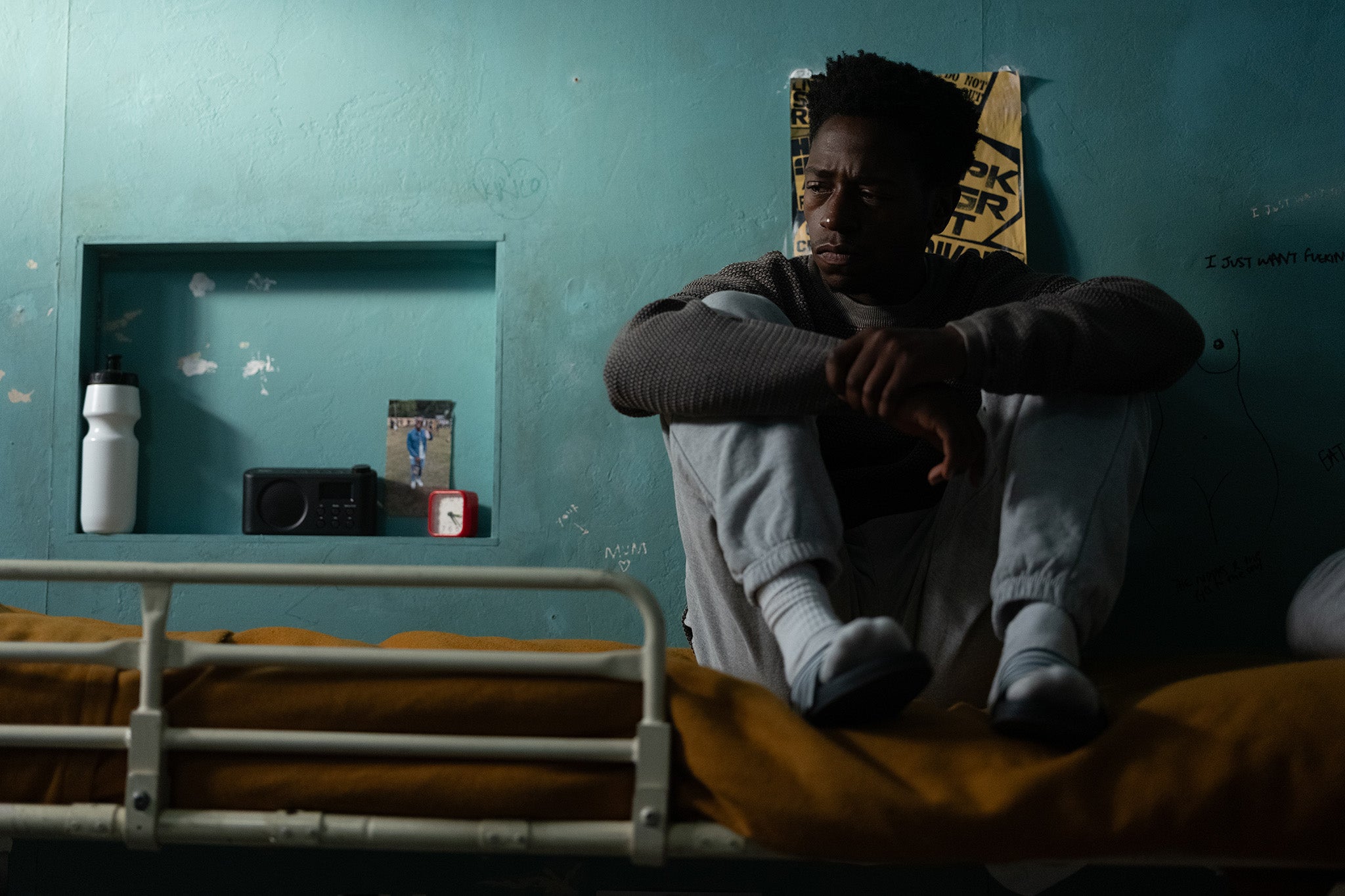
He’s talking about what might have been because his new film, he says, is the “closest to home” that he’s ever played as an actor. In Wasteman, he stars as Taylor, a heroin-addicted father who’s spent 13 years in jail for selling drugs to a teenage boy who later overdosed – it was a terrible mistake, revealed in spurts over the course of the film, that resulted in Taylor receiving a manslaughter conviction. As we meet him, he’s told he’s up for parole, but it’s an opportunity endangered by the arrival of a new cellmate, Tom Blyth’s volatile, drug-dealing Dee. Whereas Blyth is a tightly wound coil forever on the cusp of unfurling, Jonsson is fragile and wounded, if hardened by years of regret. It’s a carefully modulated performance, and arguably his finest to date.
Jonsson had been attached to Wasteman for several years, but financing only materialised three weeks before production began, meaning his physical preparation had to be fast. “And I knew I wanted him to be struggling with addiction and to feel as if something had been taken from him, so he needed to be thin,” he recalls. He lost two stone, reducing his body mass by eating just 700 calories a day. Meanwhile, Blyth was going the opposite direction, bulking up to play a character as violent as he is physically imposing. At the end of filming, they were able to drop any sense of antagonism. “He goes, ‘Mate, we all good? Should we go to the pub?’” Jonsson laughs.
The craziest thing about being a young Black actor is a lot of times you’re having to break new ground. And it’s a really unnecessary pressure that you don’t actually want
Wasteman is gritty and complex, and eager to spark conversation. I ask Jonsson if he thinks Taylor should have been imprisoned, considering his age at the time of the incident and the specifics of the crime. “I don’t know if I have an answer to that,” he says. “Because he committed a crime, and a crime that affected a lot of people. But I also believe in second chances, even third chances.” The prison system is complicated, he adds. “At its core, it’s a rehabilitation system. Or at least it’s meant to rehabilitate. So it’s kind of beside the point whether you think someone should be there or not. Because they’re meant to be being helped.”
I’m curious about whether his mum has watched the film, I tell him, considering the work she used to do. Jonsson winces. “I don’t really like her watching anything of mine. I’m way too embarrassed. I’m sure she’ll find her way to this one and tell me that I was being naughty.” He laughs. “I know she wants to watch because she’s proud. But I’m also, like… mum, look away.”
open image in gallery
David Jonsson in ‘Wasteman’ (Lionsgate)
It’s probably a given that Jonsson’s mum hasn’t seen him in Industry, the bonking’n’banking drama that first propelled him to fame. He played Gus, the gay Old Etonian with political ambitions, but only for two series – by its third he was gone, under slightly opaque circumstances. Why did he leave it behind? “I always try to compare this job to being a plumber or a builder, because those are the people I grew up around,” he says. “I want this job to be as normal and regular and working-class as that. But, you know, it’s not.” He laughs again. “Like it literally pays my bills, but that’s also not why I’m doing it. I’m doing each job hopefully to mean something. And I don’t want to do a job that doesn’t feel right.” He loved his time on Industry, he says, but felt like he needed to move on from it. “I want a body of work,” he continues. “When I look at people like Gary Oldman or Tom Hardy, I just think, ‘They’ve done so much’…” In other words, there’s a clear distance between the posh aspiration of Gus and the damaged hopelessness of Taylor – naturally he’d want to show off his range.
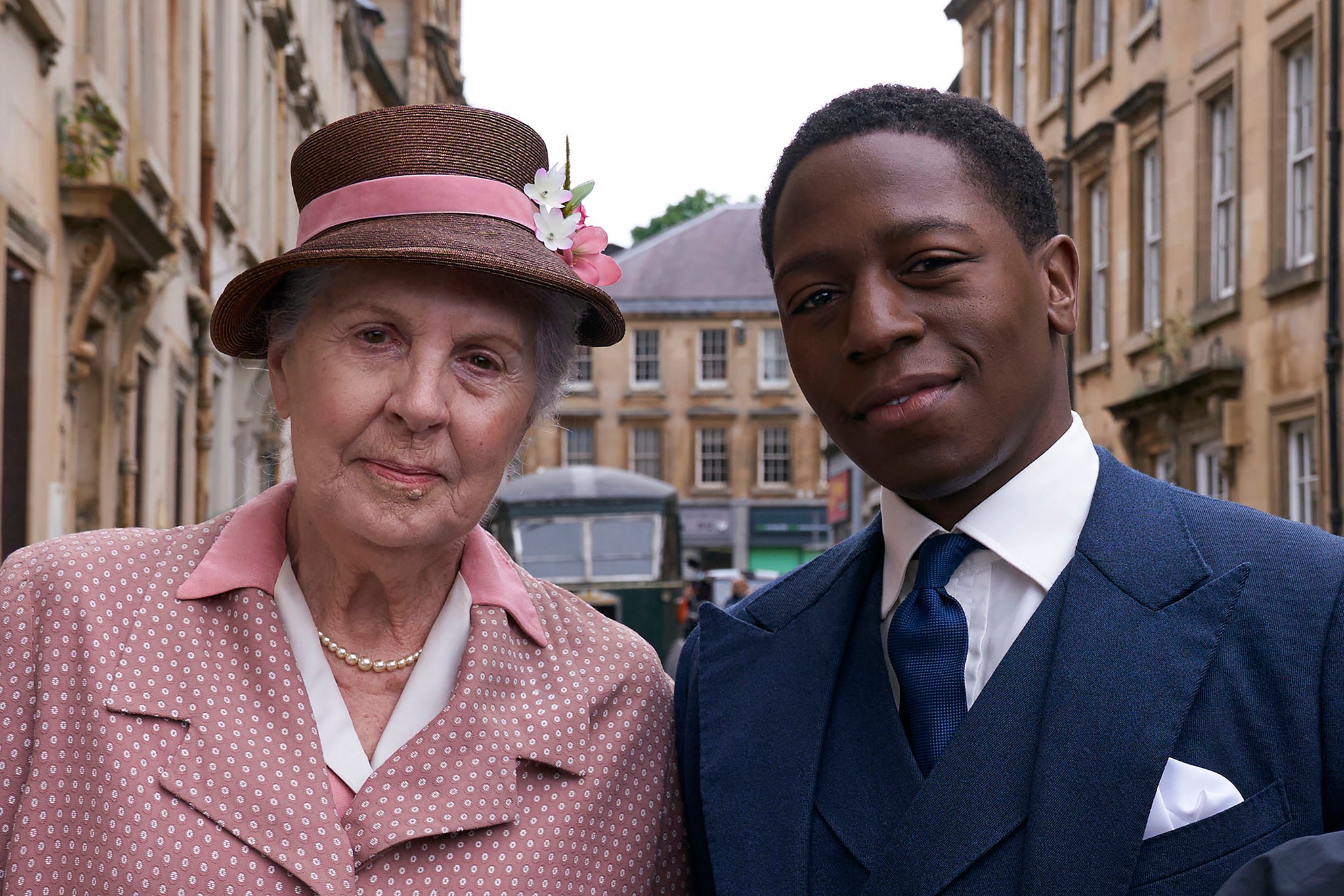
One of the first jobs he booked after his time on Industry ended was an Agatha Christie adaptation for the BBC, Murder Is Easy. When he last spoke to The Independent, for its release, he was apprehensive about it – his casting made him the first Black actor to lead a Christie mystery, and inevitable backlash appeared in its wake. And we’re meeting in October, a few months before a BBC report into representation on screen warned that “unless it’s very skilfully done, there is a danger that [on-screen diversity] will feel overly didactic and preachy”.

Watch Apple TV+ free for 7 day
New subscribers only. £9.99/mo. after free trial. Plan auto-renews until cancelled.
Try for free
ADVERTISEMENT. If you sign up to this service we will earn commission. This revenue helps to fund journalism across The Independent.
Watch Apple TV+ free for 7 day
New subscribers only. £9.99/mo. after free trial. Plan auto-renews until cancelled.
Try for free
ADVERTISEMENT. If you sign up to this service we will earn commission. This revenue helps to fund journalism across The Independent.
“It was necessary,” he says now. “As opposed to something exciting for me, I suppose.” He ponders the role a little. “The craziest thing about being a young Black actor – or anyone of colour – one, a lot of times you’re having to break new ground. And two, it’s a really unnecessary pressure that you don’t actually want. The pressure of life is enough. The pressure of the industry is enough. All I can do is just try and take everything in my stride.” He has no regrets about it, though. “I look back on that with a lot of pride, actually. I’m proud of the people who worked on it and made the decision to cast me, because we need more bravery.”
open image in gallery
Jonsson and Penelope Wilton in the BBC’s ‘Murder Is Easy’ (BBC)
Jonsson has a few different projects in the pipeline – a sequel to Alien: Romulus, where he played a cyborg, and a reunion with his Long Walk co-star Cooper Hoffman, in a dark comedy called The Chaperones. But a question about a rumoured movie he’s in that’s directed by Frank Ocean is mysteriously waved off by a publicist, and he goes uncharacteristically mum when I ask about playing Sammy Davis Jr in a forthcoming biopic to be directed by Colman Domingo. (We speak in October, and come January, that makes a little more sense, as filming is delayed.) Still, he’s aware that life is pretty great right now.
“I’m not gonna bulls***, it’s strange and weird and at times overwhelming,” he says. “I’ve never been one of those people who’s machiavellian about their career, and at times I wish I was a bit less chill. But all I can do is fight for the things I want to do.”
He stretches his legs, takes a sip of water, and smiles.
“I’m having a brilliant time.”
‘Wasteman’ is in cinemas