
One summer evening, a prominent British businessman opened his laptop and began tapping out a long email. The year was 2019, long before Prince Andrew, Duke of York, would become plain Andrew Mountbatten-Windsor, and the writer had a lot to get off his chest. Specifically, he wanted to warn the Prince of Wales that his younger brother’s business activities risked damaging the reputation of the whole Royal Family.
Apologising for what he described as a ‘breach of protocol’, he made a bold attempt to email the heir to the throne directly, copying the email to the late Queen’s solicitors.
It is almost seven years since I first saw that message. It was passed to me as part of a huge cache of private correspondence between Andrew and his private bankers and business associates, David and Jonathan Rowland. The material was sensational. Finally, have we the answer to a long-running mystery: how did Prince Andrew make his money?
In The Mail on Sunday that year, I revealed how the Duke of York worked with the Rowlands in a way that enriched all three. It was a clever scheme.
Together, the three men were courting some of the shadiest regimes in the world. It was all entirely legal. For a member of the Royal Family, the question was one of ethics.
Here’s how it worked. In his capacity as UK trade envoy, Prince Andrew would hear about all sorts of opportunities. Sometimes, he would tip off the Rowlands, allowing them to get ahead of the competition.
Meanwhile, they travelled the world in pursuit of their own business leads.
Andrew’s other job was to open doors for them, giving them unique access to foreign royals, heads of state and chairmen of multi-nationals.
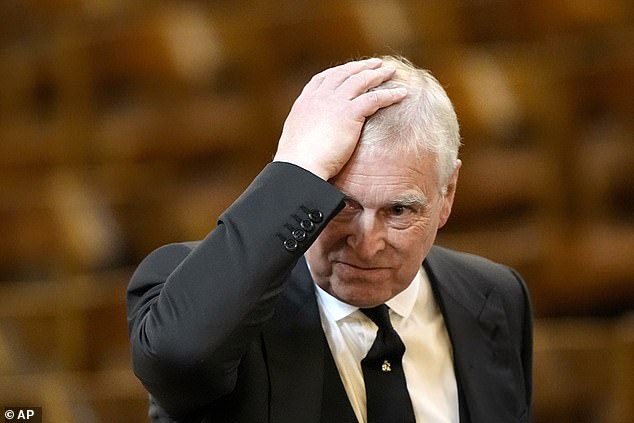
In his capacity as UK trade envoy, Prince Andrew would hear about all sorts of opportunities
For years, it worked a treat. Travelling by private jet and sauntering in and out of ambassadorial residences and presidential palaces, the Prince and his banker friends talked of seven- and eight-figure sums as if they were pennies.
Some of the messages they exchanged between 2008 and 2012 were jaw-dropping.
With offices in London, Luxembourg, Monaco and Moscow, these ‘Very Private’ bankers (as they once described themselves in an email) were happy to do business with all sorts, boasting of their ‘very strong links and in some cases JVs [Joint Ventures]’ with hostile states including Russia, Belarus and China.
The Chinese venture capitalist who organised their trip to Pyongyang to cultivate ‘relatives of Kim’ (as he put it) was also targeting ‘former and current heads of state’ in various Africa hell holes, including Guinea Bissau, the Central African Republic and South Sudan. Edgy stuff.
I was stunned. What on earth was the Queen Elizabeth’s favourite son doing?
Not long after the Rowlands’ private bank was established, it was raided by 40 armed police.
The Rowlands were furious, privately complaining that they were being treated like ‘Mafia Drug Warlords’.
It was a terrible look, yet Andrew stuck with them, just as he and his wife Sarah Ferguson continued to be friends with Jeffrey Epstein long after he was exposed as a paedophile.
No wonder someone thought that the future King should know. The businessman who tipped off Prince Charles in 2019 even volunteered to help his solicitors investigate.
Could the catastrophe that is now engulfing the monarchy have been averted? By then Andrew had long ceased to be our trade envoy.
What if Andrew then started to live a life of exemplary public service, like his mother the Queen?
In truth, by 2019, it was too late. There were far too many skeletons in Andrew’s closet for Prince Charles or anyone else to magic them away.
We don’t know how the Palace reacted to this email, but if they took it seriously they will at least have been prepared for the crisis that has come their way.
Share or comment on this article:
A stark warning to the Palace that Andrew had been playing with fire