
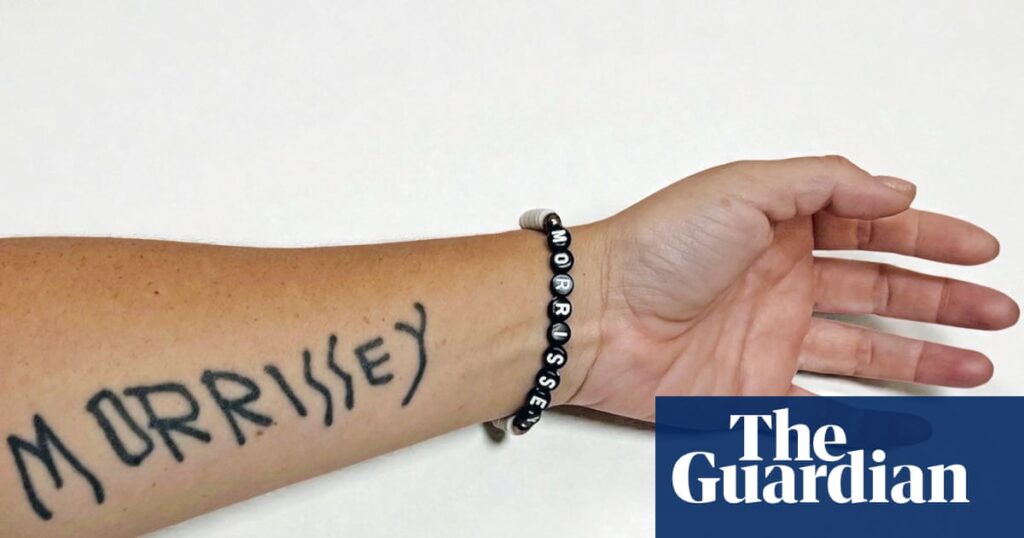
On 20 February 2012, Coté Arias met Morrissey at a fan meet-up in Santiago, Chile. The former Smiths frontman signed her forearm in spiky capitalised lettering, which Coté later had traced permanently on to her skin with ink. Her years-long plan for the tattoo, which had started with her founding Morrissey’s Chilean fanclub, had worked. “Morrissey had such an impact on me growing up,” she says. “I struggled with shyness and lacked confidence for much of my life, and his lyrics helped me feel seen while transitioning into adulthood.”
But in recent years, that inked signature has taken on more complicated associations for Coté. “The tattoo is very visible,” she says, “so it’s brought up many discussions regarding Morrissey’s comments.” Morrissey has publicly supported a far-right party, and made inflammatory comments about immigration, but denies allegations of racism.
Coté’s experience is far from isolated: it mirrors a broader cultural reckoning happening across fan communities as people confront their changing relationship with the idols they grew up with.
Olivia’s Marilyn Manson tattoo. Photograph: Courtesy of Olivia
Fandoms have a way of pushing people towards extreme behaviour, to go to great lengths to pledge their loyalty and display their devotion. Fans will plaster their walls with posters, queue for hours in the freezing cold, shell out hundreds of pounds on merchandise and spend hours running dedicated social media accounts. At the more extreme end they’ll throw phones at pop stars or end up in hospital with collapsed lungs due to screaming too much. But behaviour of this sort isn’t necessarily new. “Fandoms” as we understand them – communities of people with a shared passion, these days often associated with musicians – can be traced back centuries, from the followers of Roman gladiators to the women who threw fruit into the carriage of Pan An, a handsome scholar who served during the Chinese Jin dynasty, and the hysterical fans of the 19th-century Hungarian composer Franz Liszt, whose frenzy came to be known as Lisztomania.
Ella’s Pikachu. Photograph: Courtesy of Ela
My first experience of fandoms was through my obsession with Pokémon: I knew each creature’s name and special qualities by heart, and found comfort in the satisfying categorisation of it all; the competitiveness and the imaginary world I could get lost in.
Then came the Jacqueline Wilson books, the Twilight Saga (Team Edward), the pop-punk band My Chemical Romance. I’ve had a fair number of obsessions that didn’t age so well: American vlogger Jenna Marbles’s YouTube channel (now defunct after she apologised for racist and sexist videos), the TV show Gossip Girl (Chuck Bass’s advances towards 14-year-old Jenny Humphrey in the pilot episode were problematic, to say the least) and the electroclash band Crystal Castles (no longer active after former frontwoman Alice Glass made sexual abuse allegations against her bandmate Ethan Kath, which Kath denied).
It’s only natural that now, years later, haunted by the ghosts of our youth, some of us may be wondering what that fandom really cost us: all of that money poured into collectibles that now sit forgotten; the hours spent arguing in a subreddit, defending a figure who didn’t know we existed. At best, you may have come out the other side with a cringey collection of T-shirts you can’t bring yourself to throw away (culture may be cyclical, but just because indie sleaze is back, it doesn’t mean wearing Franz Ferdinand tees is cool if you’re past 30).
Grace’s Blink-182 tattoo. Photograph: Courtesy of Grace
Like me, Ella grew up with Pokémon, watching the cartoons, playing the Game Boy games and swapping cards with friends. After wanting a tattoo for years, she finally got inked when she was starting university. She remembers feeling proud walking out of the studio with a yellow Pikachu tattoo on her wrist. “It felt grownup and bold, but by my mid-20s I started to hate it – particularly the placement,” she remembers. She was asked about it at a job interview, and afterwards started wearing long sleeves to cover it up – even in the summer. After years of embarrassment, “repeating the same story when people asked me what it meant”, Ella started the process of slowly having the tattoo lasered off: “It’s expensive and painful, but worth it. I think I’d feel more confident without it.”
Grace, from London, has also taken drastic action to cover up a tattoo, in her case a Blink-182 smiley logo that she had inked on her hip when she was 15. By her 20s, while still harbouring a soft spot for the pop-punk trio, she began to dislike “having a stupid smiley face on my hip”, and so got a “cheap cover-up”: a shaded rose. “It’s maybe equally bad, but at least it’s slightly less embarrassing,” she says.
Tim’s Frank Ocean-inspired numerals. Photograph: Courtesy of Tim Photograph: Tim
Others, though embarrassed, prefer to style things out. “I have a tattoo on my knee which says ‘3:04’ in a calculator font, referencing a specific second in a song I love: White Ferrari, by Frank Ocean,” explains Tim from Bristol. “I got it done when I was 25 and in a very ‘party’ stage of my life.” He liked the idea of getting a “subtle” tattoo that he wouldn’t have to explain to anyone. But, disastrously, “the morning after I got it, I realised that if you read it upside-down, the numbers say ‘hoe’”. Despite not being “at all what I intended”, Tim has no plans to get his 3:04 covered up or removed. “I think it’s a nice reminder of how careless I was.”
Embarrassment is one thing, but the emotional load associated with carrying reminders of your former idols can cut much deeper. At worst, you may feel some sort of grief, grappling with the feeling of having outsourced parts of your identity to corporations or figureheads whose values, views or behaviour have become unpalatable to you. Kai, from Seattle, was 15 when the first Harry Potter film was released. They soon became the person going to midnight releases, bought thousands of dollars’ worth of merchandise and eventually got a Deathly Hallows tattoo, which they came to regret after reading JK Rowling’s 2020 essay critiquing what she called “the new trans activism”.
“I’m non-binary and my partner is a trans woman, so the ‘trans issue’ is something I have personal experience with,” Kai says. “The essay felt to me like a lot of misunderstandings about who and what trans people are. My tattoo now feels like being branded: I cringe when Harry Potter fans see it and try to engage with me about new material.”
double quotation markIf I were to give advice to my children, I’d suggest going with the band T-shirt instead
Josh*, from Brazil, is reworking his tattoo referencing the 2008 album 808s & Heartbreak by Kanye West, now known as Ye, after the rapper publicly expressed antisemitic sentiments. “I tried to come to terms with it, separating the art from the artist and all that, but it kept bothering me,” he says. His is not a unique situation: a London studio even went viral several years ago for offering free laser removals of tattoos related to the artist.
Dr Paige Klimentou, a popular culture academic at RMIT University in Melbourne, who also works as a receptionist at a tattoo parlour in the city, has had her Brand New-inspired tattoo covered up, after sexual misconduct allegations were made against the New York band’s lead singer, Jesse Lacey. “I felt like I was complicit in showing support for Lacey by having it,” she says. Navigating fandom in the post‑#MeToo era is complex, she adds, explaining that she also decided to give away her Brand New vinyl, not stream their music or engage with their content. A fresh grooming allegation emerged against Lacey in April 2025.
Josh’s Ye print. Photograph: Courtesy of Josh
Meanwhile, Olivia Jordan, from New Zealand, contemplated covering up her Marilyn Manson tattoo after multiple women made allegations of abuse against the musician. He denies any wrongdoing and has not been convicted of any offence, but an LA judge reopened a sexual assault case last month, under a new law enabling old sexual assault cases to be heard. Manson’s lawyer responded by saying his client “never committed any sexual assault”.
Finding the artwork too large to rework into anything other than a blackout sleeve, and learning the substantial cost of removal, Jordan has since learned to live with the regret: “I look at the tattoo now and fondly remember a time when I didn’t think so much about lifelong consequences,” she says. “I was back in London in my mid- to late-20s, living a completely different lifestyle to now, as a mother with a baby. If I was to give advice to my children, I’d probably recommend going with the band T-shirt instead.”
Paige’s Brand New design. Photograph: Courtesy of Paige
It’s not unusual for fans to decide against a removal or cover-up of a problematic tattoo. For some, the solution lies in simply renegotiating what the tattoo means. Coté tells me that the conversations she has had about her Morrissey tattoo “have helped me to come to the conclusion that, as fans, we are not forced to like everything the artist does, or agree with their philosophy, which most likely will change over time”. Despite not agreeing with his views, she still considers herself a “Moz megafan”.
To dismiss the role these fandom communities once played, especially during our formative, free-spirited years, would be to turn our backs on parts of our own identities. Instead, we can look back on beer-sodden underage gigs with joy, wince at the problematic headlines relating to our former idols and eventually renegotiate our relationship with fandom, appreciating what it once gave us without feeling obliged to stay loyal.
* Name has been changed