
As a busy professional, I can’t follow the latest Jeffrey Epstein scandal developments to their disgusting fullest, even as we finally reach the good part: watching the world’s crisis management operatives race to stop the contagious “Important Person Resigns; Who’s Next?” virus from infecting their hapless Epstein-knowing clients. Nonetheless, one piece of Epstein news accomplished the unthinkable and made me, a proudly disgruntled American, pay closer attention to the comings and goings of the British royal family.
I was done in by a single sentence of historical context in a breaking news story. Last week, after British police arrested Andrew Mountbatten-Windsor (previously known as Prince Andrew before his title was stripped) on suspicions of Epstein-related misconduct, the Wall Street Journal noted it “marks the first time that a royal has been taken into custody since King Charles I during the English Civil War in the 1640s.”
Thank you WSJ, you have captured my full attention. Wasn’t Charles I the one they beheaded four centuries ago before kicking off the short-lived English Republic? They didn’t even lock up the Windsors who futzed around with Nazis. It seems times have changed. You can always interest me in some unexpected republicanism, especially the absentminded kind.
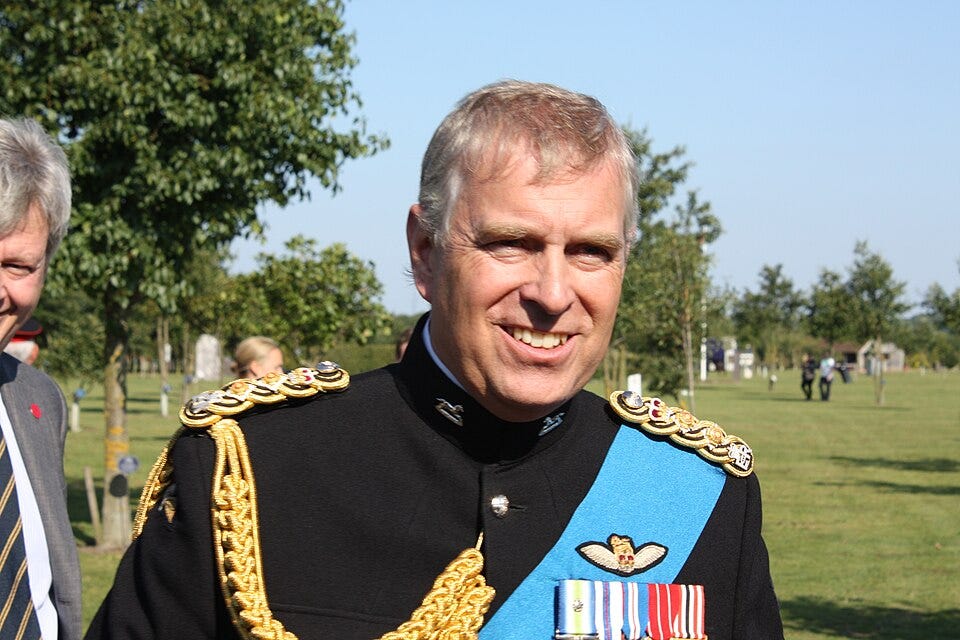
I was especially sold on learning about the Andrew angle of the Epstein saga after brilliant Reuters photographer Phil Noble captured the King’s brother slumping in the back seat of a car speeding out of a Norfolk police station, the old chap’s expression frozen in classic tabloid rictus, caught like a raccoon on a trail cam halfway through pawing open the trash bin. “It was a proper old school news day, a guy being arrested,” said Noble, displaying the exemplary English talent for understatement. Who could resist? Here was two of Britain’s most successful cultural exports — the royal family and whodunit detective shows — packaged into a single product.
The worst of the allegations against the wayward Mountbatten-Windsor have been known for many years, via the late Virginia Giuffre, who said she was trafficked by Epstein from Mar-A-Lago while underaged and sexually abused by then-Prince Andrew, which Andrew denies. The pair were photographed together in 2001, by Epstein, with Andrew’s arm around Giuffre’s bare midriff, with Ghislaine Maxwell in the background. Giuffre sued both Epstein and Andrew, who both settled rather than risk trial. One of the most damning things I read about the whole episode was Edward Klein’s 2011 feature in Vanity Fair, “The Trouble with Andrew,” about how Queen Elizabeth II warded off the press after Giuffre’s allegations became public:
With the prospect of even further humiliation to her and her son, the Queen decided to intervene by employing the most potent instrument at her command: royal symbolism. She summoned Andrew to Windsor Castle and in a private ceremony invested him with the insignia of a Knight Grand Cross of the Royal Victorian Order, the highest possible honor for “personal service” to the Queen. From now on, Prince Andrew will be entitled to use the letters G.C.V.O. after his name and wear a red-white-and-blue sash complete with the order’s star-shaped insignia, made from sterling silver, silver gilt, and enamel.
Under the protection of the Queen, Prince Andrew was untouchable. … As things turned out, her symbolic intervention on Andrew’s behalf produced its desired effect. When I arrived in London, two weeks after Andrew’s investiture into the Royal Victorian Order, the British press had fallen all but silent about his murky connections.
As Javier Bardem’s villain tutted to Daniel Craig’s James Bond in “Skyfall”: Mommy was very bad. Andrew’s brother, King Charles III, would be less indulgent. Though as of a few months ago, as Tina Brown noted, Andrew still presented a vexing threat to the institutional integrity of the royal family:
Charles, I am told, is not looking to punish his pampered brother to the point, he says, that he can’t “cope.” He’s more aware than anyone that Andrew has been served all his life by a cook, a butler, and a valet who used to accompany him on foreign trade trips, lugging a six-foot-long ironing board through the lobby of five-star hotels. Calling Andrew entitled is beside the point. He was raised with no economic purpose and now he finds himself as a connector to whom no one wants to be connected. “I have no idea who he will socialize with,” one Norfolk grandee told me. “All his friends are Chinese spies.” If Charles were not to pay his brother’s bills and ensure a certain level of comfort, Andrew would have only his secrets to sell.
And there are few things more damaging to monarchies than full disclosure. Walter Bagehot, the theorist of the English Constitution in the 19th century, said the British monarchy needed mystique to function effectively, while acknowledging a pungent criticism of nobility was that “the cure for admiring the House of Lords was to go and look at it.” Nonetheless, the mystery of the majesty was crucial to the whole enterprise, as Bagehot argued:
When a monarch can bless, it is best that he should not be touched. It should be evident that he does no wrong. He should not be brought too closely to real measurement. He should be aloof and solitary. As the functions of English royalty are for the most part latent, it fulfils this condition. It seems to order, but it never seems to struggle. It is commonly hidden like a mystery, and sometimes paraded like a pageant, but in neither case is it contentious. The nation is divided into parties, but the Crown is of no party. Its apparent separation from business is that which removes it both from enmities and from desecration, which preserves its mystery, which enables it to combine the affection of conflicting parties — to be a visible symbol of unity to those still so imperfectly educated as to need a symbol.
Yet in recent weeks, here was Andrew reappearing, fully disclosed, in the Epstein files pried open by a bipartisan intervention of the U.S. Congress, seen forwarding apparently confidential economic reports to Epstein in Andrew’s official capacity as a British trade envoy. Like Al Capone going down for tax evasion, “It was that, not allegations of sexual misconduct linked to his friendship with Epstein, that appear to be behind Andrew’s arrest this week on suspicion of misconduct in public office,” the Wall Street Journal reported, noting that Andrew had not commented on the allegations.
“Above all things our royalty is to be reverenced, and if you begin to poke about it you cannot reverence it,” Bagehot wrote. “When there is a select committee on the Queen, the charm of royalty will be gone. Its mystery is its life. We must not let in daylight upon magic.” Events around the Epstein saga have taken such a path that sunshine has become the only choice. There’s no more magic here. Just a guy being arrested.