
‘Do You Like Scary Movies?’
With Neve Campbell coming back for another round of meta-bloodshed, THR ranks all seven installments of the horror franchise.
Published on February 28, 2026
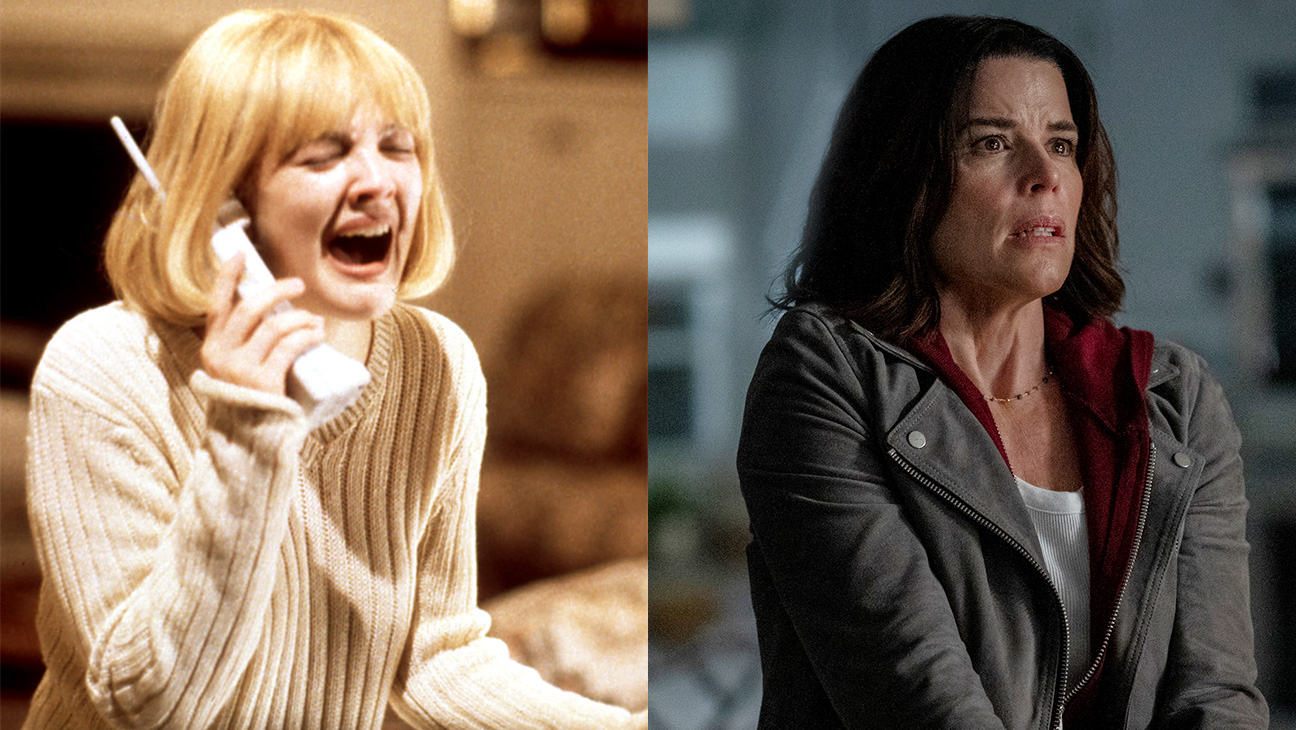
Drew Barrymore in the original ‘Scream’ (1996) and Neve Campbell in ‘Scream 7’ (2026)
Courtesy Everett Collection; Paramount Pictures
Thirty years ago, you answered the phone every time it rang. Watch Casey Becker in 1996’s Scream. She’s Drew Barrymore in a brilliant stunt cameo, but she could be any kid back then practicing now-ancient telephone etiquette. Casey asks, “Who are you trying to reach?” She says, “I think you have the wrong number.” When a stranger keeps dialing her back, she makes casual conversation. She does not assume, as anyone would today, that the unknown caller is a scammer, a spambot or worse. The central shock of that perfect first scene depends on a recent revolution in consumer technology: Casey, on her house’s cordless landline, realizes the man must have a cellular. He could be anywhere. He could be anyone. He will die bloody, like Casey, but the media, the movies and the internet keep resurrecting his ghost’s face. In the fullness of time, he becomes an app.
Scream paid homage to Psycho, Halloween and Friday the 13th. Director Wes Craven was a living genre legend who blew minds with 16-millimeter scumshock cinema before creating Freddy Krueger. The Ghostface mask was a pre-existing Halloween outfit, still licensed all these years later from Fun World. But the script came from Kevin Williamson, a rookie screenwriter about to become the voice of WB youth. A fresh-faced cast helped define the new teenquake: indie-cute, gothy-hot, overflowing with self-aware verbosity and whatever “Skeet” was. The movie’s success brought horror back to box office life and launched a series that continues three decades later. After a successful Gen Z pivot withered in geopolitical controversy, Scream 7 reunites Williamson with a few of his original stars. Put the popcorn on the stove. Grab a kitchen knife. Crank Nick Cave and the Bad Seeds’ “Red Right Hand.” We’re gonna play a little game and figure out which Screams stabs hardest.
(Warning: Spoilers ahead if you haven’t seen all of the Scream films.)
UNRANKED: Scream (2015-19)

Image Credit: Eliza Morse/MTV/Courtesy Everett Collection
Did you forget when Scream went to basic cable? MTV’s attempt to do another Teen Wolf spent a couple years grafting the movies’ tropes (freaky phones, jump scares, oft-tormented girl, sketchy boyfriends, “Everybody’s a suspect!”) onto a small-town mystery about a surgical-masked serial killer. It’s Pretty Little Liars with more farm-equipment gore — until the third season ignores all of that, rebooting to Atlanta for a new teenkilling saga that features Keke Palmer in a “Mrs. Obama” Halloween costume and a Ghostface killer played by Tyga. (That final run of episodes got dumped without ceremony onto VH1.)
Small-screen Scream was brisk and silly, and I bring it up to make a crucial point. Nobody expects Michael Myers to hack your home-security system. Ever-trendy zombie apocalypses give Earth a healthy internet detox. The Conjuring only conjures stuff from half a century ago. For better and for worse, Scream must be Right Now. The TV show’s version of digital modernity was often clumsy — snuff GIFs, murder selfies, a true-crime podcast hosted by a long-lost murderous half-sister — but that evokes the source material’s bleeding-edge spirit. The Scream concept launched in a gone world of 900 numbers, Star 69 and corded receivers. Sequels track the creep of insidious innovation: Caller ID, creepy texts, ranty message boards, social media, malicious livestreams. Now Scream 7 features motion sensors, AI deepfakes, Ring Cams and a hellish AirBnB. Unique among the great slashers, Scream’s taps a fear that’s primal and postmodern. The knife is just a weapon. The true terror is connectivity. Or, as Neve Campbell’s Sidney says in Scream 7: “Oh, fuck you, phone!”
7. Scream 3 (2000)
Image Credit: Courtesy Everett Collection
Sensing a post-Columbine backlash against amusing teen butchery, Scream went to Hollywood to uncontroversially slay a bunch of showbiz sinners. After murdering the host of the country’s “No. 1 nationally syndicated talk show,” the new villain carves through the cast of threequel-within-a-threequel Stab 3: Return to Woodsboro. The script by Ehren Kruger replaces Williamson’s video-store savvy with lame insider gags: Carrie Fisher as a Carrie Fisher lookalike, Jenny McCarthy complaining about rewrites, queasy casting-couch subplots in a film executive produced by Harvey Weinstein. The big tech idea is that Ghostface has, like, the Home Alone 2 Talkboy? Campbell seems too classy for this tomfoolery. While death stalks West Hollywood, Studio City and the Hills, Sidney Prescott spends the first half of the movie working a crisis hotline in a remote cabin. At least Parker Posey has fun as the daffy actress playing Stab’s Gale Weathers, streaks and all.
6. Scream VI (2023)
Image Credit: Philippe Bosse/Paramount Pictures/Courtesy Everett Collection
Don’t laugh when I say every Scream is both a film and an essay on film. There’s a slasher about slashers, a sequel about sequel, a remake about remakes, a legacy sequel about legacy sequels. (Scream 3 announces itself as “the concluding chapter of a trilogy,” a big deal back when trilogies still concluded.) Scream VI is the first installment that can’t pin down what sort of movie it is. When bloodshed follows the “Core Four” Woodsboro survivors to their New York City campus, Jasmin Savoy Brown’s Mindy claims they’re in “a continuing franchise” of “episodic installments designed to boost an IP.” That should be a dire warning: Nobody’s safe now that Hollywood killed Iron man and James Bond! But then precisely zero main characters die. Returning directors Matt Bettinelli-Olpin and Tyler Gillett have fun unleashing this housebound franchise in a very Montreal neighborhood of Manhattan. (Ghostface goes to a bodega, an apartment building, and a subway.) The climax leaves the mean streets behind, though, enclosing the cast inside a museum of Scream artifacts. That’s when you realize VI is less about continuing a franchise, and more about maintaining an archive with referential nostalgia. (Stop thinking The Last Jedi; start thinking The Mandalorian.) Since star Melissa Barrera got dropped from the seventh film after posting about Gaza, her strange duology wraps as an inadvertent warning about IP-ravenous Hollywood. All these new characters wind up trapped in somebody else’s old content.
5. Scream 7 (2026)
Image Credit: Paramount Pictures
OK, but you know who doesn’t think every Scream needs to be some sort of meta-essay on film theory? The creator of Scream. Returning to co-write the seventh installment and direct his first feature in 27 years, Williamson mostly avoids Stab by self-reference for a personal tale of maternal instincts in chaotic times. Sidney Prescott is now “Mrs. Evans,” mother of three, police wife, proprietor of The Little Latte café in Pine Grove, Indiana. She has tried to keep 17-year-old Tatum (Isabel May) innocent — and worries her helicoptering has left her daughter a defenseless victim. “If we protect our children too much, they’ll never learn to protect themselves,” a mom friend points out. It’s that big question breeders keep pondering lately: Gentle Parenting or FAFO?
While this seventh installment got delayed and reconceived, something unthinkable happened. Last summer brought sequels to Final Destination and I Know What You Did Last Summer — and both were incredible! There was suddenly a real possibility that Scream was becoming the third-best franchise of the teen-horror wave it launched. That’s why, with all due respect to the truthers protesting Barrera’s firing, I had one question about Scream 7: Would Neve Campbell get material as good as Jennifer Love Hewitt got from the last Summer? Answer: No. It’s great watching Campbell play parental paranoia — she really doesn’t trust teen boys — and a genuine pleasure how Williamson rediscovers tension in the “complicated but enduring” Sidney-Gale dynamic. But the central mystery muddles AI skepticism with limp backwards continuity. Oddly, this family-focused installment is most notable for its garish brutality. Deaths involve a chandelier, a drama-club flight rig, a beer tap, and a construction site with sharp tools lying around. Random objects used for bloody murder? Consider this a stinging compliment: It reminds me of Final Destination.
4. Scream (2022)
Image Credit: Brownie Harris/Paramount Pictures/Courtesy Everett Collection
There are certain rules one must abide by to make a Scream movie. Actually, there’s only one rule. A good Scream is about other movies, and a bad Scream is only about other Screams. This revival narrowly enters the “good” column by making mirth from the age of blockbuster fandom backlash. Characters old and new get caught in the latest maniac’s oh-so-Reddit attempt to keep progressivism out of sequels and Make Stab Great Again. Savvy casting caught Jenna Ortega and Mikey Madison right before Wednesday and Anora propelled their stardom. And Melissa Barrera had been delightful as the hot-mess sister on the Starz’s Vida — which makes it baffling that her Sam Carpenter is such a rueful wet blanket. She’s the daughter of Billy “Ghostface the First” Loomis, so her stern resolve masks simmering psychopathic rage. But expressing that killer instinct with a de-aged Skeet Ulrich is a bad, bad, bad idea. Conversely, 5cream’s best grace note comes from a decidedly un-de-aged David Arquette, returning for one last stumble as lovable human pincushion Dewey Riley. I assume if you’ve read this far you won’t mind spoilers about everything from here? The ex-Sheriff comes back just long enough to look cooler and more pitiful than ever. His death — he looks at his phone at the worst time — is the kind of shock missing from the lesser Screams.
3. Scream 4 (2011)
Image Credit: Gemma La Manna/Dimension Films/courtesy Everett Collection
Sidney joins forces with a savvy teenagers — like the fifth movie, and the seventh. Except these youths are self-absorbed, traitorous, wacked out on webcasts, desperate for clicks, entirely unoriginal, and potentially illiterate. Also: They all die. Emma Roberts plays Sidney’s lookalike cousin Jill. Introduced as the new teen hero, she’s actually — twist! — a fame monster. She mutilates her friends, targets her own family, and shoots her boyfriend’s dick off — all for the likes! Scream 4 takes aim at the previous decade’s remake culture, a debased and delirious era of extreme violence and “flashy music-video direction.” So it’s extra meaningful that Jill’s ultimate plan is reboot herself as Sidney 2.0 — right after she eliminates the original. Production was troubled. The Cox-Arquettes decoupled. Williamson left, later telling Entertainment Weekly he had a “massive fight” with producer Bob Weinstein. Craven surely didn’t want his final feature to be a fourquel. But the director’s previous film — 2010’s painfully sincere My Soul to Take — was an original-concept flop, severely undergrossing all the remakes of his horror classics. The indie cool of the 1990s had long since mutated into 2000s pop sleaze, and Dimension Films’ own Scream-replicating Scary Movie parodies were earning more than Scream ever did. Does all this explain the rage bubbling beneath Scream 4’s playful surface? I think Jill is the best villain this series produced after Billy Loomis, and the final showdown has serious resonance. Sidney killing Jill is quite possibly the single meanest thing Generation X ever did to millennials.
2. Scream (1996)
Image Credit: Courtesy Everett Collection
Wes Craven made an amazing movie where a woman gets scary phone calls from the murderer who wants to trap her inside a horror film. It flopped. Two years before Scream, Wes Craven’s New Nightmare brought back original Elm Street star Heather Langenkamp to play a version of herself stalked by her cinematic past. Why was that meta-horror slasher the lowest-grossing Freddy Krueger sequel right before this meta-horror slasher became Craven’s biggest hit? You could call out all of Scream’s young stars: Rose McGowan as the no-bull best friend, Matthew Lillard’s Kabuki-theater version of teen jerkitude, Skeet Ulrich doing James Dean doing Anthony Perkins, Jamie Kennedy’s oddly endearing loudmouth-nerd virgin. Williamson weaves a brilliant mystery into slasher logic. Craven directs with slick efficiency, but you spot his gnarly ‘70s instincts in the intestinal rawness of the bloodshed, not to mention all the hilarious ways the victims keep beating Ghostface up.
People in Screams always tell Sidney Prescott she’s the hero, the leading lady, the star. (In Scream 7, at long last, someone finally calls her a “Final Girl.”) But right from the start, the series has two equally crucial tentpole personalities, and I believe their friction explains the film’s runaway success. Not enough respect gets paid Courteney Cox for filming a zeitgeist-dominating feature film on hiatus from her day job on one of the most popular sitcoms in history. And I maintain Gale Weathers is Cox’s greatest performance: Ambitious, self-destructive, brave, ridiculous, unapologetic. (Think Monica without any friends.) Cox’s comic energy balances Campbell’s sensitive toughness. When they team up in the finale to stop a couple mass-murdering bros, it’s an alliance that’s both surprising and totally righteous.
1. Scream 2 (1997)
Image Credit: Courtesy Everett Collection
Of course Sidney Prescott wants to forget Billy Loomis ever happened, and of course Gale Weathers writes a bestseller so successful that Billy Loomis becomes a pop culture virus that will never die. As legendary film reporter Clark Collis recounts in his recent horror-film history book Screaming and Conjuring, the sequel came together at breakneck speed. Williamson was filming the pilot of Dawson’s Creek while he crafted this College Years follow-up for Sidney and her friends. It should feel rushed, slapdash, desperate. Instead, Scream 2 soars high on its own supply, at once enamored and horrified by its own phenomenon. The opening scene replays Drew Barrymore’s nightmarish killing with carnivalesque dread. When Jada Pinkett Smith gets attacked at a Stab screening by somebody dressed as Ghostface, nobody helps her. They’re all dressed as Ghostface, too; they assume her death is a publicity stunt. It’s the best scene in any Scream movie, a bent-reality mindwarp that’s owes less to Halloween than Natural Born Killers.
What a cast! Pinkett Smith, Omar Epps, Sarah Michelle Gellar, Joshua Jackson! Timothy Olyphant and Liev Schreiber give attention-grabbing parts eons before their TV stardom. Kennedy’s Randy rocks a goatee, and his death hurts — just like the endearing limp Arquette gives Dewey. Jerry O’Connell sings. And Courteney Cox’s hair is the best hair anyone has ever had on their head. Tori Spelling also appears as “Sidney Prescott” in the movie-within-a-movie. Airquote gags like that would swallow a couple Screamquels, but Neve Campbell’s palpable dismay keeps the movie grounded. She’s an essential ‘90s archetype, a cultural sensation who just wants to be left alone.
A crucial plot tangent reveals Sidney has taken up acting, playing Cassandra in the Windsor College production of Helen of Troy. Can she relate to the mythic prophetess? “She knew she was cursed,” her drama professor explains. “It was her fate, and she embraced it.” Sidney carries her own curse, hunted by something that won’t die no matter how many times she kills it. It’s an easy shorthand to call Scream’s bad guy Ghostface, but all those masks and killers are disposable. The real villain is the voice on the phone — still and always performed by the great Roger L. Jackson. “Hello, Sidney,” the voice purrs in her era, “Remember me?” She killed Billy Loomis but she can’t kill that voice. In 1997, Scream 2 saw the new century of lunatic fanbases and trollish anonymity. Naturally, the new killers met on the internet. “God, I hate this shit!” Sidney says. She doesn’t like scary movies. Her problem is that we all do.
THR Newsletters
Sign up for THR news straight to your inbox every day
Subscribe
Sign Up