
In the past six months, the image that springs to mind when you hear the words “David Harbour” has probably gone from gruff but loveable small-town sheriff, or perhaps second-tier Marvel hero, to a Duane Reade bag filled with used sex toys. Stranger Things vaulted Harbour from that-guy status to big-screen star, playing variations on a man—or, in the case of Hellboy, a horned half-demon—clawing his way back from rock bottom, beaten down by life, yet not quite as broken as he seems. But it’s hard to look at Harbour now and not think, at least fleetingly, of the portrait painted by his ex-wife Lily Allen, whose most recent album, West End Girl, is a blow-by-blow account of the end of their five-year marriage that paints Harbour as a compulsive sex addict using his newfound wealth to blind his wife with extravagant gestures while he gorges himself at an open buffet.
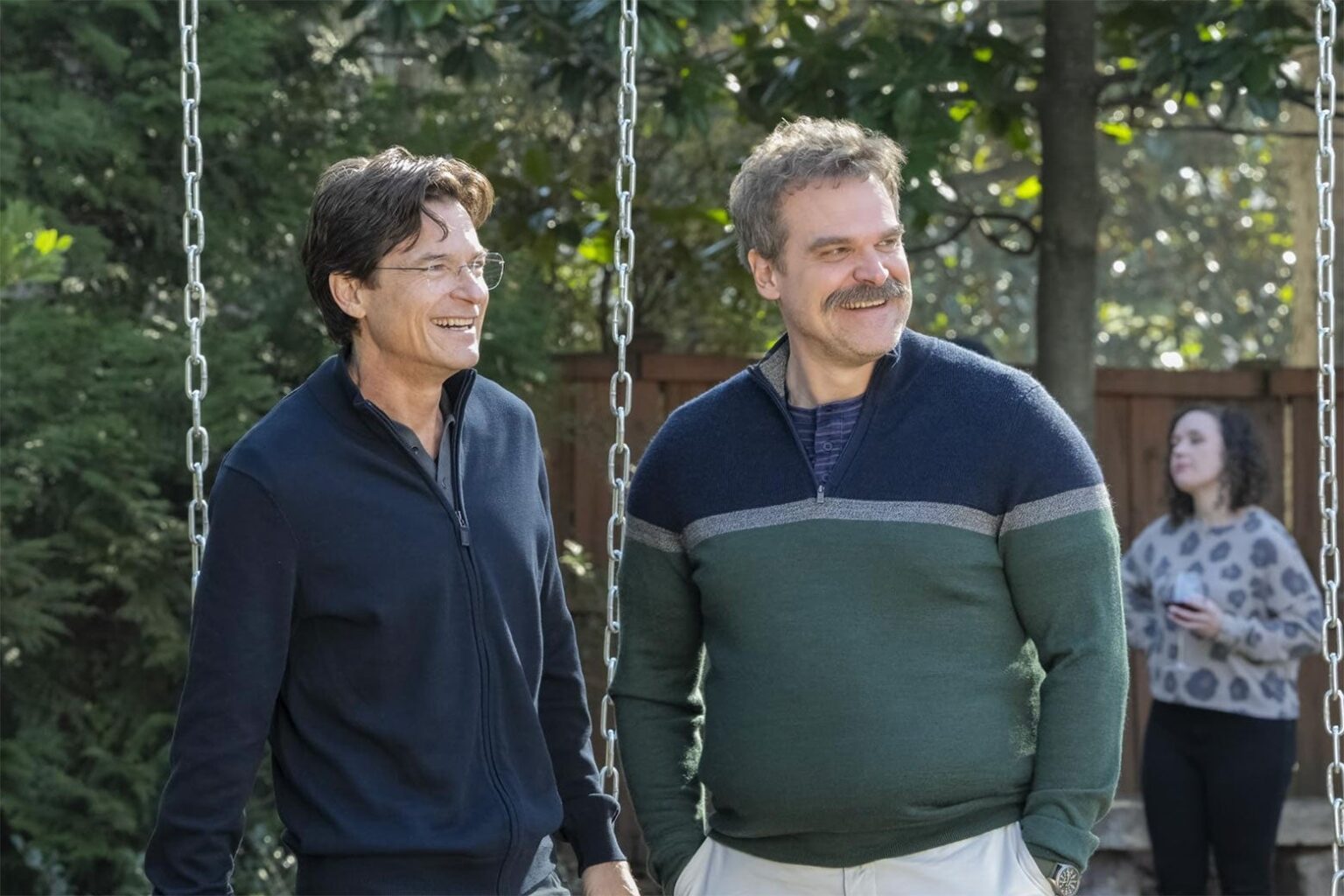
That makes him, in essence, the polar opposite of Floyd, his character on the new HBO miniseries DTF St. Louis. If Harbour is a player, Floyd is one of life’s played, a stalled-out suburban dad who lugs around a giant beer belly like it’s a sack full of his life’s regrets. An American Sign Language interpreter, Floyd strikes up a friendship with Clark (Jason Bateman), a TV weatherman who uses live interpretation in some of his broadcasts. Clark, who beams down at their middling Midwestern town from a billboard that promises sunny days ahead, seems to Floyd to have everything he lacks—security, prestige, a sense of purpose—so much so that he doesn’t notice how miserably unhappy Clark is.
Floyd gets his first hint when Clark pulls him aside to tell him about a new app he’s been looking into: DTF St. Louis, which promises clandestine hookups for people looking to stray outside the bounds of their marriage. Floyd’s not interested at first, despite the fact that he’s lost all interest in his wife, Carol (Linda Cardellini), who’s been moonlighting as a Little League umpire in order to keep their family financially afloat. Floyd works only sporadically—in fact, we rarely see him work at all—and Carol already has a full-time job at Purina. But her side gig, he claims, has killed his longing for her, because every time they’re about to have sex, he pictures her in her oversized padding and cage-like mask. To be fair, it’s not all her fault, he tells Clark. “I’m sure there’s something I do that turns her off,” Floyd admits. “I don’t know what.” Cut to Floyd schlumping around their kitchen in his boxers, gut spilling everywhere, while Carol takes care of business in her corporate fleece.
Steven Conrad, a longtime screenwriter and more recent showrunner whose credits include The Pursuit of Happyness and the Prime Video series Patriot, seems to have conceived of his new show as a dark-hued comedy. But it’s as if he neglected to inform his actors, whose performances are soaked in middle-aged discontent, or his cinematographer, who gives the series a uniformly gray and downcast feel. It sure doesn’t help that one of the main characters turns up dead halfway through the first episode, splayed out in the changing area of a public pool named for Kevin Kline.
After Big Little Lies and The White Lotus, it seems that HBO no longer knows how to tell a story about unhappy couples without bringing murder into it. (Harbour, who spent years working with Conrad to develop the series, has explicitly cited The White Lotus as an inspiration.) But in DTF St. Louis, the device feels especially egregious, because it’s not dealing with characters whose outwardly fabulous lives conceal a dark underbelly. It would only take one glance at Floyd to identify him as an aimless schmuck, a guy who carries his own personal rain cloud with him wherever he goes, but the show keeps finding new ways to humiliate him. It’s not bad enough that he’s fat and mostly unemployed, or even, as he tells Clark early on, that he’s got a medical condition that results in him having a curved penis—the show also has to hint at that condition being the result of a significant trauma, and then drag out revealing the precise nature of that trauma for longer than the four episodes sent to critics. Floyd has been kicked in the balls by life, and that’s not just a metaphor.
In order to stretch out what seems to be a fairly thin story over seven episodes, DTF St. Louis starts hopping around in time from the moment the corpse is discovered, and two detectives—one a lethargic old white man (Richard Jenkins), the other an ambitious young Black woman (Joy Sunday)—take on the case. There are revelations to come, of course, but they’re not particularly shocking. In fact, the show sometimes wrongfoots us in the other direction, making us expect some salacious tidbit is about to surface and then revealing some entirely mundane bit of entry-level kink, as if to suggest that the things people treat as deep, dark secrets are rarely as perverse or freakish as they might fear. If Floyd could have just gotten up the nerve to tell his wife that her umpire outfit was a boner-killer, none of this would have happened.

Sam Adams
The Delightful New Comedy That Feels Like the True Heir to 30 Rock
Read More
How Is Timmy Chalamet Getting Away With It?
Taylor Swift Is Back to Her Old Tricks
Jason Bateman’s New HBO Show Wants to Be the Next White Lotus or Big Little Lies. It’s No Such Thing.
The weird aspects of DTF St. Louis come not in its characters’ predilections, but in tone and staging. At times, it’s unrelentingly morose, at others broadly comic, as when Jenkins’ detective learns that one of the DTF app’s users expressed a preference for ass play, and he dutifully whips out his notebook to jot down the letters A and P. Then there’s his habit of conducting interviews for a murder investigation in the lobby of his police precinct, a vacant black box with constant foot traffic where he sits a dozen feet away from his suspects. Is this some odd feint at abstraction, or maybe just history’s most low-budget reshoot? (Possibly they overspent on the scene where a suspect’s credit-card statements are spread out across a wall full of TV monitors like this suburban police station is NASA Mission Control?) Perhaps that, like the mystery of Floyd’s bent dick, is to be solved in the final three episodes.
Conrad writes most acutely when he’s sitting in the malaise of midlife, probing the gallows-humor resignation to the reality that few people’s lives turn out the way they wanted. When Carol laments that Floyd “used to be, like … ,” Clark cuts her off and says, “We all used to be like.” A more confident show, or a more honest one, might have stuck with that feeling, rather than ginning up a plot better suited for a true-crime podcast. But maybe it’s the final proof of the characters’ banality that not even a murder mystery can make them interesting.
Get the best of movies, TV, books, music, and more.