
Joachim Trier knew when he was making “Sentimental Value” that it was a character study of two sisters and their father. “We did not want to make a film that felt like a chamber drama where people sit around the table and talk.”
Trier wanted the characters to move.
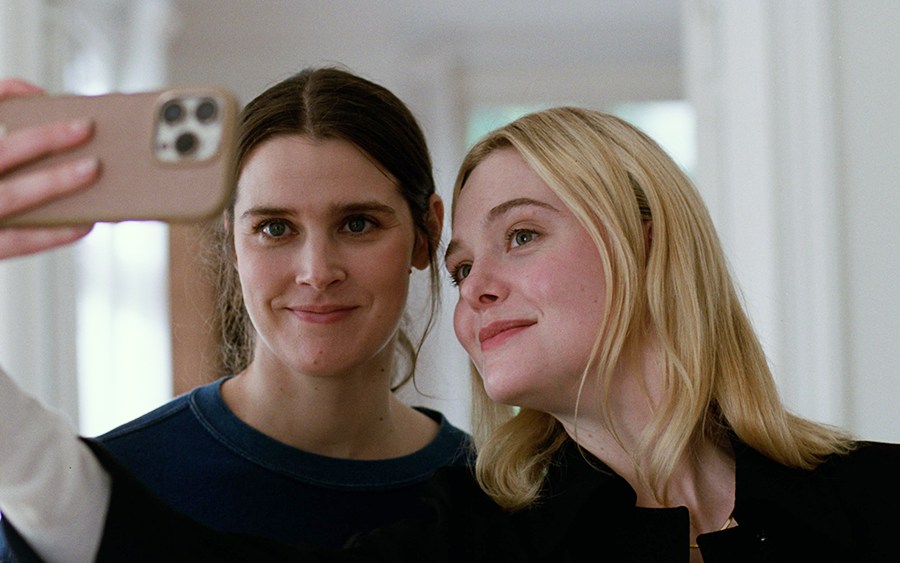
“Sentimental Value” is a Norwegian drama about two sisters (Renate Reinsve and Inga Ibsdotter Lilleaas) who try to reconnect with their estranged director father (Stellan Skarsgård), as he moves to cast a rising American star (Elle Fanning) in a coming feature.
To add perspective and move the characters, Trier introduced the idea of the family home as another character. “The house gave us a key to understanding a bigger perspective on time and this family story.”
The film opens as Agnes and her sister Nora (Reinsve) are navigating the aftermath of their mother’s death. The family home is distinct with its red exterior, but it has a history. It’s been in the family for generations, and now Gustav, their estranged father, wants to shoot a film there.
Through voiceover, Nora shares a story, narrating its past – we learn Gustav’s great-grandfather died in the same second-floor bedroom his grandmother was born in. We learn that his mother took her life in a room downstairs, and Nora would eavesdrop on her mother’s sessions via a fireplace.
Speaking with Variety, Trier explained that the house montage follows a period of 130 years. “There’s this idea of more philosophically looking at how short a human life is, looked at from the perspective of a house, and also the idea of inherited trauma. Those themes that are percolating in the background were given a more entertaining and more interesting visual, formal approach because of the house.” He adds, “The house helped us tell a story in an original way.” He also revealed how when he was 11, he accidentally started a house fire, and that moment had “percolated” in his mind, as he co-wrote the scene with Eskil Vogt.
Can you talk about this “house montage” and the information you wanted to get across?
Joachim Trier: It’s an essay that the 12-year-old oldest daughter, Nora, writes about the house as if it were a character in English class. She reveals a lot, and that she comes from a home where her parents are arguing. She also reveals that she’s using creativity and creating something as, maybe almost as an avoidance mechanism, not to really look at the real problems going on, and this is a recurring theme with her and her father throughout the film. But it also is a story of reconciliation. We don’t have eternity with our parents, so if you want to try to forgive them, or at least take baby steps of reconciliation, the film talks about that.
On a personal note, I haven’t talked about this a lot, but when I was 11 years old, by mistake, I burned down the top floor of our family house the night before Christmas. A candle fell over while I was out of the room, and it caught fire. My Madonna and Michael Jackson posters that were hanging around the walls also caught fire, and the house started burning, and we had to rebuild it. I remember losing all my things at the age of 11. We were just stunned by my idiotic behavior, but that idea that of the constancy was suddenly were wiped. So this idea of a place being rebuilt and being different felt like the soul of the house had changed, and that, I think, percolated in the back of my mind when I wrote this.
Olivier, when it came to conversations about how the sequence needed to look, what was in the back of your mind?
Olivier Bugge Coutté: It’s a phenomenological study of a space. When you take it from an editing point of view, we let the light, the shape of the rooms and sounds and guide the editing of putting the piece together. It’s almost as if we’re like taking the house apart bit by bit. Many of the shots didn’t have a specific place. There were shots of the house, windows and kids running. So, we built it and left pauses for the space of the house to sink in. We leave a lot of empty spaces where you hear sound outside the frame because you experience things better when they’re outside the frame, when you hear them, than when you see them. And that leads to a different experience.
What was your collaboration like?
Trier: It’s clearly written, and it’s in the same place as the screenplay. As we were filming, we found better moments here and there, and we changed the voiceover a little bit. Olivier is great at doing montage work, so it’s exciting to alternate bits and pieces outside of what was planned, also just to see if he can create something more exciting, and he always does. We were looking for the poetry of the house throughout the shoot.
Coutté: Our DP Casper is so creative, he built that little house when we cut to the black and white house built like sticks. He did that without telling anyone.
Trier: We talked about doing something along those lines, but it was too expensive to build the whole house, so he did a scale perspective cheat and created that moment, and it is now a core element in the montage.
Was there anything metaphorical in the windows because they play such a part in the visuals?
Coutté: If you pay attention to the cut, the space comes before the humans, so you have an empty frame. You have people entering the frame. You have them exit, and we leave the frame empty. The frame is there before and after the humans.
Olivier mentioned the voiceovers earlier. What is the story behind that?
Trier: We were looking for a voice that had the authority to tell a story of the 20th century. Bente Børsum is the voice, and she’s in her 90s. She was the lead in my grandfather’s film “The Chasers.” My grandfather was captured and imprisoned during World War II, and was also in the resistance, so he’s very traumatized. In the background of our film is the theme that we’re dealing with – the inherited trauma – three generations of war, trauma, and the Holocaust. Bente Børsum’s mother was also imprisoned during the war and barely survived, so I knew she had that relation of that experience with my grandfather. Years later, she’s a renowned actress, and somehow using her as the voiceover connects me back to my grandfather, and it was a full circle moment.
How did you match the tone of the voiceover with that montage and what we’re seeing?
Coutté: It’s a play between the voiceover and the space, and not let the voiceover take the forefront, but also leave moments for the space to breathe. We let the voice-over run, and then we let the house take over.
I ask about that final shot as the camera pulls away, and you see Nora and Gustav. Can you talk about that final shot?
Trier: That’s when we knew we had a film in the writing room at an early stage – when I understood what the ending could be in this film, and the non-speaking part. This understanding, hopefully for the audience, of a deeper perspective on this life choice that Nora and Gustav have made. It’s like a sad love story between a father and a daughter who are very similar but don’t know how to function together in the world, and the idea that they create something together, and that’s the best they can do. So they meet inside this world that they’ve chosen, rather than around the family table, where having a conversation is impossible. I didn’t want the ending to be a sellout, where they say everything’s fine, or they forgive one another. That’s not how life works in my experience.
This interview has been edited and condensed.
Read the screenplay below, and watch the house montage scene above.