
When you hear Jessie Buckley’s name, what image springs to mind? Given the Oscar buzz around her performance in Chloé Zhao’s Hamnet, it’s probably the Irish actress dressed in red as William Shakespeare’s wife, Agnes, roaring like a wounded animal over the death of her son.
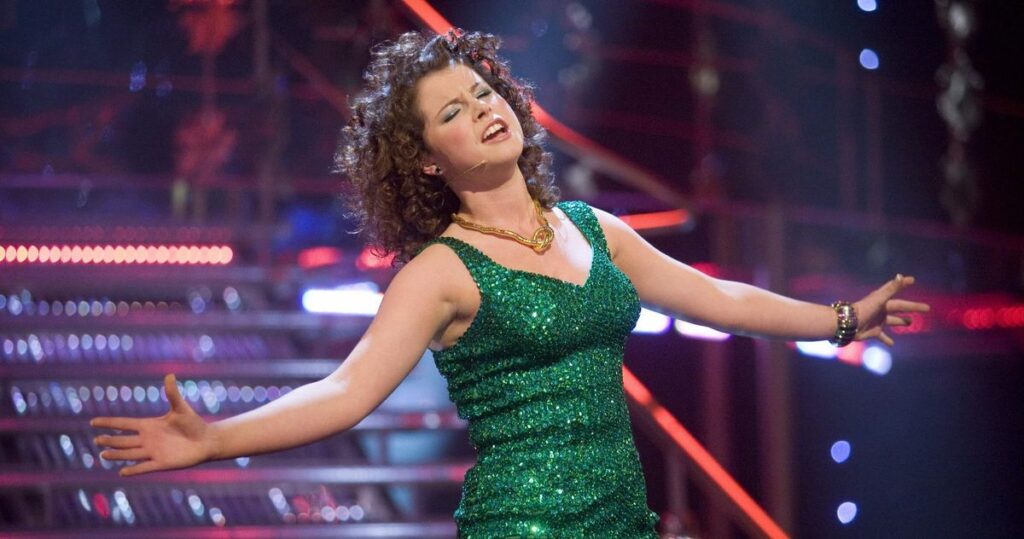
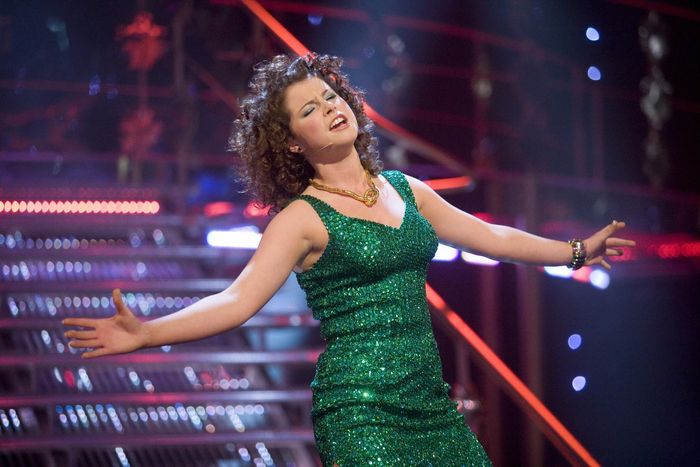
But to a certain millennial-and-over subset of the British public, there’s a specific version of Buckley that’s hard to forget: one with smoky eye shadow, her hair in tight curls, singing her heart out in a shiny dress that could have come in a “Victorian woman” costume bag from Party City — the same one she wore on live TV every weekend for three months in the spring of 2008. There, Buckley belted out a catalogue of show tunes, jazz standards, and pop songs in front of composer Andrew Lloyd Webber and a panel of judges in a desperate bid to snag the part of Nancy in the big-budget West End revival of Oliver!. Her voice was undeniable, even if the judges dinged her for how stilted her movement was. (She often sang with her arms limp at her sides.) Her awkwardness made sense, though. After all, Buckley was just 18.
The BBC series I’d Do Anything arrived in the middle of the reality-TV boom of the 2000s, when everything from ice dancing to finding a “British best friend” for Paris Hilton could be turned into a competition format. The show was the third installment in Webber’s reality-TV empire, each airing in a prime-time Saturday-night slot on the BBC with Graham Norton hosting. The aim? Finding fresh musical-theater talent to lead new productions of The Sound of Music, Joseph and the Amazing Technicolor Dreamcoat, Oliver!, and The Wizard of Oz. In allowing the viewers to have their say in the casting process by voting along, the public became invested in the U.K. theater scene like never before.
It cannot be understated just how strange the Webber shows were. Collectively referred to by their respective character names (as the “Nancys,” “Marias,” etc.), the contestants lived in a house together and were sent out each week to take part in themed “missions.” In the case of I’d Do Anything, Buckley & Co. worked at an East End market and, for some reason, were made to practice kissing scenes in front of their fathers. (Buckley, at least, saw the humor in it, jokingly prodding her father and telling him, “You’re not meant to see that, Dad!”) And then there was head judge Webber, who sat on a throne and was referred to as “the lord” throughout.
Still more ridiculous was the climax of each results show, when the eliminated Dorothys placed their ruby slippers in Webber’s hands and the departing Josephs were stripped of their colorful coats by fellow contestants before being made to sing “Close Any Door.” There was always someone, usually multiple people, crying, and who could blame them? Dreams were being destroyed live on TV. Musical theater being more of a niche than pop, the Webber shows didn’t produce stars on the scale of American Idol’s Kelly Clarkson or The X Factor’s Leona Lewis. But while they aired, the contestants were proper celebrities. When the Sex and the City movie premiere came to London, the Nancys walked the red carpet. Buckley wore a wide-sleeve floral dress and chunky bow belt. It was all very 2008.
These shows not only gave viewers a peek behind the curtain and onto the stage but rewrote the rules on who could stand up there and sing in the first place. Trained actors with agents could try out, but they’d have to line up to audition alongside amateur performers with stage experience limited to school and community productions. Buckley, who had been rejected from London’s Guildhall School of Music & Drama just days before the I’d Do Anything open auditions, was firmly in the latter camp. Her small-town beginnings in southwestern Ireland were a constant focus throughout the competition. “Nothing as big as this has ever happened in her town,” her mother, Marina, told the cameras.
They had plenty to be proud of. From the outset, Buckley established herself as one to watch. Webber was a particular fan and would wax lyrical about her voice and its ability to “pin [him] to the back wall.” The other judges, however, were less sure. There was a real obsession with Buckley being a bit awkward and unsexy and too much of a “tomboy,” all of which amounted to a narrative, as one judge scoffed, that she was “so unfeminine.” Those comments felt at odds with the rough-and-ready “street kid Nancy” Webber professed to be looking for (as opposed to a pious Maria or naïve Dorothy). They’ve aged especially poorly considering the roles Buckley is now known for — in Women Talking, Wild Rose, and, yes, Hamnet — and the ungendered earthiness she brings to each.
At the time, Buckley was emotional and, understandably, confused. In a recent British Vogue interview, she spoke about the I’d Do Anything judges’ “messed up” fixation on her femininity or lack thereof. “I was growing into my body,” she told the magazine. “I was in a moment of discovery. As women, it’s such unfair objectification.”
Over the season’s duration, Buckley earned an unfortunate reputation as the “inconsistent” one. She would leave Webber visibly vibrating in his chair with her rendition of “The Man That Got Away” one week, then was declared too “emotionally fragile” to be Nancy the next. Yet the voting public clearly saw the same star quality in Buckley that “the lord” did. She was never in the bottom two and eventually made it to the final alongside 28-year-old northern lass Jodie Prenger.
A former winner on the U.K. version of the weight-loss competition The Biggest Loser, Prenger had charisma by the bucketload and experience that Buckley lacked. The panel was split on who they wanted to be Nancy; Webber and producer Cameron Mackintosh, however, backed Buckley. So when Norton declared Prenger the winner, you couldn’t blame her for looking genuinely flabbergasted. Buckley put on a brave face, smiling before running to her family, while Webber declared Prenger “the people’s Nancy” (ouch).
It’s to Buckley’s credit that she knew what she didn’t want to do after I’d Do Anything. When Mackintosh asked her to be Prenger’s understudy in Oliver!, she turned it down and instead appeared in a revival of Stephen Sondheim’s A Little Night Music at an off–West End theater. A stint as a jazz singer followed, leading to Buckley picking up where she left off before her first TV audition and going back to drama school. She’d been going down one path since 2008 and now “was wanting to get off the track,” she told The Guardian in 2019.
Even non–I’d Do Anything viewers are now familiar with the rest of her story: the BBC dramas, the BAFTA nominations for Beast and Wild Rose, the Charlie Kaufman and Alex Garland films, the Olivier-winning turn as Sally Bowles opposite Eddie Redmayne’s Emcee. An Oscar for Hamnet would be a testament not just to the raw talent you can see on I’d Do Anything but to the willingness of the people around Buckley and the actress herself to invest in and nurture that gift. She’d still have something special without it, but who can deny the magic of a reality-TV runner-up to Oscar front-runner story?