
Unlock the Editor’s Digest for free
Roula Khalaf, Editor of the FT, selects her favourite stories in this weekly newsletter.
Molly Vs the Machines is a harrowing feature-length documentary that attempts to take on the giants of Silicon Valley by focusing on a teenage girl from north-west London and her father’s fight for justice in her name. Molly Russell was 14 when she died in 2017. Her suicide came after months of viewing content on social media about depression and self-harm. Five years after her death, a UK inquest concluded that “she died from an act of self-harm whilst suffering from depression and the negative effects of online content.”
These negative effects have been minimised by the companies that distribute it, but this film does a coolly furious job of dismantling their defences. It is a collaboration between director Marc Silver, academic Shoshana Zuboff, author of The Age of Surveillance Capitalism, and, provocatively, AI, producing a hybrid of documentary and dramatisation. The makers prompt AI software to tell the story of Molly Russell’s life. The result is a brief history of the digital age: its evolution from the early days of optimistic anarchy to the present era of opportunistic, and many would say predatory, maximisation of profit. This runs alongside memories of Molly’s childhood, as told by her family and friends, and gently explains how social media and the internet became an integral part of life for her and for her generation.
The documentary attempts to tell a vast, sprawling tale of data harvesting and tech giants aiming to replace politics and even states, but its makers know that its greatest power lies in the personal and specific. Molly’s father, Ian, makes the indelible point that he thought his daughter was safe at home, in her bedroom, but that, through her smartphone, others were making the decisions about what was suitable for her to see. He speaks with grace and eloquence about his decision to confront Meta about the company’s insistence that many of the horrific posts his daughter saw were not in violation of their policies.
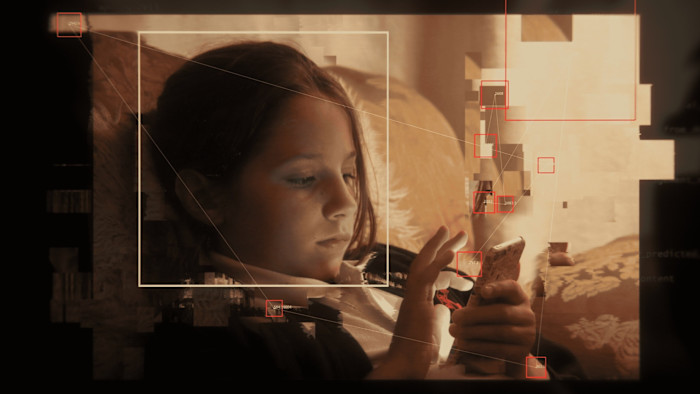
 Molly had viewed content on social media about depression and self-harm
The film also recreates parts of the inquest, including some of the testimony of Meta’s then “head of health and wellbeing policy”, Elizabeth Lagone, on a studio set. Much like Channel 4’s 2022 film Grenfell, which used actors to dramatise parts of the Grenfell Tower inquiry, this technique makes plain the simple, horrifying facts of the case.
This dramatisation is watched by Ian and by a group of Molly’s school friends whose role here is vivid and deeply moving. They are older now, of course, as their friend will never be. The UK government has just begun its public consultation on a social media ban for under-16s. This distressing and insistent documentary shows what is at stake.
★★★★☆
Channel 4, March 5 at 9pm, then streaming