
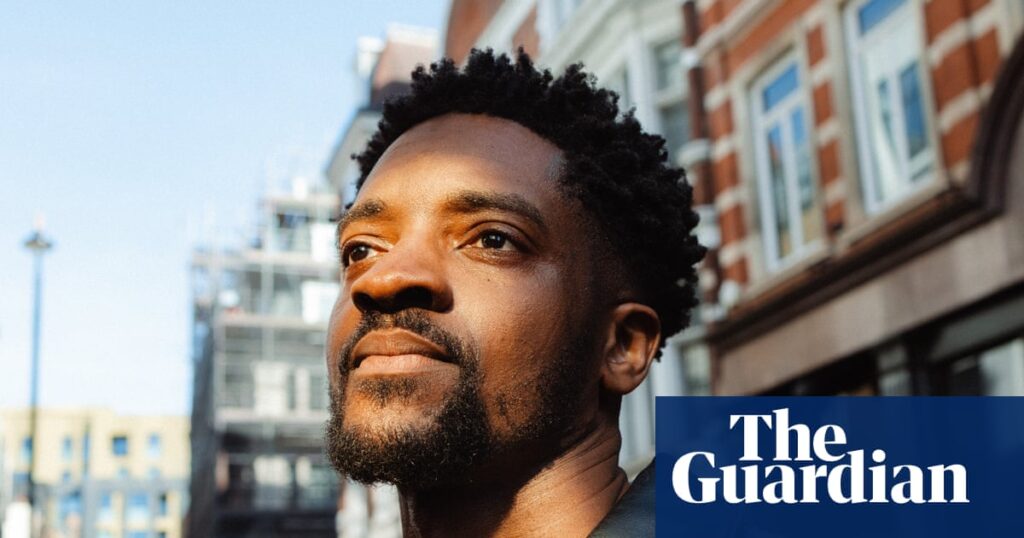
The past five years have been punishing for Isaac Borquaye, AKA the British rapper Guvna B. In 2021, he was left without sight in one eye for several months after being targeted in an unprovoked racist attack at his local coffee shop in east London. It left him shaken, but also motivated him to write his searing 2023 album The Village Is on Fire, which questioned structural racism. The album’s cover featured a closeup image of his bloodied eye.
In the opening track, the 36-year-old musician intersperses his own words – “Coffee in his hand and he dashed it in my face / Five seconds later, right hook to my socket” – with voice notes his cousin, the actor and writer Michaela Coel, left him in the days after the attack. The record immediately became one of his most streamed, with listeners drawn not only to his frank recounting of the attack but also to his thoughts on youth violence and gentrification, and his grief at the death of his father in 2017. His new, equally confessional album – more on which shortly – tackles even more thorny themes.
Starting his career making gospel-influenced rap during the early 00s explosion of grime music, Borquaye has long been an introspective outlier in a genre better known for its bravado and excess. While Wiley’s 2008 party-focused Wearing My Rolex saw grime enter the mainstream and reach No 2 in the UK Charts, Borquaye released Pray As You Go the same year, exhorting listeners to “give praise to the Lord every day”, since “the future ain’t Orange / the future is heaven”. He won best gospel act at the Mobo awards in 2010 and in 2016, and was nominated again in 2020. Clean-cut and careful not to spend too much time cussing on record, Borquaye developed a grounded and uncontroversial public persona as a man of faith, happily raising his two young children.
‘Music is usually my method of getting my thoughts out …’ Photograph: Jamie Salmons/The Guardian
His trouble-free brand made the anger and desire for revenge expressed on The Village Is on Fire all the more shocking. “I was five minutes from my house getting a coffee and when I came back to my car, these two white guys were standing by the driver’s side, blocking my way in. When I asked them to move, they threw the coffee in my face and punched me. They were clearly looking for a fight,” he says, sitting in a dark central London basement studio. Although he reported it, the Metropolitan police closed its investigation after six months owing to a lack of leads.
Thankfully, Borquaye’s physical injuries healed, but the attack triggered a wider moment of self-reflection. “It’s returned me to this kind of streetwise nature that I developed growing up on a council estate in east London,” he says. “From as young as I can remember, I’ve always had my head on a swivel and even though I thought I’d done well and moved to a nicer area, I’m still on the lookout. It’s exhausting.”
Writing about it was, he says, “the only way I thought I could get a sense of closure because the perpetrators weren’t going to be found. Albums are like chapters in the book of my life and I can’t move on until I document and communicate.”
Guvna B collecting his award for best gospel act at the 2010 Mobo awards in Liverpool.
Photograph: PA Images/Alamy
In the years that followed, his personal life became increasingly fraught. In 2023 he separated from the mother of his two children and confronted an addiction to pornography, which he describes as “a battle I’ve had for most of my life”. That same year he entered rehab. “It’s been frantic and I’ve had whiplash from it all,” he says. “But I have to address it and music is usually my method of getting my thoughts out to find some catharsis.”
Borquaye’s new, tenth studio album, This Bed I Made, explores the shame and secrecy of this journey to recovery. Full of jazz-influenced instrumentation, the record’s 11 tracks cover everything from the psychological imprisonment of addiction on To Be Free, to the possibility of relapsing on What Now, and the humiliation of admitting your secrets on Shameless, all punctuated by clips of lectures from the physician, author and addiction specialist Gabor Maté.
“Every time I think the next album is gonna be a happy one, something happens in my life that makes it take a different course,” Borquaye says. “With The Village Is on Fire, it was vulnerable but racism and the attack is something that happened to me. It wasn’t my fault.” But his latest album is different. It is, he says, “all stuff that I’ve done to myself. I was hiding things and wearing a mask and it’s harder to talk about because I’ve actually contributed a lot to what’s happened.”
Borquaye cuts a relaxed figure, stretched out in a leather jacket and crisp white T-shirt, but when it comes to speaking about his addiction and relatively nascent recovery, it’s clearly an uncomfortable topic. “I don’t want to be a poster boy for recovery but it felt strange not to address it in the music when I’ve put so much of my life into it over the years,” he says. He wants to be as open as possible: “That’s the only way to break the stigma and let others who might be struggling know there is no shame in getting help.”
That stigma, he says, “comes when people pretend that something isn’t a problem and they don’t want to talk about it”. So, in part for the sake of the many other men struggling with pornography addiction – according to more than half of therapists recently surveyed by the British Association for Counselling and Psychotherapy, it has been on the rise among British men over the past year – he’s talking about it.
‘We keep secrets because we’re scared what people will think.’ Photograph: Jamie Salmons/The Guardian
While he doesn’t feel comfortable delving into the why or how of his compulsion, shame, he says, was a key factor that led to him hiding his behaviour for so long. “Culturally, I grew up in a family that didn’t talk and faith was also a big part of my life. In those environments, everyone seems perfect … if you have got anything shameful that you’re battling, it’s hard to be honest about it,” he says. Also, he says, “I was in denial and probably felt like it’s not that deep – it isn’t the same as a drug or alcohol addiction.” This isn’t just Borquaye’s opinion: according to the World Health Organization, it is registered as an impulse control disorder rather than an addiction, while the American Psychiatric Association has no formal diagnosis.
Still, Borquaye explains, it leads to the same kind of dependency. “You might be enjoying something but you can’t stop and it starts to be detrimental in other areas of your life,” he says. “I ended up getting divorced and I wasn’t as much of a present father as I’d like to be. All the relationships in my life were suffering and I thought, I could either stick at rock bottom or be forced to rebuild.”
It was only after those closest to him uncovered the secret of his addiction that he was prompted to seek help. “People were shocked at how I could function at a relatively high level while I was hiding all this stuff,” he says. There was catharsis in finally being honest. “We keep secrets because we’re scared what people will think,” he says, but when he puts into words, “any shame that I’m feeling, it’s quite a freeing thing”.
During his time in rehab, Borquaye describes doing the “unglamorous work” of refiguring his life and finding the daily, repeatable habits that could help him quell his urges. He began limiting his time on social media, as well as delving into the works of Maté, who writes about addiction being a response to pain rather than a moral failure. He also started therapy, which looked at the childhood reasons for his addictive behaviours.
At the Youth Music Awards 2025 at the Troxy in London, pictured with presenter Nakeira Westmaas. Photograph: Nic Serpell-Rand/Shutterstock
“My dad didn’t have the tools to process emotions and so they didn’t get handed down to me either. I had all these big feelings but I didn’t know how to deal with them,” he says. “Addiction numbs a lot of the things that you’re meant to feel, especially difficult feelings. When you’re sober, the good thing is you get your feelings back – but the bad thing is, you get your feelings back.”
Borquaye was raised by Ghanaian parents who worked long hours in multiple jobs to make ends meet. Often left to his own devices, he describes himself as an introspective child who was drawn to writing and storytelling, a skill that soon blossomed into rap verses he performed at his local church-run youth group. It wasn’t until a friend was murdered on his estate when he was 15 that he began to take rapping more seriously.
“When I was growing up, a lot of the rappers that I watched on TV were all about the money, the girls, sex and jewellery, but when my friend lost his life I remember vividly thinking it’s weird to promote that kind of lifestyle or negative actions in my music when I’ve seen first-hand the consequences that youth violence has on a community,” he says. “I just naturally gravitated towards rappers that were a bit different, like Kano, who spoke about relationships rather than sex. It felt quite wholesome.”
Guvna B performs at the Metropolitan Black Police Association’s celebration of life concert in London in 2010. Photograph: Roberta Parkin/Redferns
In the years since his 2008 debut album, The Narrow Road, other UK rappers have gradually followed suit to promote self-consciousness and vulnerability over machismo. Artists such as Loyle Carner and Dave, for instance, have released acclaimed records exploring everything from fractured relationships with their fathers to mental health and racism. A movement may be forming, but Borquaye still sees plenty of work that needs to be done, especially with the impressionable young men he works with in secondary schools and prisons. “I hold creative writing workshops to try to help young men delve deeper into their feelings. It can be a humbling experience,” he says. “They might be feeling angry, and rather than channel that into ‘I’m gonna stab you or shoot you’, I want to get them to open up.” Success is more likely to come from “trying to have genuine empathy and care for their situation”, rather than “labelling them with terms like the manosphere”. That, he says, “will go the furthest way in helping men get rid of that bravado and start developing the emotional toolkit that everyone needs, regardless of upbringing, wealth or creed”.
At home, where Borquaye now shares custody of his six-year-old son and three-year-old daughter, he is trying to implement the same lessons. “There’s something beautiful in being open to figuring things out together,” he says. Yet he is in an in-between space when it comes to his addiction, wanting to safeguard his children until they are old enough to understand, while also releasing an album that is going to make it known to the wider public. While it might be too soon just yet, one day, he says, he wants his son to listen to his latest record and think “it’s sick that his dad was so honest”.
Guvna B’s new single Rest My Head is out now; the album This Bed I Made is released on 24 April. The project is supported by the Samaritans, the Forward Trust and Dr Gabor Maté