
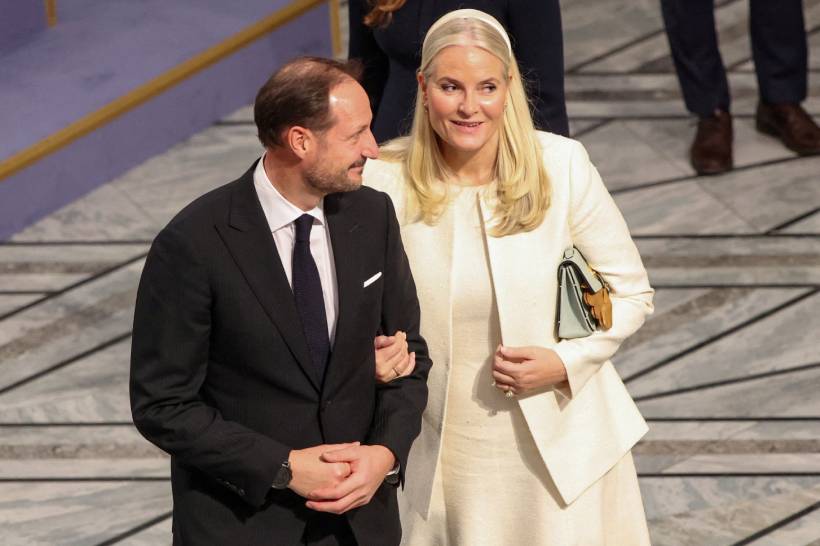
Mette-Marit has publicly expressed regret over her past association with Jeffrey Epstein, as newly released U.S. documents expose the extent of their contact.
The revelations are part of a massive disclosure by the U.S. Justice Department, detailing Epstein’s connections with high profile figures worldwide, including members of Norway’s elite political and diplomatic circles.
In a tearful interview with NRK, the crown princess said she had been “manipulated and deceived,” adding that she deeply regretted ever meeting Epstein.
What the Files Reveal
The documents show that Mette-Marit remained in contact with Epstein from 2011 to 2014, years after his 2008 conviction for soliciting an underage girl.
They also confirm that she stayed at his Palm Beach residence for several days in 2013, suggesting a more sustained relationship than previously understood.
An email from 2011 further complicates the picture. In it, Mette-Marit acknowledged that Epstein’s record “didn’t look too good,” raising questions about her awareness at the time. She later said she could not recall why she wrote the message and insisted she had never witnessed any illegal activity.
Importantly, she has not been accused of any criminal wrongdoing.
Political and Public Reaction
The disclosures have triggered an unusually sharp response within Norway. The government has called for a fuller account, while public scrutiny of the royal family has intensified.
Earlier media reports had already linked the crown princess to Epstein, but the scale of communication revealed in the new files has deepened the controversy.
The issue has also exposed inconsistencies with her 2019 statement, in which she said she had not fully understood the seriousness of Epstein’s crimes at the time.
Personal Strain Inside the Royal Family
The crisis comes at a difficult moment personally and publicly for the royal household.
Haakon, her husband and heir to the throne, has stood firmly by her side, emphasizing support during what he described as a challenging period.
At the same time, Mette-Marit has been absent from public duties for weeks, dealing with both health and family pressures. She suffers from a chronic lung condition that will eventually require a transplant.
The situation is further complicated by the legal case involving her son, Marius Borg Hoiby, who faces serious criminal charges and has pleaded not guilty to rape and domestic abuse.
Impact on the Monarchy
The scandal has begun to affect public confidence in Norway’s monarchy.
Recent polling shows support for the institution dropping significantly, with a noticeable rise in those favoring a republican system instead.
While the royal family continues its official engagements, including international appearances, the controversy surrounding Mette-Marit has become one of the most serious reputational challenges it has faced in recent years.
Analysis
This episode highlights how legacy institutions like monarchies are increasingly vulnerable to global scandals, especially those linked to figures like Epstein whose networks cut across borders and elite circles.
For Mette-Marit, the central issue is credibility. Her defense rests on being misled, yet the documented timeline of contact after Epstein’s conviction raises difficult questions about judgment and due diligence.
For the Norwegian monarchy, the stakes are broader. Public trust is its core currency, and even without legal wrongdoing, perceived lapses in judgment can erode that foundation quickly.
The timing makes the impact sharper. With ongoing personal and family challenges already in the spotlight, this controversy amplifies scrutiny and risks reshaping public attitudes toward the institution itself.
Ultimately, the situation is less about legal culpability and more about accountability, perception, and whether the monarchy can maintain legitimacy in an era of heightened transparency.
With information from Reuters.