
How should documentary filmmakers respond when significant facts change after their film premieres?
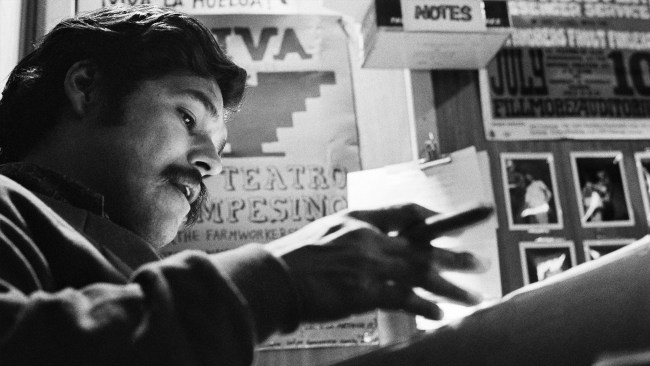
That’s the challenge David Alvarado now must navigate. He won the Festival Favorite award at Sundance for “American Pachuco: The Legend of Luis Valdez,” a portrait of the eponymous playwright who played a key role in the Chicano movement. The film emphasizes how Valdez used his artistic abilities to help his childhood friend Cesar Chavez, forming the El Teatro Campesino acting troupe to deliver Chavez’s pro-labor message to farm workers around California. That helped lay the foundation for the union that’s now known as United Farm Workers.


Reviews of the film were largely positive, with critics and audiences appreciating the link between art and political organizing. But everything changed when the New York Times published an investigation on March 18 in which multiple women accused Chavez of sexually abusing them when they were as young as 12. It was part of a larger pattern of alleged abuse toward women who volunteered for his movement. Notably, one accuser was Dolores Huerta, the most prominent female activist to align with Chavez.
These allegations will inevitably shape how audiences view Alvarado’s film.
The director addressed the controversy during a private Q&A at the Houston Latino Film Festival on March 18 (the same day the NYT investigation was published), where he screened the film alongside star Cheech Marin, producer Everett Katigbak, and Valdez’s brother Daniel. Alvarado shared a video of the post-screening panel with IndieWire.
In an email correspondence, Alvarado also shared his own summary of the event and the nuanced topic of separating the actions of one individual from a larger movement.
“Whenever… Cesar Chavez came up on the screen, obviously that was going to grab my attention and everybody else’s because that’s the hot topic,” said one audience member in the video. “But I like how y’all made the film and it’s not about Cesar Chavez, it’s about Luis Valdez. So he is mentioned, but it’s at the end of the day Luis Valdez, and that’s what I got from it.”
Said another, “I feel like it’s very important that we continue to stress the great things that UFW and the Chicano movement represented, regardless of who the face was,” another viewer said. “That it was a collaborative effort.”
But while audience members understood that Chavez’s alleged actions didn’t negate the value of the film or the Chicano or organized labor movements, they made it clear that the movement cannot tolerate abusers.
“It’s not a protection if we allow violence and abuse in the movement to persist and exist,” said another audience member. “We got to address it as it’s happening.”
Alvarado admitted that he isn’t sure what is the best path forward for the film, and turned to the audience for feedback. When he asked the room whether he should keep showing the movie, he received an enthusiastic round of applause that could only be interpreted as an unambiguous “yes.”
He then asked the audience to brainstorm ways that he could address the allegations, with suggestions ranging from adding a title card noting that the film was made before the report came out to including more footage of Huerta or even adding video from this very Q&A to the film.
All options are being considered, but the team plans to proceed with a release that addresses the seriousness of the allegations without losing the narrative.
Alvarado wrote that he left the screening impressed by the audience’s ability to discuss the issue without jumping to black-and-white conclusions.
“Houston was the first audience to see the film after this news broke,” he wrote. “They did not need to be managed or reassured. They watched the film, they raised the hardest questions themselves, and they arrived at their own conclusion: The film is about Luis Valdez, the Chavez material is contextualized appropriately, and the conversation the film generates is exactly the right one for this moment.”