
The Zubillaga family had come from Veracruz, Mexico. Julio and Miryam had brought their daughters, Renata, 15, and Fernanda, 11, as a gift, across 15 hours of flights to a city none of them had visited before.
They had tried for world tour tickets to see BTS in Mexico but they had been snapped up already, so they came to Seoul instead, joining the tens of thousands outside the gates, waiting for the music to reach them. “It’s beautiful,” Renata says of the new album, Arirang. Her favourite member, like her mother and father, is Jung Kook.
The Zubillaga family, (L-R) Julio (44), Renata (15), Miryam (43) and Fernanda (11), flew to South Korea from Mexico as a birthday gift for Renata.
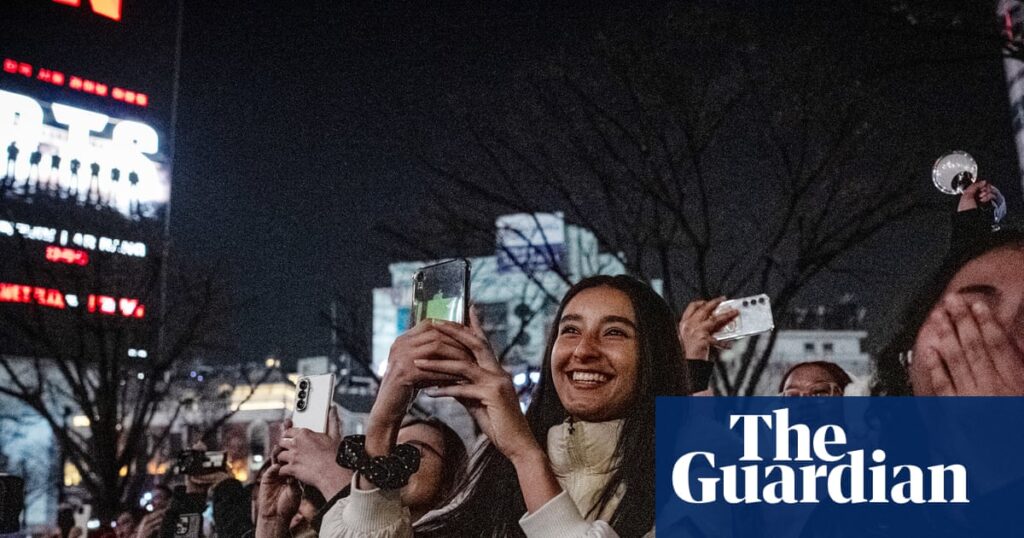
The crowds had been flowing in to South Korea’s capital since morning, with fans coming from all over the world; Malaysia to China, France to Bolivia. Nani Cruz, 30, had come from Guam. “Seeing them come back is a huge thing,” she says. “The longing that ARMY is feeling, that’s what we’re able to experience again tonight.”
Maggie Kang, the Korean-Canadian film-maker who six days earlier had collected the Oscar for best animated feature for KPop Demon Hunters, was among those in attendance. “Just this crowd, and this open public space – it’s so awesome that Korea is able to do this,” she says.
Yu Hye-sun (44), a Seoul office worker, has come with friends whom she met at BTS’s last concert before their military service (above). A person carries BTS merchandise and inspired goods and a K-pop light stick ahead of the concert (below).
BTS are seven South Korean men who became, by almost any measure, the biggest band in the world. Over little more than a decade, they sold hundreds of millions of records, became the first Korean act to top the Billboard Hot 100 and address the United Nations, and built a global fanbase known as ARMY. They did it largely in Korean, at a time when the industry insisted the language was a commercial barrier.
Then, in late 2022, they stopped. South Korean law requires all able-bodied men to serve in the military, and BTS were no exception. One by one, the seven members enlisted.
For nearly four years, the group that had performed to sold-out stadiums worldwide went silent as a unit. The return, when it came, raised questions about the logistics of such a reassembly, and whether a changed world had kept a place for them.
The answer resoundingly came in Gwanghwamun square, a location that sits at the symbolic heart of Seoul, framed by the Bugaksan mountains and flanked by Gyeongbokgung palace, built in 1395 as the seat of the Joseon dynasty kings. It is, above all, a space that belongs to the people. It is where Koreans have gathered by candlelight, and more recently by the glow of K-pop light sticks, to demand accountability from their leaders. Two presidents have been brought down in part by protests that filled this square in recent years.
When BTS walked on to the stage, the square erupted. Thousands of ARMY light sticks glowed in unison against the dark sky, the palace walls of Gyeongbokgung lit up behind them as a canvas for visual projections. About 22,000 had secured free seats in the designated viewing zone as many thousands more watched on screens nearby. Still more fans watched via Netflix, which streamed the show to more than 190 countries.
“Annyeonghaseyo! We’re back,” RM, the band’s leader, told the crowd, using the Korean word for “hello”, as they opened with Body to Body.
The one-hour set drew heavily from Arirang, the group’s new album released the day before, which had already sold nearly 4m copies. Its sound felt more textured and expansive than the group’s earlier pop records. When Swim, the title track, rang out, the crowd met it as though they already knew every word.
 BTS Comeback Show, Seoul, Korea. Saturday 21 March, 2026. Tina Hsu/The Guardian
Later, when Dynamite, the 2020 English-language single that brought them to a wider global audience, flooded the square, it felt less like nostalgia than a reminder of the distance they had travelled to stand in this particular place.
Lea Baron, a German 30-year-old living in Seoul, had been an ARMY member for 13 years. She had met fellow fan Nani Cruz from Guam that morning, strangers until ARMY. “I’m just really happy they’re back together and still making music,” Baron says.
(L) Lea Baron (left), 30, from Germany and Nani Cruz (right), 30, do not have tickets but have arrived early to sit outside to watch the show. (R) Lea shows a necklace with the words “Golden”, Jung Kook’s debut studio album. Photographs: Tina Hsu
Atsumi Shioya, 18, had flown in from Shizuoka, Japan, with her mother, Ayako, a ballet pianist, two weeks after finishing high school. The free tickets – one per booking and snapped up within minutes of release – were nearly impossible to secure. Ayako had managed to get one. Atsumi had none but came regardless. “Their voices, their dances. I think I will cry if I see all seven of them performing,” her mother says in the buildup to the concert.
Atsumi Shioya (18) (R), and her mother, Ayako Shioya, (L), from Shizuoka, Japan, flew to South Korea specifically for the BTS concert.
Adelina Gainanova, 24, from Russia, found BTS before she found the country, and has now lived in South Korea for several years. Seeing them in the flesh was “just amazing”, she says. She was also impressed by the sheer organisation of the event.
(L) Adelina Gainanova, 24, from Russia, has been living in South Korea for four years with K-pop being a primary reason to move there. (R) An So-young, 41, from Cheongju, South Korea, (right) travelled over 110km to reach the concert venue. Photographs: Tina Hsu
By the time the show ended, An So-young, 41, an English teacher who had travelled from Cheongju, about 110km south of Seoul, was still piecing together what she had heard.
What stayed with her was a moment during Body to Body, when the traditional arirang melody surfaced briefly, unmistakably. “The album is called Arirang,” she says. “So I’d been wondering how they’d include it.”
The Arirang title references Korea’s best-known folk song, often described as an unofficial national anthem, whose themes of longing, separation and return have resonated across Korean life for centuries.
“The way the Arirang melody was woven into Body to Body, it was so unexpected.” She paused. “It made me well up.”